

Some Of Our Favorite Supplies For An Art Area In Your Home
“As well as being part of our history and a way of understanding other people’s experiences, art is also a form of personal expression, like poetry, song, dance, and telling stories. It is a form of human connection that can evoke feelings, thoughts, and hopefully appreciation and understanding. Montessori encourages families to expose children to as many forms of art as possible. Encouraging your child’s interest in art and giving them room to be creative provides them with experiences that will endure.” — Excerpt from Montessori for Every Family by Lorna McGrath & Tim Seldin
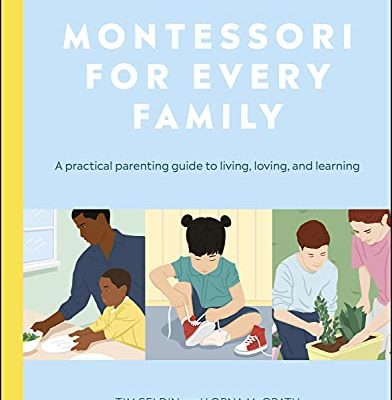
The new book, Montessori For Every Family: A practical parenting guide to living, loving, and learning, by Lorna McGrath and Tim Seldin, shares some ways to encourage an enjoyment of art and to set up a space to create. We have searched out materials to help you set up an inviting art space in your home.
A child-sized wooden table can be your art area for years. Look for a sturdy table and chairs that fit under the table. If you do not have space for a separate art table, consider a coffee table with storage nearby.
Pictures by different artists can be chosen by you or your child if you visit an art museum, or ordered from art.com. Also consider a piece of wood with clips attached and a variety of postcards for a changing display.
You may want a paper roll so you can create different sized pieces of paper.
The MÅLA


Paper roll holder with storage is a good choice. It is available from several vendors, including Amazon. Here is a link to one from IKEA: tinyurl.com/ mrxfc27e
MÅLA Apron


Keeping clothes neat during art exploration is difficult for some of us, so a smock can be a beneficial part of any art set up. tinyurl.com/2zzsetah
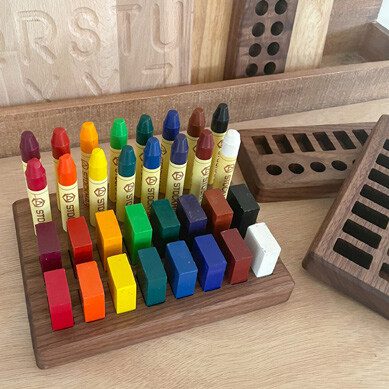
Stockmar Beeswax Crayons


Beeswax crayons allow for layering of colors and draw smoothly. They also last longer than traditional crayons. tinyurl.com/289usjem
Eco Finger Paint


Changing out art materials for different ages can help keep their interest up. Young children enjoy the opportunity to finger paint; this finger paint is made with food-grade materials, so you do not need to worry too much when painty fingers go into mouths. ecokidsusa.com/ eco-finger-paint/
Watercolor Pencils


Older children may like the many different ways to draw with watercolor pencils. tinyurl.com/2p9a6d5n
Add a pad of watercolor paper. ecokidsusa.com/eco-art-pad-1

Watercolors


This all-natural, set of opaque watercolors has magnetic pots of color, so just a few can be used at a time. tinyurl.com/3ruhf9yu
Honeysticks


For younger children, who may even like to taste their paints, Honeysticks is a set made from food-grade ingredients. tinyurl.com/bdfjy9w9
Beeswax or Soft Dough


Younger children may find beeswax or soft dough easiest to use. Stockmar modeling beeswax warms up in your hands and smells delicious. tinyurl.com/mws8axc3


Soft play dough can be reused again and again. tinyurl.com/2p9zy89v
Include a container or two, to collect items for collage and sculpture making. Egg cartons, confetti, rubber bands, pom poms, whatever could be reused and is appropriate for their use, can go in the containers for building and creating. Be creative, and follow your child’s interests. Have fun with these ideas and supplies, and add your own art area in your home.

MOVIE REVIEW: The Biggest Little Farm
A documentary produced this year is our top pick for all elementary-on-up children, educators, and parents to watch. It’s called The Biggest Little Farm.
In 2009, a California cinematographer and a food blogger met and married. The Biggest Little Farm follows the couple as they attempt to build a sustainable farm an hour north of Los Angeles, CA. With the help of a dedicated environmentalist, they work through the trials and tribulations of achieving perfect (almost, anyway) harmony with nature.
This is the movie to introduce or reinforce many of the Cosmic Education lessons. It will help everyone understand the fragile balance of nature and how easy it is to be destroyed. The visuals are stunning, and the relationship with the animals on the farm are endearing. This movie brought joy, tears, and hope to me, and I highly recommend sharing it with all families to open up discussion on what each of us needs to be aware of to help do whatever we can to respect nature and protect our earth. •
DEAR CATHIE: A CONCERNED PARENT
DEAR CATHIE—
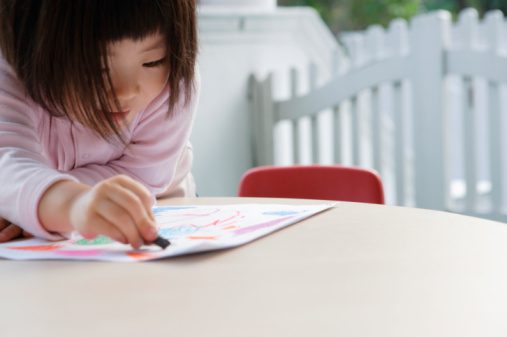
I have visited a number of Montessori schools as we consider a placement for our 3 and 4 year old children next year. I see the children all busy on different projects, and it all looks great. But can it really work? How can one teacher, even with an assistant, really keep track of who did what and be sure that each child is progressing and getting what she or he needs? All those children—all those needs. I can see it more for younger children, but I really get concerned in the Elementary grades. Does this method really work?
— A CONCERNED PARENT
Dear Concerned Parent,
I am so glad you are looking at Montessori schools for your children and that you have started the search so early. Many schools have rolling admissions and are open to admission at times other than the start of the school year or semester.
The Montessori Method works, as it is truly an individualized approach to education. Each child spends his or her school days in a carefully prepared environment with a group of multi-aged learners and a guide. A child chooses activities that call to her from within that environment while her guide watches her interests and offers lessons. From there, she develops a set of skills upon which to build. She practices the lessons she has learned and asks for new lessons as soon as those are comfortably mastered.
Children in the Montessori prepared environment also have the opportunity to watch others work and are often enticed by the work of those older children, aspiring to do what they do. This leads to more and more advanced work within the classroom as a whole and by your child individually. No child needs to wait for another child to have mastered a skill to move on! She has a new lesson as soon as she is able. Children also assist others younger than themselves, often teaching lessons they have already mastered. The child teaching lessons is one of the best ways to ensure mastery and confidence about something they have learned. It also leads to a kind and caring community.
Children have a say in what parts of the curriculum with which they engage and when they do so—always with awareness and support from the guide and other adults in the room.
Guides spend time observing the class to see which children are working at the mastery level on certain skills and are ready for a new lesson, which children need re-presentation, and which children need social
encouragement. They carefully chart these observations on paper or on the many computer programs that are now available and used in schools. While the classroom may look free flowing and easy going, it is actually a skill and data-driven environment, even though students do follow their own interests and work on projects and activities of their choosing. Their connection with their guide—often for three
years—enhances this relationship and connection and allows for learning to happen more easily from year to year. They offer carefully timed lessons to children as they are ready. These lessons are often one on one, but can be executed with the whole class or small groups. It is often hard to find the guide in the classroom as she is working with only a few children at a time.
In answer to your question, yes, the Method can and does work!
Children have a say in what parts of the curriculum with which they engage and when they do so— always with awareness and support from the guide and other adults in the room. Children learn initiative, self-control, and discipline while mastering basic skills. This method truly parallels the expectations and skills needed as a child grows and faces more adult challenges.
Enjoy your journey looking at schools! Montessori schools truly are unparalleled! •
Cathie Perolmanis a reading specialist, elementary educator, author, consultant, and creator of educational materials for primary and elementary students. Check out her new downloadable materials on her website cathieperolman.com.
For more than three decades she has dedicated her energies to improving reading for all youngsters.
She is the author of Practical Special Needs for the Montessori Method: A Handbook for 3-6Teachers and Homeschoolers published by the Montessori Foundation (available throughmontessori.org.) She is a regular contributor to Tomorrow’s Child and Montessori Leadership magazines.
Cathie Perolman holds a BS in Early Childhood Education and a MEd in Elementary Education with a concentration in reading. She is credentialed as a Montessori teacher. She is married and has two adult children and two adorable granddaughters. Cathie lives in Ellicott City, Maryland with her husband.
TOMORROW’S CHILD © • NOVEMBER 2019 • WWW.MONTESSORI.ORG

Sample Discipline Policy – Damariscotta Montessori School (based on positive discipline)
Damariscotta Montessori School uses positive discipline, which is implemented in a developmentally and age-appropriate fashion to meet the needs of the individual child. Our focus is on how to help children resolve problems and empower them to have a successful experience in the classroom and school community. The goal of our discipline policy is to provide an environment that promotes respect and safety for each person as well as the space we share.
The need for discipline within a Montessori classroom is greatly reduced by the prepared environment. The teachers make a point of keeping engaging activities available for the children so there is never a lack of something interesting for each student to do. The teacher may also redesign the work areas, jobs available, number of children allowed in a work area, etc., in response to classroom behavior.
For younger children, the primary method in a Montessori classroom is redirection – moving the child from a disruptive activity and engaging him or her in something more productive. Emphasis is put on directing a child to what they may do (making appropriate choices) rather than telling them what they may not do. For elementary-aged children, the primary method used in a Montessori classroom is involving the child in making respectful and constructive choices. This may be done using mini-conferences, reflective listening and questioning, giving limited choices, making agreements, class meetings, helping to resolve conflict, etc.
The classrooms also utilize a peace area. This is a comfortable area in which the child may relax and calm down, or to try to resolve conflict with another child. The child may choose to go to the peace area her- or himself or may be requested to visit the area by a teacher, or, in the case of conflict resolution, by another child. On occasion, in the event of unsafe physical or verbal behavior, or a persistent problem, a child may be removed from the classroom for a period of time to collect him or herself and to give the staff an opportunity to help resolve the situation.
Parents will be notified of significant or persistent disciplinary problems at school in a timely manner. If it is necessary to involve parents in the resolution of a problem at school, it will be done with a spirit of cooperation and with the aim of helping the child. Parental support during that time is very much appreciated. Through conferences, goals will be mutually agreed upon. If the goals are not able to be met within an allotted time, further professional help or other school placement will be considered for the child. Parents or faculty may call upon the Head of School to act as a facilitator at any time. Should it become apparent that a family cannot be supportive of the school’s missions or goals, it may be necessary for the Head of School to consider whether it is in the best interest of the school to keep the child enrolled at DMS.
In order to provide an environment that is physically and emotionally safe for all children, suspension or expulsion procedures may be executed in the event of serious and/or persistent behavior problems. Such behavior includes but is not limited to: defacing or damaging property (school or other), profanity (verbal or written), triggering a fire alarm, violence, threats of violence, blatant disrespect, disorderly conduct, and endangering the safety of self or others. This kind of disciplinary action will be determined by the Head of School upon consultation with the faculty. The Board of Directors will be notified in the event that such disciplinary action is taken.
—
44 Deer Meadow Lane
Jefferson, ME 04348
207-380-3465
Helping Children to Be Successful: Developing Grit
by Rachel Buechler
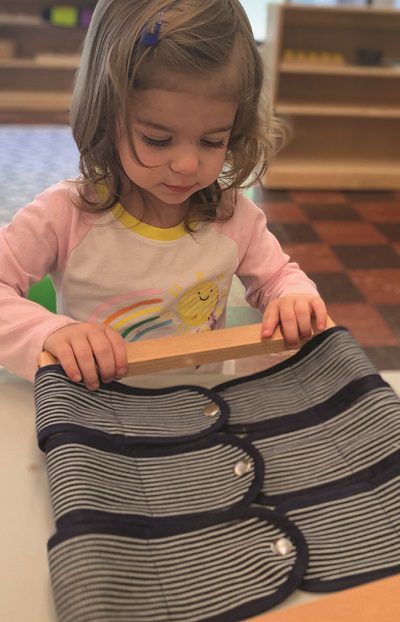
 A little girl sits at the table with the Snap Dressing Frame. She has picked it up several times before today and quickly returned it to its stand after a short attempt. Today she picks it up and places it on the table. She tries the first snap; it doesn’t connect. She looks at the snap from the left side, then the right side. She tries again; it doesn’t connect. She looks at her teacher for help. The teacher demonstrates how to connect the snap then returns it to its unconnected state. The child moves onto the snap above and, as she pushes down, she hears it connect. She pauses, smiles. Then goes back to try the first one; it still doesn’t connect. She squeals in frustration. She takes a moment to look again and again; then she keeps trying. This continues for twenty minutes until she looks at the dressing frame and the three connected snaps. She sighs and smiles then exclaims, “I did it!” Her teacher says, “You did it!” The little girl continues to look at the completed work before quickly taking it apart again to repeat the lesson.
There is so much for us to learn from this toddler’s determination to work on mastering this lesson. She is showing us how we can develop a skill that will place us ahead of others in the working world: grit. Grit is what keeps us working with our children, even when it is hard, even when we think we aren’t getting the results we want, or the progress is slower than we hoped. No matter what, we keep thinking of new ideas to try and keep believing we will see results. We are displaying grit. How can you help your students, or your own children, develop grit?
1. EXPRESS FRUSTRATION
Let the child experience frustration. This is hard to do when we can see the solution to their problem is so easy for us to fix. As they try to fit puzzle pieces into a board, we can see they just need to turn it a little further, and we can feel so helpful if we just showed them how it fit by reaching over to place the piece. If we continue to solve the child’s frustrations, we are robbing them of the opportunity to feel greater success in working through the issue. We are also telling them that anytime they are frustrated, they should rely on an adult to solve the issue. We need our future leaders to learn how to problem solve and persist to solution by accepting frustration, then working through it.
2. THE RIGHT AMOUNT OF HELP
During the Dressing Frame story, the teacher did show that the snap can be connected and, thus, modeled the action for the child. The teacher also returned the snap to its original state so the child would continue to work from where she left off. Deciding exactly what help children need is critical to allowing them to persist with the challenge, but not discourage them by completing it on their behalf. It also helps children to learn when to ask for help.
If we continue to solve the child’s frustrations, we are robbing them of the opportunity to feel greater success in working through the issue.
3. ENCOURAGE REPETITION
Even if children don’t succeed with lessons, tomorrow might just be the day they will figure it out. Maria Montessori believed repetition was the key to mastering a skill. If an infant went to walk for the first time but fell after one step, and we said: “Looks like that’s not the activity for you,” they would likely feel discouraged from attempting it again. Our response is more likely to be supportive, helping them up and encouraging them to try again and again until they are walking with stability. This is how we should help our children attempt many lessons in different areas of the classroom or skills at home. There are times when a child masters a difficult skill and then finds joy from repeating the lesson over again, as it gets easier and easier each time. As new skills are developing, mistakes will be made. When mistakes are made, we must be matter of fact about them. As the book, The Montessori Toddler, says, “Mistakes are simply opportunities to learn… if they break or spill things, we can have things at the ready for them to help tidy it up…. We can model being friendly about mistakes by not taking ourselves too seriously when we make mistakes” (Davis, 2018, p.93).

4. CELEBRATE VICTORY
The child had picked up the Snap Dressing Frame several times on various days before and realized, through self-awareness, that this was not a task that would give her immediate success. There were other skills that needed to be built first. This shows great knowledge in knowing her own abilities and where she is ready to seek the next challenge. By allowing children to guide their own learning journeys through choice and freedom, they develop more than the academic skills. They build skills in planning, organization, order, and determination (or grit). The growth of these skills allows children to feel internal celebration when they complete activities on which they have been working. This grows confidence as children learn how to fail and keep persisting until they succeed. As the book, The Confidence Code, says, “failing fast allows for constant adjustment, testing, and then quick movement toward what will actually work” (Kay & Shipman, 2014, p. 140).
ADULT INTERVENTIONS THAT DISCOURAGE THE DEVELOPMENT OF GRIT:
• Jumping in to help before you have assessed exactly how much help the child truly needs. Give only this amount of help. The joy within the child comes from persisting through a difficult task to reaching completion.
• Saying “good job” or “I like it when you_____”. These statements make the success about you and not about the internal development of the child.
• Moving the child away from a task because you think it looks too difficult prevents developing grit. Let them try; model it. Help them to determine what is too difficult. Don’t become frustrated or upset about mistakes made.
REFERENCES:
Davies, S. (2018) The Montessori Toddler. Amsterdam: Jacaranda Tree Publishing Kay, K. & Shipman, C. (2014). The Confidence Code. New York: HarperCollins
Rachel Buechler earned her BA in Education in 2009 before relocating to Charlotte, NC from England, UK. She joined Charlotte Montessori School in 2010and was the Lead Toddler Teacher for three years. During that time she earned her Infant/Toddler Montessori Certification. Ms. Buechler enjoys the individualization of the Montessori classroom foreach child and watching them follow their own unique interests as they learn and grow in the classroom.
TOMORROW’S CHILD © • NOVEMBER 2019 • WWW.MONTESSORI.ORG
Preparing an Early Childhood Learning Environment
Editor’s Note: We know that the authors of this article really meant it to help teachers remember how important setting up children’s environments is to maximize the potential of each child at each stage during the early childhood years. However, because of how broadly they talk about the classroom environment, the principles can also be applied to the home environment. If you are a parent, there may be two “take-aways’’ for you. One might be that you have a better understanding of the many facets to be considered by Montessori teachers as they prepare their classrooms for your child. The second might be ideas for setting up a rich and supportive environment for your child at home. I found it helpful to change the word “materials” in this article to toys or activities as I read through it.
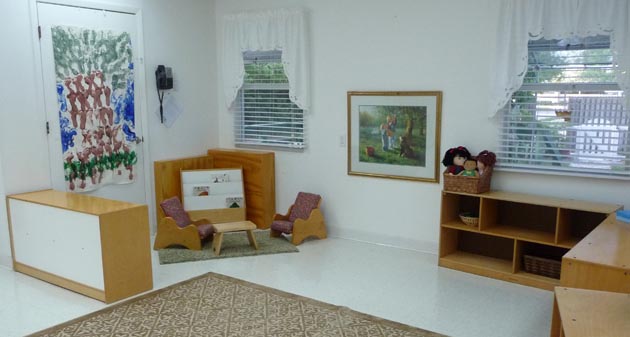 Early Childhood, the period between birth and age six, is the most critical period in postnatal human development and learning. During this time, basic movements are mastered, speech is developed, senses are consolidated, and bodies acclimate to sensory input. With this tremendous development taking place, the environment where children spend their days must reflect the constantly changing needs of childhood.
During their first months, children are in a state of unconscious absorption in which they learn from their environment spontaneously and effortlessly. This period of intense mental activity gradually leads to a state of conscious absorption, allowing for more purposefully chosen activities. At the same time, there is a tremendous quest toward both independence and a need for order. The optimal early childhood environment will have opportunities for children to gain the self-help skills they need in order to build confidence and realize self-liberation; providing order in the physical arrangement of the furnishings, the materials, and the activities offered.
The role of the caregiver, or educator, is to prepare the environment to meet the needs of the unique group of children in their care. There are several factors that need to be considered in order to provide a space that will enrich their experience in a developmentally appropriate manner:
MEETING THE NEED FOR MOVEMENT
As we learned from Dr. Maria Montessori (1870 – 1952), movement is intrinsically satisfying. It also affects psychic and spiritual energies; eventually, it helps children acquire abstract thinking by first enabling them to experience abstract concepts through concrete forms. Young children need to move! Knowing the ages, developmental levels, and needs of the children in your care will enable you to arrange the environment to provide the appropriate amount of physical activity.
Infants and Toddlers: If you are serving infants, who need to creep or crawl, provide open, obstacle-free spaces with warm flooring surfaces of varying textures that they can safely navigate and explore. Toddlers need space for independent exploration, as well as secure objects for grasping and pulling themselves into sitting and standing positions. Later. they will need apparatus for stretching and developing their arm and leg muscles, such as climbing triangles, dome climbers, and short sets of stairs. At this age children begin to learn when and where it is appropriate to run and climb and when it is safer to walk or keep feet on the ground. With guidance, toddlers will start to make the appropriate choices.
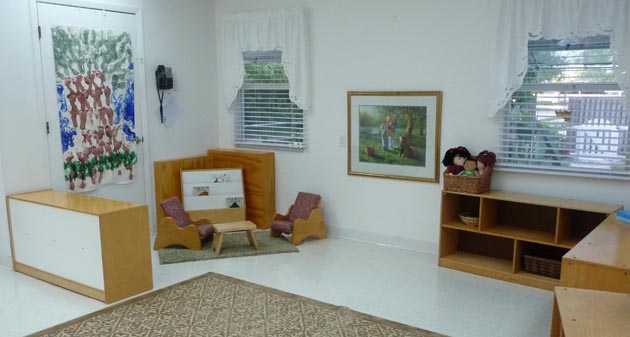
Preschoolers (ages 3—6): Preschoolers need spaces to: move back and forth between shelves, tables, and large open floor areas for unencumbered work; individual spaces, such as cozy reading corners, where they can settle, concentrate, and focus; and spaces to congregate in small and large groups. Long narrow openings tend to encourage running, which can be a safety hazard. Try to break up these long expanses with furniture or plants. A combination of child-sized tables and chairs (preferably adjustable to each child’s height); shelves and cubbies that they can comfortably reach; and open floor space will accommodate multiple types of activities.
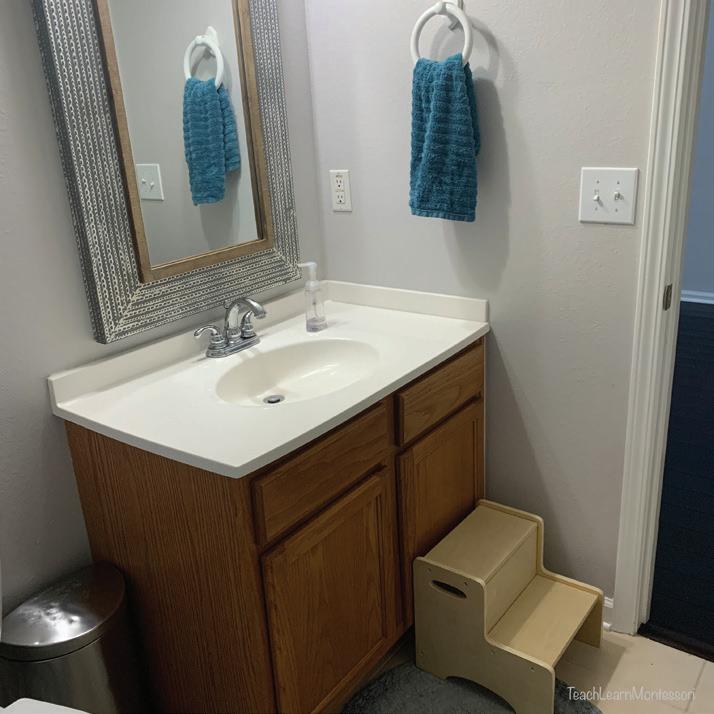
MEETING SENSORY NEEDS IN THE ENVIRONMENT
Visual Component: Because young children are constantly adjusting to the barrage of sensory impressions they receive, what children see plays an important role in environment preparation. We live in a world focused on extensive visual stimulation. Although there is a trend to provide eye-popping bright colors or bold primary colors in early childhood environments, a palette of neutral colors and/ or colors from nature can be more conducive to learning and to promoting a sense of calm. A subtler background allows the materials to stand out and attract the child’s interest. In addition, urged on by décor manufacturers, early childhood educators (and parents) often plaster their environments with posters and other materials. However, uncluttered walls can be comforting, soothing, and far less distracting. Be selective and discriminating in choosing what is displayed and hang thoughtfully chosen artwork at the child’s eye level.
Considering your lighting is also important. Lots of natural light is optimal in any setting. If artificial lighting is also necessary, using incandescent bulbs will lend a warmer glow to your environment than the cool blue of fluorescents. You might also want to explore energy-efficient LEDs. In any case, remember safety considerations with young children, ensuring stability, taking care with cords, hot bulbs, and shades.
Auditory Component: Have you considered the sounds the children can hear in your learning environment? Just as your classroom can be visually cluttered, noises such as side conversations, small-group lessons, musical instruments, the rustle of leaves, or even the whisper of wind can make the classroom feel cluttered auditorily. Determine which of these noises are appealing and conducive to learning and which are distracting. Try to adjust the ones you’d like to control or mitigate by using sound-absorbing materials such as rugs and carpeting. Add soft pillows and child-sized upholstered chairs to the reading nook. Hang fabric curtains at the windows or draped across ceilings. If your budget allows, you may also want to consider unobtrusive acoustic panels for walls and ceilings.
Tactile Component: Are the surfaces of your furniture smooth and free of dangerous or pointy edges? Do you provide a variety of materials that appeal to the sense of touch, such as soft woolens, smooth silks, warm wooden objects, and cool metals, which encourage the child to explore and discover the unique characteristics of each? For babies and toddlers still crawling and creeping, have you considered the different sensations they feel on their hands and knees as they make their way around on varying surfaces?
Olfactory Component: What smells greet the children? Whenever possible, avoid the use of harsh-smelling chemical cleaners. Allow fresh air to permeate the environment. Objects with appealing scents, such as a cinnamon bark box or a clove box, can be enjoyed by the children. Fragrant herb plants that are safely edible, such as sage, rosemary, and lavender, also make lovely additions. Allow children to use a mortar and pestle to crush them to release their enticing scents into the air.
Choosing Materials: Besides the physical attributes of your home, there are various considerations to take into account regarding learning and play materials:
- Quality: Are the materials constructed to last through use by many children?
- Are they safe and free of sharp edges and small parts not suitable for children under three? Are they attractive and inviting?
- Relevance: Do the materials embody and respect the personal identifiers that make up the diversity of your family and the wider community in which you live, such as race, ethnicity, and languages? Do they take into consideration the children’s interests, and inspire new ones?
- Developmental levels: Do the materials and activities provide appropriate learning experiences for all the ages and ability levels in the class?
- Language development: Does the variety of materials offered expose the children to the vast array of living and non-living things offered by our world and the rich vocabulary associated with them to expand their burgeoning language development? Are there opportunities for them to express themselves?
In Conclusion: Considering these various factors when creating living and learning environments for young children will help you provide spaces that benefit them by enriching their experience in a developmentally appropriate manner that contributes to their physical, cognitive, and social-emotional growth and learning.
REFERENCES:
Bagnoli, D. (2021) “Montessori by Design: School Spaces That Stay True to the Montessori Method.” Montessori Life. 33 (1). 26 – 35.Montessori, M. (1964). The Montessori Method. New York, NY: Schocken Books.
Photos in this article courtesy of Alicia Diaz-David.
Reprinted with permission from Community Playthings www.communityplaythings.com
Marie M. Conti, M.Ed. is head of The Wetherill School in Gladwyne, PA, and a former member of the American Montessori Society board of directors. She has more than 40 years of experience as a Montessori classroom teacher and administrator. Contact her at marie@wetherillschool.org.
Marcy K. Krever is a freelance writer and the former Senior Director of Communication & Community at the American Montessori Society. Contact her at marcykremer@gmail.com.

Neurodevelopmental Tools for the Classroom
To continue reading, you will need to choose a subscription plan.

Weather Kids
To continue reading, you will need to choose a subscription plan.
Science for Everyday — Student Assessment Question List
To continue reading, you will need to choose a subscription plan.
Montessori Infant Toddler Programs
This PDF file is an excerpt from our book, the Montessori Way, by Paul Epstein and Tim Seldin, Copyright 2003
There is an ironic prejudice about education found in almost every country: the older the students are that one teaches, the higher the pay and respect for the teacher. We take it for granted that a professor in a graduate school is a more prestigious position than that of a high school teacher, which is, in turn, considered a more sophisticated position than teaching elementary and, of course, both are far more respectable than that of a nursery-school teacher. And no one in his or her right mind would want to teach infants and toddlers, right? Yet research clearly shows that the most important period in a human being’s educational and emotional development are not the years of high school and college but rather the first six years of life. Human beings are a magical combination of at least three factors: our genetic inheritance, our biological development, and our experiences.
To read more: Download File
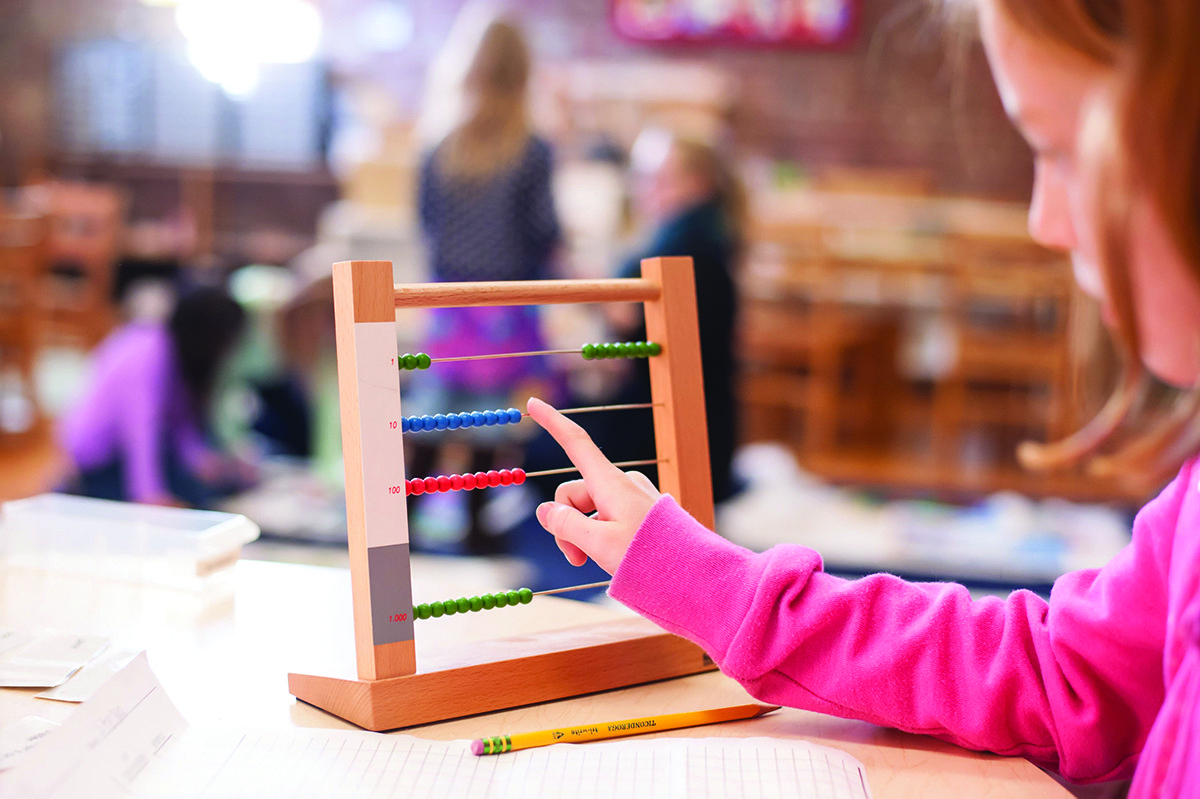
The Montessori Philosophy
Over the last century, Dr. Maria Montessori’s ideas have had a growing influence on education around the world. However, while individual elements of her program find their way into more classrooms every year, there is a cumulative impact when schools fully implement the entire Montessori model. When done well, something that is quite distinct for children is possible. Montessori schools are designed to help each student discover and fully develop her unique talents and possibilities. They treat each child as a unique individual, allowing her to learn optimally at her own pace and in the way that best suits her learning style. They strive to be flexible and creative in addressing each student’s needs.
Learning the right answers may get a child through school, but learning how to become a life-long, independent learner will take her any- where. Montessori teaches children to think, not simply to memorize, feedback, and forget.
Rather than presenting students with the right answers, Montessori educators lead students to ask their own questions and to discover how to find the answers for themselves. Older students are encouraged to do their own research, analyze what they have found, and come to their own conclusions. Teachers encourage children to think for themselves and become actively engaged in the learning process.
Intrinsic Motivation
One of Montessori’s key discoveries is the idea that children are intrinsically motivated. They are driven by their desire to become independent and competent beings in the world. They naturally learn and master new ideas and skills. For this reason, outside rewards are unnecessary. Outside rewards create a dependency on external motivation. Far too many children become dependent on others to define their self-image or obtain permission to follow their dreams. In the process of making independent choices and exploring concepts largely on their own, Montessori children construct knowledge, their own sense of individual identity, and their own understandings of moral right and wrong.
Montessori saw children as far more than students. In her view, each child is a full and complete human being, the mother or father of the adult man or woman he or she will become. Even when very young, they share humanity’s hopes, dreams, fears, emotions, and longings. From her perspective, this goes beyond mental health to the very core of one’s inner spiritual life. Montessori programs offer consciously designed experiences that cultivate the child’s sense of independence, self-respect, love of peace, passion for self-chosen work done well, and the ability to respect and celebrate the individual spirit within people of all ages and the value of all life.
Independence and Movement: Acquiring Self-Discipline
Montessori teachers share a conviction that success in school is directly tied to the degree to which children believe they are capable, independent human beings. Young children are shown how to pour liquids, write letters, and compute sums. Older children are shown research techniques, Internet search routines, and forms of expository writing. When children develop a meaningful degree of independence, they set a pattern for a lifetime of good work habits, self-discipline, and a sense of responsibility.
Children readily take pride in doing things for themselves carefully and well. All children learn through movement. They must actively explore and examine the world around them. Montessori environments encourage children to move about freely, within reasonable limits of appropriate behavior.
Much of the time they select work that captures their interest and attention, although teachers also help them choose activities that will present new challenges and new areas of inquiry. Montessori teachers also direct students to master the basic skills of their culture.
Children learn by doing, and this requires movement and spontaneous investigation. Children touch and explore everything in their environment. The mind is handmade, because, through movement and touch, the child investigates, manipulates, and builds up a storehouse of impressions about the physical world around her. Children develop thinking through hands-on learning.
Montessori children enjoy considerable freedom of movement and choice. Montessori children freely move about, work alone, or with others at will. However, their freedom always exists within carefully defined limits on the range of their behavior. Free to do anything appropriate within the ground rules of the community, children are consistently redirected promptly and firmly if they cross over the line. Children may select an activity and work with it as long as they wish, so long as they do not disturb anyone or damage anything. When finished, they are expected to put materials back where they belong. Becoming self-disciplined is a major goal of Montessori programs. Students are taught to manage their own community, and they develop strong leadership skills and independence.
Respectful Communities of Mixed-Age Groups
Montessori schools are warm and supportive communities of students, teachers, and parents. As children grow older and more capable, they assume a greater role in helping to care for the environment and meet the needs of younger children in the class. The focus is less on the teachers and more on the entire community of children and adults, much as one finds in a real family. A child experiences courtesy and trust, two important aspects of optimal learning conditions.
The number of students in a Montessori class is determined by: the physical size of the classroom; regulations governing children-to-adult ratios; and the beliefs of the school community. Originally, Montessori enrolled more than forty-five children in a classroom. Her purpose for this was to ensure that her teachers would help children become capable, independent learners, children who would also turn to one another for lessons and guidance.
Classrooms today are typically much smaller (usually there will be twenty-five to thirty-five children), bringing children together in multi-age groups, rather than classes comprised of just one grade level. Schools that place children together into small groups assume that the teacher is the source of instruction, a very limited resource. They reason that as the number of children decreases, the time that teachers have to spend with each child increases. Ideally, we would have a one-on-one tutorial situation.
But the best teacher of a three-year-old is often another child who is just a little bit older and has mastered a skill. This process is good for both the tutor and the younger child. In this situation, the teacher is not the primary focus. Instead, a larger group size puts the focus less on the adult and encourages children to learn from each other. By having enough children in each age group, all students will find others at their developmental level. By consciously bringing children together in a group that is large enough to allow for two-thirds of the children to return every year, the school environment promotes continuity and the development of a very different level of relationship among children and their peers, as well as among children and their teachers. Classes tend to be stable communities, with only the oldest third moving on to the next level each year.
A strong community develops as teachers and children create close and long-term relationships. Teachers know each child’s temperament, personality, and learning style. Ideally, there would be an equal number of girls and boys evenly divided among the three age levels.
With the strong emphasis on international education, many Montessori schools attract a diverse student body representing many ethnic, religious, and international backgrounds. The curriculum is international in its heritage and focus and consciously seeks to promote a global perspective, promoting mutual respect. The intent is for children to regard diversity as a call for celebration and not a cause for fear. Older students learn to care about others through community service.
The Montessori Peace Education curriculum supports this purpose. Montessori’s spiritual perspective leads Montessori schools to make a conscious effort to organize programs of community service, ranging from daily contributions to others within the class or school setting to community-outreach programs that allow children and adults to make a difference in the lives of others. The fundamental idea is one of stewardship. Students also develop a love for the natural world. Natural science and outdoor education are important elements of our children’s experience.
The Prepared Environment: Curriculum and Materials
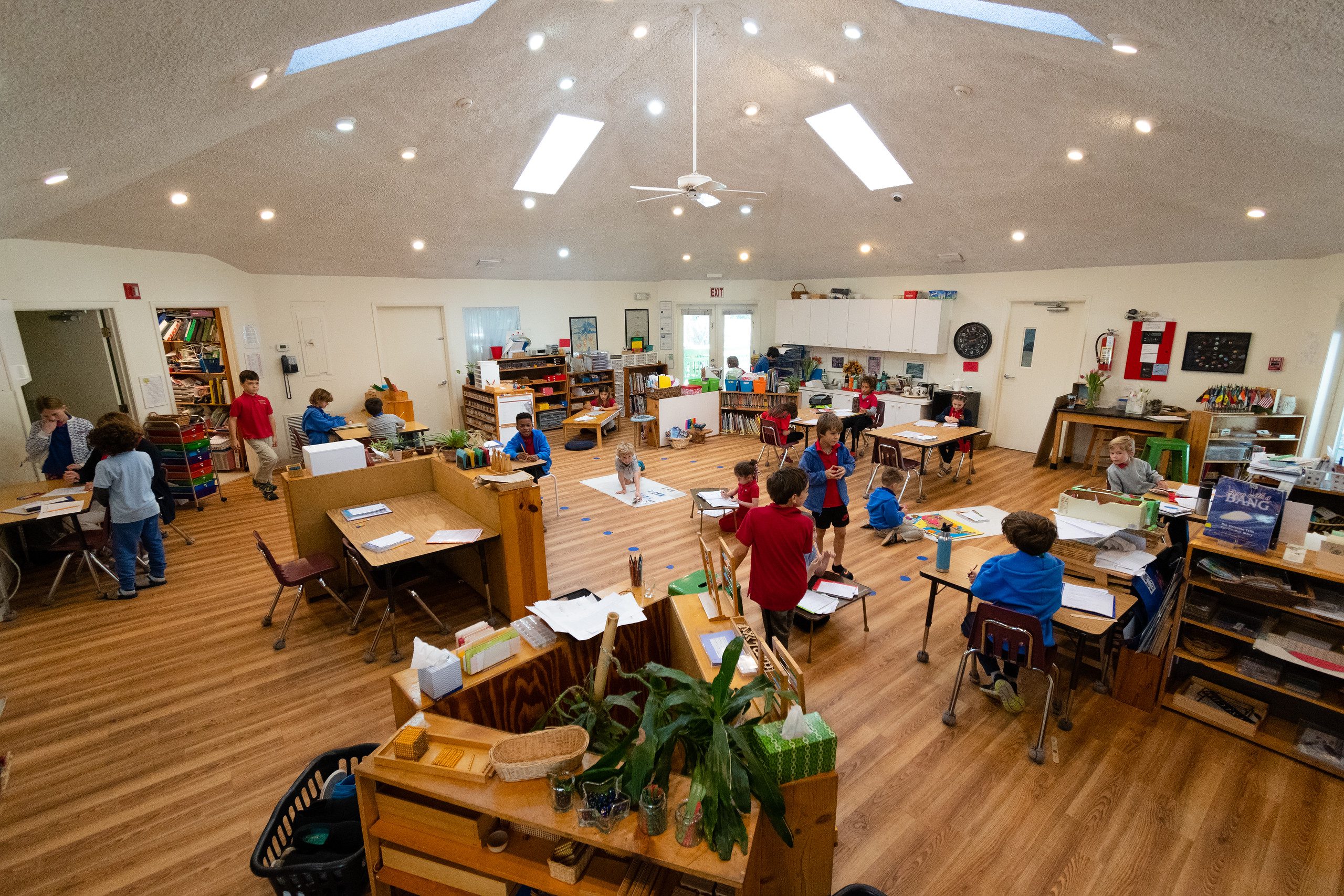
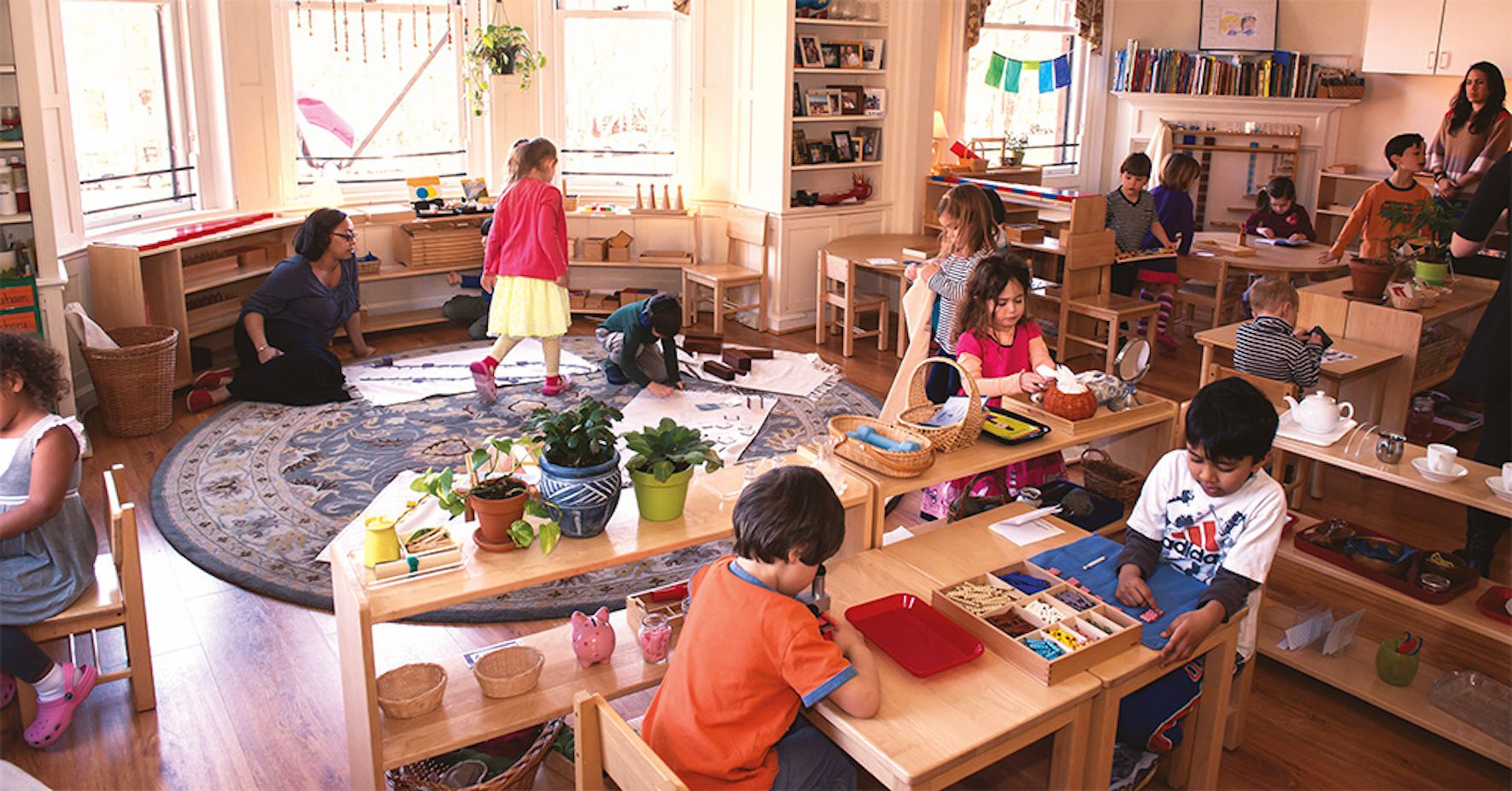
Montessori classrooms tend to fascinate both children and their parents. They are normally bright, warm, and inviting, with an abundance of plants, animals, art, music, and books. Shelves are filled with intriguing learning materials, fascinating mathematical models, maps, charts, fossils, historical artifacts, computers, scientific apparatus, a natural-science collection, and animals that the children are raising. Montessori classrooms are commonly referred to as prepared environments. Each is a learning laboratory in which the children are allowed to explore, discover, and select their own work. The independence that the child gains is not only empowering on a social and emotional basis, but it is also intrinsically involved with helping the child become comfortable and confident in her ability to master the environment, ask questions, puzzle out answers, and learn continuously instead of waiting for adult direction.
The Montessori goal is less to teach the child facts and concepts, but rather to help her fall in love with the process of focusing her complete attention on some challenge and solving its riddle with enthusiasm and joy. Work assigned by the adult rarely results in such enthusiasm and interest as does work that children freely choose for themselves.
The classroom is organized into several curriculum areas, usually including language arts (reading, literature, grammar, creative writing, spelling, and handwriting); mathematics and geometry; everyday living skills; sensory- awareness exercises and puzzles; geography; history; science; art; music; and movement. Most rooms will include a classroom library. Each area is made up of one or more shelf units, cabinets, and work tables with a wide variety of materials on open display, ready for use as the children select them.
Students are typically found scattered around the classroom, working alone or with one or two others. They tend to become so involved in their work that visitors are immediately struck by the peaceful atmosphere. It may take a moment to spot the teachers within the environment. They will be found working with one or two children at a time, advising, presenting a new lesson, or quietly observing the class at work. The focus of activity in the Montessori classroom is on children – who each one is, his or her interests, and styles of learning. The teacher is a guide, providing direct learning experiences whenever possible.
A Montessori classroom is filled with vast arrays of sequenced learning activities known as the Montessori materials. The materials are displayed on open shelves sized for the height of the children. They are arranged to provide maximum eye appeal without clutter. Each object has a specific place on the shelves, arranged from the upper left-hand corner in sequence to the lower right.
The materials are arranged in sequence from the most simple to the most complex, and from the most concrete to those that are more abstract. Because of the order with which they are arranged in the environment, children can find precisely what they need whenever they wish.
When children choose a material, they develop an array of personal traits such as independence, responsibility, and time management. While investigating and using the materials to sort, arrange, build connections, and problem-solve, they develop cognitive capabilities. Educational theorists now advocate learning through direct experience and the process of investigation and discovery. The child must be active and engaged, constructing her or his own knowledge. Most students do not retain or truly grasp much of what they “learn” through memorization. Instead, children need to manipulate and explore everything that catches their interest. Part of Montessori’s contribution was her discovery of what is now assumed. But, she went further. Montessori developed a series of sequenced learning materials designed with incredible precision.
Each material is a concrete representation of an abstract idea. Depending upon the ages of the children, they will use the materials to explore and investigate ideas found in anthropology, art, astronomy, biology, botany, chemistry, earth science, geography, geology, geometry, history, language, m a t h e m a t i c s , music, physics, and sociology. Some materials isolate and teach one concept or skill at a time. Length, for example, is explored by three-year-olds arranging a set of ten rods. The first is 10 centimeters long; the second is twice this length. This progression continues until the tenth rod is in place with its length of 1 meter.
Children from ages two to six are interested in sequencing and sorting objects. They are drawn to the sensory properties of objects within the classroom: size, shape, color, texture, weight, smell, sound, etc. Children of this age tend to repeat exercises. With repetition, their movements slow and become more precise. Their attention to detail increases; they discover small details in the objects and classroom as they observe and appreciate their environment.
This is a key in helping children discover how to learn. Elementary and secondary students are interested in sequencing and sorting ideas. They are drawn to the interpretive meanings of literary works, social and historic events, scientific findings, and issues of moral justice.
Elementary and secondary classrooms are designed to facilitate student discussion and stimulate collaborative learning. In group discussions, students readily propose and debate solutions to open-ended problems. A goal is to pursue topics in depth rather than to “cover the material.”
At the secondary level, an integrated thematic approach is used to connect the otherwise separate disciplines of the curriculum into studies of the physical universe, the world of nature, and the human experience. Literature, the arts, history, social issues, political science, economics, science, and the study of technology all complement one another.
The organization of the Montessori curriculum from early childhood through secondary programs could be thought of as a spiral of integrated studies rather than a traditional model in which the curriculum is compartmentalized into separate subjects, with given topics considered only once at a specific grade level. The Montessori curriculum is carefully structured and integrated to demonstrate the connections among the different subject areas. History lessons, for example, link architecture, the arts, science, and technology.
An especially important aspect of the materials is that they offer multiple levels of challenge and can be used repeatedly at different developmental levels. For example, the Trinomial Cube, which presents a complex and challenging twenty-seven-piece, a three-dimensional puzzle to the five-year-old, is used to introduce the older elementary and secondary child to the algebraic concept of the exponential powers of polynomials.
The teacher presents the materials with precision and offers each child an initial exploratory procedure; the child is able to imitate what the teacher did. The teacher’s presentation also enables children to investigate and work independently. A goal is for the children to become self-disciplined, able to use the materials and manage the classroom without direct adult supervision.
Children progress at their own pace, moving on to the next step in each area of learning as they are ready. Initial lessons are brief introductions, after which the children repeat the exercise over many days, weeks, or months until they attain mastery. Interest leads them to explore variations and extensions inherent within the design of the materials at many levels over the years.
The Montessori learning materials are not the Method itself; they are simply tools used to guide children into logical thought and discovery. The Montessori materials are provocative and simple; each is carefully designed to appeal to children at a given level of development.
In developing these materials, Dr. Montessori carefully analyzed the skills and concepts involved in each subject and noted the sequence in which children most easily master them. She then studied how children seemed to be able to grasp abstract concepts most easily and designed each element to bring the abstract into a clear and concrete form.
The Control of Error
The design of many of the materials gives children immediate feedback. Called the Control of Error, this feature makes it possible for Montessori students to determine for themselves if they have done each exercise correctly.
Children choose their learning activities within carefully defined limits as to the range of their behavior. Making mistakes is a vital part of the learning process. Discovery, investigation, and problem solving involve making wrong turns, getting stuck, and trying again. An important part of the learning experience is to recognize an error and learn how to make corrections.
These experiences are part of the process of becoming self-disciplined. A young child takes ten cylinders out of a wooden case; the cylinders vary in height and diameter. The control of error lies in the construction of the objects: a cylinder can only fit into one place in the wooden case. Another child learns the names of African nations. In this case, the control of error is initially found with the teacher, who uses the “Three-Period Lesson” to teach and re-teach the correct names of nations. Once the child knows these names, the control of error becomes his own knowledge.
Each repetition is not an exact copy of the previous use. Children continuously refine their work and learn more. The principle of control of error guides this process. In addition to the design of the materials, prior knowledge is also a control of error.
Knowledge of colors, shapes, and size for younger children — knowledge of addition and multiplication for older children — results with self-corrected learning. The Three-Period Lesson Montessori teachers will use the Three-Period Lesson to help children develop a rich vocabulary in all areas of study. Children best learn the meaning for names when they can associate the name with an object. In the following example, a young child is taught the names of secondary colors. During the first period, the child is shown an orange-colored tablet. The teacher names the color: “This is orange.” The child is now shown a green-colored tablet. The teacher names this color: “This is green.” Finally, a purple-colored tablet is shown, and the teacher states, “This is purple.” During the second period, the child makes a link between the language and her own experience. The teacher gives the name, and the child finds the object. The teacher asks, “Show me orange.” The child points to the orange tablet. “Show me purple.” The child now points to the purple tablet.
Considerable learning and teaching occur during the second period. If the child is asked, “Show me green,” but she points to the purple tablet, the teacher simply re-teaches. Returning to the first period, the teacher points to the purple tablet and restates, “This is purple.” The teacher again points to the green tablet and restates, “This is green.” In the final period, the teacher points to one of the tablets and asks, “What is this?” The child answers, “Orange.” If the child answers one of the other colors, the teacher will again re-teach the colors by renaming and reconfirming them using the first- and second-period lesson formats. Maria Montessori understood that learning occurs best when stress and apprehension are removed from the learning situation.
The Three-Period Lesson format is based on readiness. Complex vocabulary words are introduced when it is appropriate. Montessori educators believe that it is important for children to learn vocabulary, which is why so much emphasis is placed on nomenclature (enhanced vocabulary). The three- and four-year-olds do not merely identify triangles; our teachers name triangles precisely: isosceles triangle or scalene right triangle. A rich vocabulary is also taught to lower elementary students; such as terms from botany as well as the various land and water forms that make up our planet’s surface. The more words children know, the more they actually see around them.
What You Will See In A Great Montessori School
To continue reading, you will need to choose a subscription plan.
List of Recommended Montessori Materials: Age 3 to 6
To continue reading, you will need to choose a subscription plan.

Five day a week attendance
To continue reading, you will need to choose a subscription plan.
Towards best Practice: Lunch
To continue reading, you will need to choose a subscription plan.
Towards best Practice: The Educational Program Lunchtime
To continue reading, you will need to choose a subscription plan.
Montessori Curriculum Theory Workshop
To continue reading, you will need to choose a subscription plan.
Featured
-
 The Montessori Way, Revised and Expanded: An Education for Life; A Comprehensive Guide for Parents and Teachers
$25.00
The Montessori Way, Revised and Expanded: An Education for Life; A Comprehensive Guide for Parents and Teachers
$25.00
-
The Montessori Child: A Parent's Guide to Raising Capable Children with Creative Minds and Compassionate Hearts (The Parents' Guide to Montessori)
$20.00
-
The Montessori Toddler: A Parent's Guide to Raising a Curious and Responsible Human Being (The Parents' Guide to Montessori)
$20.00
-
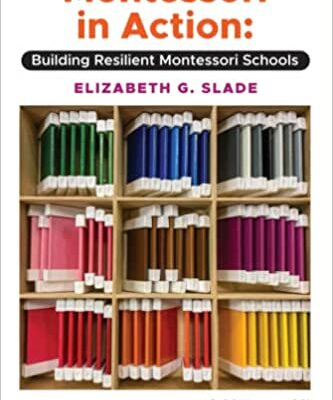
Montessori in Action: Building Resilient Montessori Schools 1st Edition
$29.95
-
Bulk Order, 30 Copies of Montessori for Every Family: A Practical Parenting Guide To Living, Loving, And Learning
Original price was: $600.00.$510.00Current price is: $510.00.

Products
-
The Montessori Way, Revised and Expanded: An Education for Life; A Comprehensive Guide for Parents and Teachers
$25.00
-
The Montessori Child: A Parent's Guide to Raising Capable Children with Creative Minds and Compassionate Hearts (The Parents' Guide to Montessori)
$20.00
-
The Montessori Toddler: A Parent's Guide to Raising a Curious and Responsible Human Being (The Parents' Guide to Montessori)
$20.00
-
Montessori in Action: Building Resilient Montessori Schools 1st Edition
$29.95
-
Bulk Order, 30 Copies of Montessori for Every Family: A Practical Parenting Guide To Living, Loving, And Learning
Original price was: $600.00.$510.00Current price is: $510.00.