by Kathryn Bowen | Uncategorized
Sitting in the sun-drenched dining room of her famed Berkeley restaurant, Chez Panisse, Alice Waters explained the philosophical principle guiding much of her life since 1944, the year she was born:
“Our senses are our pathways into our minds.”
Waters lingered over the point, which, like her food, is deceptively simple.
“So,” Waters continued, resolute, “we need to be educating those senses that have been dulled by fast-food culture, indoctrination. We need to touch, we need to taste, we need to listen.”
And that education, an edible education, is what the chef, author, and activist has attempted to provide not just to guests at Chez Panisse, but to a much wider, perhaps even pickier, swath of the dining public—children—since 1995, when she launched the Edible Schoolyard (ESY) Project, a garden, kitchen, and cafeteria curriculum at Martin Luther King Jr. Middle School in Berkeley. Two-and-a-half decades on, the organization has partnered with more than 5,600 schools around the world.
Now, as ESY launches into its 25th year, Waters and the organization’s staff talked lessons learned, challenges and their most ambitious pledge yet—to help Americans eat their way out of climate change.
How It All Began
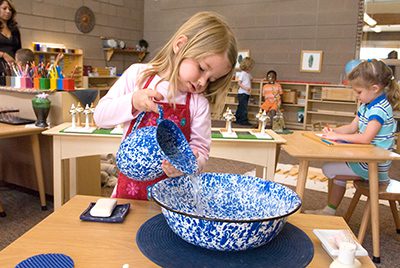
It’s hard to say exactly where and when Waters began contemplating edible education. One thread traces to 1967, the year that Waters graduated from UC Berkeley. Soon after, she learned about the Montessori pedagogy from a family friend, according to her memoir, Coming to My Senses. Waters was immediately captivated by the aesthetically conscious, experiential approach to learning.
“I could never learn in the abstract, and Montessori was all about learning through your senses, learning by doing,” she wrote.
Waters’ fascination led her to an internship at a Montessori school in Berkeley, followed by a training program in London, and ultimately back to Berkeley for a teaching position.
But, as history would have it, Waters proved to be a far more effective chef than school teacher, and she was eventually let go from her Montessori position. Still, the experience gave her a guiding framework that she applied when Chez Panisse opened in 1971.
“I’ve used my Montessori principles in running this restaurant,” Waters said. “There’s flowers. There’s lights. There’s soft music. We want people to smell what’s happening in the kitchen, so it’s engaging people in almost an unconscious way.”
As Chez Panisse got its sea legs, life for Waters proceeded, and, in 1983, she had a child. Waters pondered: Where would she go to school? What were the schools like in Berkeley? These questions sparked an extension of the revolution that Waters began in the kitchen.
“I was going by King school, and I noticed how run down it looked. I thought it was abandoned. Truly I did. And I thought: How in this city, in Berkeley, could this be happening when we have a great University of California?’”
Waters voiced her view publicly to a reporter at the time. Not long after the story broke, her phone rang. It was Neil Smith, then the principal at King Middle School. “We immediately had a meeting of the minds,” Waters recalled. “He said, ‘I want to do something here. Can you help me?’”
By then, King Middle School had, according to Waters, outgrown its facilities on Rose Street, which are located just a half-mile from Chez Panisse. The buildings, Waters said, were built to accommodate roughly 500 children; in 1995, though, the school had a student population of 1,000 (a number it retains to this day). Still, King had an asset—room to grow. “It was built on 21 acres of land, which is kind of amazing,” Waters said.
So, while on a visit to the school, Waters had an epiphany.
“I looked around with Neil Smith, and I just had this complete vision, I guess, a kind of Montessori vision. I thought, let’s make a garden classroom.”
A Place of Learning by Doing
“Honestly, it could have used more olive oil.”
“Maybe a little more crisp.”
“It was okay, but not: ‘Oh My God.’”
“You didn’t put salt in it!”
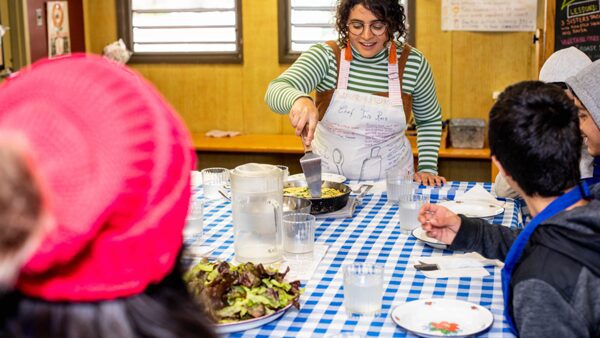
Are these the takes of discerning guests at Chez Panisse? Or critiques from its studied cooks, huddled over some new dish? No, these are the honed opinions of seventh graders at King Middle School, dissecting a kale-pesto bruschetta that they’d spent roughly 90 minutes preparing during a class in the ESY kitchen.
“I looked around with Neil Smith, and I just had this complete vision, I guess, a kind of Montessori vision. I thought, let’s make a garden classroom.”The students’ assembly of that bruschetta demonstrates a similar culinary confidence, one that belies their age: a diminutive girl with spiraled hair eagerly grates Parmesan; three boys in athleisure huddle around an oven toasting bread. One student pounds garlic in a mortar and pestle, while another liberally adds olive oil that cascades into the receptacle.
“You’re seeing this program two-decades plus in, it wasn’t always like this,” said senior chef teacher and kitchen operations manager Esther Cook with a laugh. “Early on, it was crazy! It was so fun because it was new. We probably made every mistake in the book and still managed to feel successful, because we knew that what we were doing was landing the students in a really positive way.”
Cook is at once affable and earnest, with a name that well suits her profession. Before she began at ESY, Cook worked for years as a chef in the Bay Area, which is how she heard about Market Cooking for Kids, a program hosted by CUESA, in which local chefs led youth-targeted tastings and cooking projects.
“I was doing that twice a month for four years, and I started realizing how much I was looking forward to those days. And what exciting work it felt like,” Cook said.
So when a position with ESY opened up in 1997, Cook jumped at the opportunity. She got the job, and that year, Waters and Smith launched a kitchen classroom at King to complement the garden curriculum.
Now, ESY at King is a veritable operation. “We have 10 classes a week, roughly 30 students per class… it’s well over 250 people a week in each [kitchen and garden] class,” said Geoff Palla, the operations manager and senior garden teacher at King. Which means that, all told, King’s ESY teachers see about 500 students a week, or roughly half the school’s population of sixth, seventh, and eighth graders.
Like Cook, Palla radiates an educator’s energy, and comes to ESY with ample applied experience. Before joining the organization in 2008, Palla ran his own farm for about five years, and worked on several others. “I came into this job identifying as a grower, coming from a deep agricultural background, and I would say I blossomed into a teacher,” Palla reflected, a transformation that he attributes to professional development at ESY.
“I really believe in working with youth, and particularly this age group—middle school —with respect and kindness and patience,” Palla said. It’s an approach that takes assiduity, especially considering the volume of students that Cook and Palla oversee. One key to their success, Palla observed, is the team’s devoted staff, which comprises three full-time chef teachers, three full-time garden teachers, a part-time garden specialist, and a teaching and research fellow. But they have other strategies, too, that have allowed ESY at King to flourish.
“There’s a lot of routines that we’ve designed in order to make [classroom] experiences efficient,” Palla said. For instance, every 90-minute kitchen class commences with a chef’s meeting, when a teacher explains the dish that students will prepare. And in the garden, students begin by congregating under a wooden ramada to volunteer for positions harvesting, cultivating, or composting that day (the process is surprisingly democratic). “After that flow of the class experience is dialed in, kids know what to expect. Then we can go deeper,” said Palla.
These routines, Cook and Palla explained, also facilitate a natural progression as students move through grade levels at King. Sixth graders in their first semester focus on familiarization with systems, staff, the sequence of the class, and the connection between garden and kitchen.
“When they come back in the spring, that’s when we start to make the academic connections to what they’re doing in the classroom,” said Cook.
One popular ESY series, she noted, covers the Silk Road, in which children learn about Chinese, Indian, and Roman influences by making rice pudding (the lesson plan and corresponding recipe is available online, like myriad ESY materials).
When students reach the eighth grade, Palla said, “there’s much more autonomy.” Cook added: “By eighth grade, we’re asking and raising a lot more questions than we’re answering.”
Those questions are posed as part of a series called Debate Plate, which covers topics that are tough, timely, and important to consider—for individuals of any age: How do your food choices affect your own personal health? How do they affect the environment? How do they affect farm workers? Is access to healthy, clean food a right or a privilege?
The idea is to have students in their final year at King “think of themselves as consumers, and [to understand] that the choices that they make as consumers have repercussions out in their own lives and in the real world,” Cook said. Debate Plate’s analytical component brings the entire experience—growing and preparing and eating food—full circle. “With that mentality, you’re maybe a more informed voter on environmental things. You’re maybe a healthier person with your diet choices. Maybe you’re even more involved in local political decisions that affect you,” said Palla. “It’s untold what can come from that.”
An Edible Future for Everyone
Any smelling of celebratory roses will be brief for King staff, as they push ahead with improvements to commemorate the 25-year-old program. There will be a bundled restoration effort, says ESY’s partnerships and events manager, Claire Sullivan, which includes plans to upgrade the wooden ramada that serves as a physical touchstone for the garden class; build a new greenhouse; and plant a lavender hillside.
And while King’s ESY program has evolved in its complexity, the organization has also expanded globally, spreading to over 5,600 partner schools in 75 countries as well as 53 US states and territories. Accessibility and value-scaling play key roles in driving that growth, said ESY’s deputy executive director, Angie McKee-Brown.
“We don’t want to own what it means to become an Edible Schoolyard,” McKee-Brown said. “We wanted to make it free and accessible to anyone who wants to implement it within their school and their community. So that’s why we provide our curriculum online for free.”
Accordingly, to become part of the ESY network, schools just have to sign up—in addition, of course, to embracing the project’s pedagogy and practices. But Waters said that’s not as difficult as it seems:
“Even with planting plants in pots, on window sills. I mean, it can be the simplest thing.” She added: “I bet in every school, there’s a teacher who’s a gardener and who would love to connect children.”
Palla agreed. “It’s absolutely possible in other places,” he said, when asked whether ESY can be replicated as successfully outside of Berkeley. He pointed to summertime training sessions hosted at King, where educators learn to implement their own ESY projects. “People in these trainings are literally coming from every single type of town and city you can imagine. So that’s been a huge eye opener for me,” he noted.
What’s more, those training sessions are about to grow. On Jan. 16, ESY announced a partnership with UC Davis to establish The Alice Waters Institute for Edible Education, in Sacramento’s Aggie Square.
“We’re about to launch into a whole new era,” said McKee-Brown of the opening. “The Institute will enable us to provide training, year-round, to edible educators.”
Plus, the organization has kicked off on-the-ground efforts to implement Waters’ ambitious “Pledge to Public Education,” starting at Taylor Leadership Academy, a school in Stockton Unified School District (SUSD).
The pledge, which Waters announced at the 2018 Global Climate Action Summit in San Francisco, has three components: to provide free, sustainable school lunch for all students, from kindergarten through 12th grade; to shift procurement practices in public schools to buy directly from local farmers and ranchers with just environmental and labor practices; and to teach students the values of nourishment, stewardship and community through a cafeteria curriculum that McKee-Brown analogizes to ESY’s garden and kitchen programs.
The pledge is an extension of ESY’s values, which as applied to the organization’s work in SUSD, McKee-Brown described as “school-supported agriculture.” Ultimately, it’s about responding to climate change by investing in farmers who adopt regenerative agricultural practices.
“There’s 30 million kids eating school lunch every single day,” McKee-Brown said. “Imagine if we were to shift where that food comes from, and what that could mean for our agricultural sector, for small to midsize organic farmers, and for the health of our community.”
Taylor Leadership Academy is, in many ways, a litmus test for the pledge. After the program is rolled out there, McKee-Brown said the organization will develop a timeline for implementing similar efforts across the south side of Stockton. That area includes 15 public schools, the program’s focus for now.
“But ideally, we’re building tools and resources that are able to translate, and scale up,” she said.
A Delicious Revolution
“No question,” Waters responded, when asked if climate change is the most important issue facing the next generation: “It’s number one for me. Above everything; it has to be.”
Towards that end, school-supported agriculture, she said, could be a bellwether of efforts to address climate change, through regenerative farming—and at the same time, boost the financial prospects of organic growers. “I could imagine every school adopting a farm, buying locally, reestablishing a rural economy, with the schools being the engines. And that’s what we have to demonstrate in Stockton.”
Waters, then, strides with ESY into the next 25 years, exulting in the transformative potential of its core values—stewardship, community and nourishment—even as applied to more exigent circumstances. “Addressing [climate change] with food is a delicious revolution,” she said. “We can do it, and I want to make it feel so easy.”
Reprinted with permission from:
https://www.berkeleyside.com/2020/02/04/alice-waters-edible-schoolyard-project-changed-how-berkeley-students-eat-its-next-goal-to-fight-climate-change
by Tim Seldin | Uncategorized
Lisa Wagoner
The Montessori School of Winston-Salem, NC
In a previous issue of Tomorrow’s Child (Back to School/ 2002), I had written about our school’s decision to implement an All Day Montessori program at the 3-6 level this year. Our school year began in August, and in a few short months, we have already seen several positive outcomes.
Our class sizes are 22-24 children in the morning, and after lunch, about 15-17 children remain in the classroom. The main benefit of the new schedule and program is that there is little to no transition for most of the children who stay after noon. We offer Before and After School care for those families who need it; otherwise, our class time is from 8:30 a.m. until 3:00 p.m. (some children leave at noon).
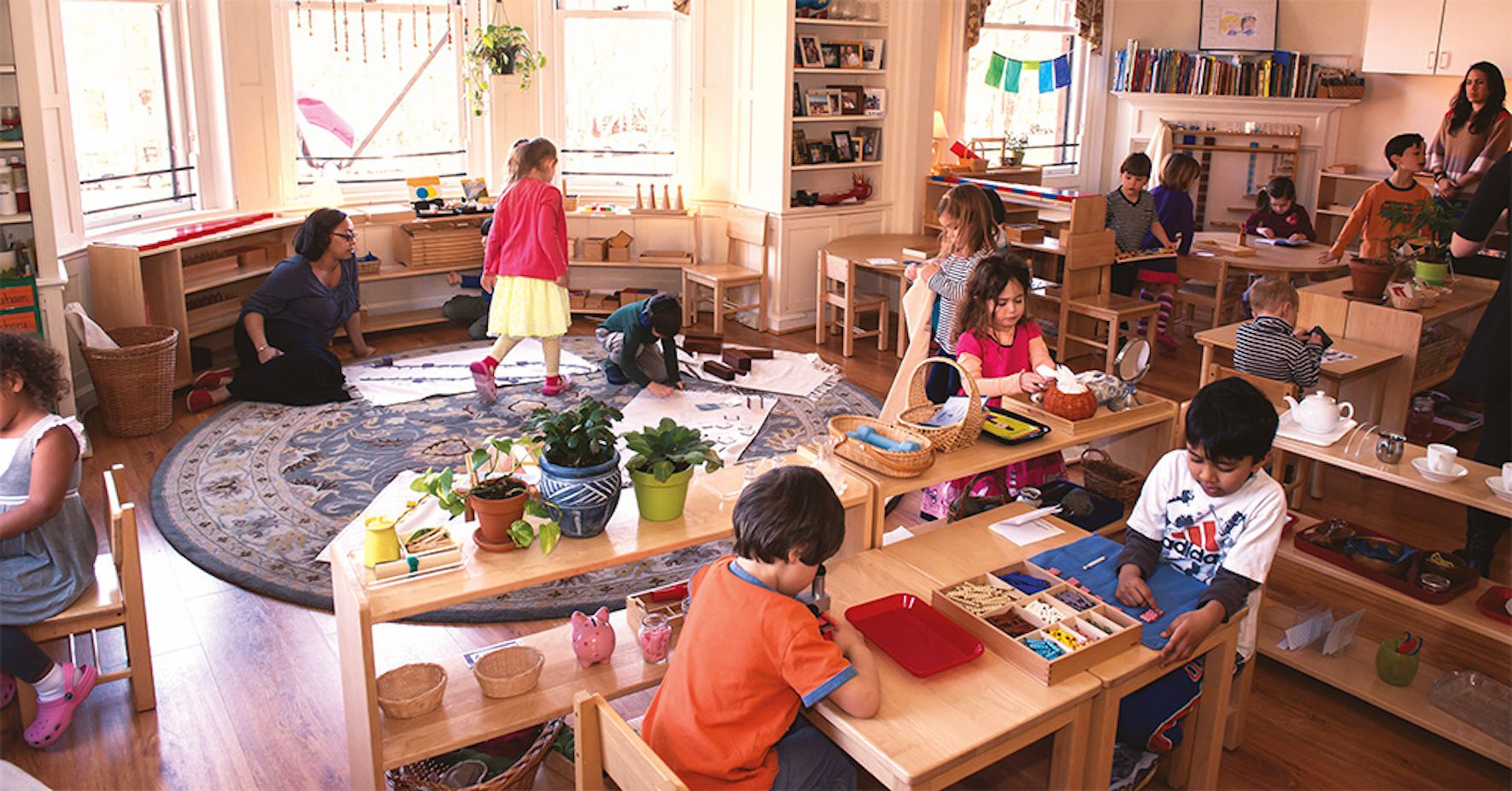
The children enjoy lunch in their classroom, along with their teachers. Lunch was at best a hurried affair last year; now the meal has become an enjoyable experience. We use cloth tablecloths, relax, and enjoy each other’s company. Previously, we would have to have the majority of the children ready to go to their resting or napping location by 12:30 p.m. Lunchtime was geared towards being ready by that time, so it was not necessarily leisurely or relaxing.
Now, instead of leaving after lunch, the children help get their nap mats ready and prepare for 30 minutes of rest. The older children usually read at this time, while the younger children look at books, sketch, write or work with a quiet activity. We found a company that produced nap mats with sheet and pillow attached, and it is 100% machine washable. They look like mini sleeping bags and the children find them very cozy for resting. On average 2-5 children fall asleep during rest time. After thirty minutes, the children get up, put their things away and begin an afternoon work cycle.
Our building is very calm during the afternoons now. The four and five year-olds who remember going into another room to rest or nap are happy to stay in their classroom with their teacher and as a result, they have been quite productive. The children are happy to stay together and are eager for lessons, which has stimulated the five year-olds to pursue the larger academic works. The 5s now have an admiring audience when they complete the 45 Layout or a Language work with the moveable alphabet. In previous years, we would have the 5s alone in the classroom for the 1-2:50 p.m. time period, which wasn’t necessarily a realistic model for their educational life after
their time in our classroom—with the All Day program, they are now learning to organize their time, their academics and socializing.
Are there drawbacks to this program? Yes, at first, it was a tremendous amount of physical labor for the teachers. However, as the year progresses, the children do more of the work in getting their mats out, helping clean up, putting their things away, etc. The children are more interested in maintaining their classroom environment, and often offer to sweep, dust shelves and wash tables.
The children in the classroom have learned to be respectful of their sleeping classmates and I have seen children remind each other not to disturb their friends as they work nearby. We have witnessed some wonderful nurturing from the older children towards the younger and vice-versa—the classrooms are true communities. The parents also like having their children remain with their teachers all day, instead of just the mornings.
At first, some of the teachers had reservations about the five year-olds being distracted from their academic work. While this does occur from time to time, the children are also eager to work together. The 4s are eager to pursue some of the more academic works in the room, which in turn inspires the 5s to work with the more advanced Math and Language lessons.
So far, the response to the program has been good. Both families and staff have had positive experiences. Some of the classroom afternoon activities have included yoga, simple cooking projects and crafts, in addition to the works in the classroom. The beauty of the All Day program has been how the concept aids in the development of the whole child—not just the academic aspect. Our classrooms are communities with children learning so much from each other, from the environment, and from being together for the majority of the day. What a gift these children are receiving—the true benefits of a Montessori education!
(Please note: The final article in this series will focus on looking back over the school year—the highlights, what we learned from having this program, and whether any changes need to be made for the next school year).
Plans for 2003-2004
(Evolving into an All Day
Montessori Program)
By Lisa Wagoner
The Montessori School
of Winston-Salem, North Carolina
Plans are already in place for next year’s program at our school. In previous issues of Tomorrow’s Child, I have written about our program as we evolved into an All Day Montessori program. There were transitions to be made, as well as adjustments and changes, but we look forward to the coming school year.
The teachers and administrative staff reviewed the program we have in place and suggested improvements. The first change is the name—All Day will now be known as Children’s House. What an amazingly simple yet profound change and so true to the nature of the program! The children help care for each other, themselves and their classroom, in addition to working with the classroom materials. We experienced this previously, but we have definitely felt an enhancement, due to the lack of physical transitions for the children and the happiness they feel in staying in the same room for most of the day.
The other improvement was to have all three and four-year-old nappers go to a separate napping room to rest. There were several reasons for this decision. We discovered that the three year olds who stay after noon have had so much to assimilate—new classroom, new teachers, larger class size and higher expectations of independence. In addition, some children have been so excited by being with their friends that they don’t rest as fully as they should, which can lead to a difficult afternoon and evening for them. As a way to help them with their transition to a Primary classroom, and respecting their need for rest, we have decided to improve our program by having all nappers eat lunch and rest together in a large room available in our building (known as our multi-purpose room). Once the children wake up, they will have Montessori works available to them so that they can continue working on what they have learned in the mornings. As the children mature and no longer need a nap, they will rejoin their classmates and stay in the classroom after noon.
The children who remain in their classroom after noon will be the four-year-olds who no longer require a nap and the five and six- year-olds. They will still have a thirty-minute rest period, during which time they can rest their bodies by relaxing, reading, sketching or writing.
Change can be difficult but it can also be viewed as an exciting adventure. It has certainly been a year of growth and change for us as we implemented a new program to meet the needs of our families. Thank you for joining us on this journey—much has been learned and we look forward to improving and refining our program as the families’ and staffs’ needs evolve. The ultimate recipient of the positive results we have seen are the children in our school—our afternoons are calm, productive periods and the children have formed closer bonds with each other and felt a stronger sense of ownership of their environment. It is our hope that other schools look into this type of program as a beneficial way of furthering Maria Montessori’s vision—may the spirit of Casa de Bambini find its way into all of our programs and continue the type of education she pioneered.