


Part 3: Supporting Our Parenting Partners Differences in Parenting Approaches
To continue reading, you will need to choose a subscription plan.

Favorite summer Reads for 2022

Favorite SummerReads for 2022
by Lorna McGrath
One of the many things that teachers do in the first few days of school is to ask children to talk about, write about, or in some way describe their summer activities. You remember that, right?
For some of us that was easy and fun because, maybe, we like to write (especially about ourselves) or we did a lot of things and went to a lot of places. But for others, this project might feel more challenging or even discouraging because they experienced everyday life at home, and it may not seem to be so exciting or alluring.
“Summer Journals” or diaries can be an opportunity to help your child see that all things are exciting, fun, and new in their own way. An appreciation if you will. Try talking with your child each night about their day and record it in a way that is appropriate for your child’s age and abilities. So, writing, drawing pictures, recording them telling their stories, and other creative ways all count!
These are some questions for you to use:
1. What was the silliest thing that happened today?
2. What was the worst thing that happened today?
3. What was the best thing that happened today?
I found these three questions can really get your child talking. You may need to help them get started by sharing your silliest, worst, or best. Remember once they open up, let them be the storyteller!
I also suggest that reading counts as part of your child’s summer adventures! Here are a few of my favorite books.

Make Music! by Norma Jean Hayes, Ann Sayre Wiseman, & John Langstaff
This is a wonderful resource with a wealth of projects for elementary-age children that have to do with creating music together. It’s fun, it’s broken down into categories from beginners to advanced music makers, and the illustrations are photos of real children in action and having a blast! Appropriate for ages 6-12.

Apple in the Middle by Dawn Quigley
Your 11–15-year-old will be captivated by Apple’s discoveries about herself, and her heritage as she spends the summer with her grandparents and others from her mother’s side of the family. She goes to a different place, experiences a culture that she knew very little about, and develops a new perspective about life. Appropriate for ages 11-15.

Our Peaceful Classroom by Aline D. Wolf
Lest we forget, this book will bring back memories of friends and activities from school days and may help with the transition for your young child back into the classroom and school life as the summer winds down. Appropriate for ages 3-6.

It’s a Book by Lane Smith
This is a hilarious book for older children. It cleverly and in a fun way depicts how in modern times, we are so attached to technology that we don’t know about or recognize a book in printed form. Love this one! Appropriate for ages 12-17.

Beach Walk by Backpack Explorers Series, Storey Publishing
This is a sturdy, somewhat water-resistant book that you can bring along on your trip to the beach. It includes a magnifying glass, which children really love to use when discovering new plants and animals by the water. There are lots of fun activities for you and your children to do together! Appropriate for ages 4- 10.

How to Find an Elephant by Kate Banks
There is an elephant (or part of one) on every page of this book, but you’ve got to really look! The words and illustrations entice the reader in a fantastic adventure, full of imagination and for hunting what otherwise might be obvious. Appropriate for ages 4-10.
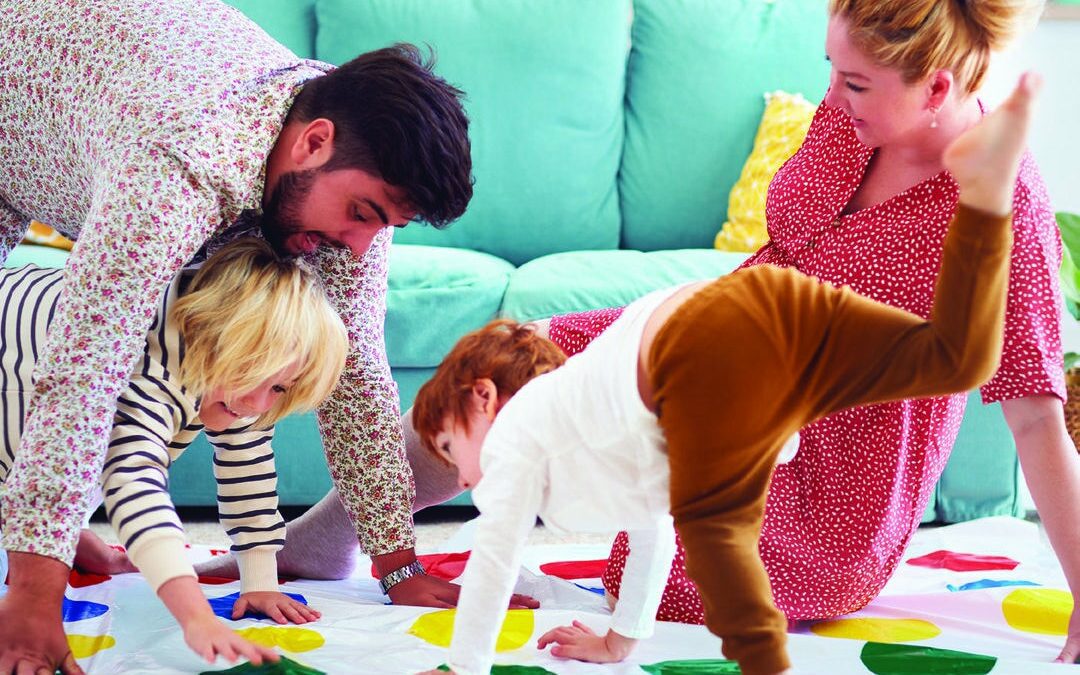
Family Fun is More Than Fluff
To continue reading, you will need to choose a subscription plan.

10 Ways to Prepare for Summer

10 Ways to Prepare for Summer
by Cheryl Allen & Lorna McGrath
1. Maintain a routine–getting up at a similar time each day, eating at regular times, keeping enough routine to keep your child comfortable. This is important for all ages. It gives them a sense of stability. It is especially important in early childhood, as these children are especially sensitive to order and consistency.
2. Keep up your family meeting schedule. Remember that family meetings provide opportunities for everyone to have a voice, be a leader, and take part in shaping the summer. If you have visitors, invite them to join your meeting.
3. Create and discuss family expectations for behavior at home, out on the town, and when traveling. These are great topics for family meetings as you prepare for summer.
4. Find out what each family member is hoping for from the summer and see if you can meet each family member’s goal. This is another topic for a family meeting. Remember to break down preparation topics into manageable pieces so that you don’t feel as if everything has to be covered in one meeting.
5. If possible, schedule only one or two activities or camps in the summer to provide consistency. Also, if these activities or camps can be chosen with your family values about respectful interactions among participants and adults in mind, the experience will probably be more enjoyable and productive for your child.
6. Let your child know about plans for the day and what may be required ahead of time so your child can plan. Even though you will share with each other at your family meetings what’s up for the week, it is important to look at each day in more detail as the day begins.
7. Allow for relaxation time each day, especially if you are traveling or have visitors. As always, we suggest that consciously planning for downtime is as important as planning for activities.
8. Encourage time for practical life activities–gardening, cooking, and cleaning. Practical life activities bring us back to our family community, interacting together, doing meaningful work, and learning to use math and science in our everyday lives.
9. If you don’t already have this, develop a quieting space for each family member. Creating “quieting spaces” for each family member involves multiple family meetings, so start planning them now. As school comes to an end, consider quieting spaces for summer travels.
10. Plan your schedule so that you’re home in time to prepare for the new school year. We always think that summer will last forever, but before we know it, it’s time to go back to school. It’s helpful to the whole family to get back into a home routine at least a week before school starts. •
Cheryl Allen is the Associate Coordinator of the MontessoriFamily Alliance and is also a parenting educator and a Montessori consultant with the MontessoriFoundation. Cheryl attended Montessori school as a child. After some time as a traditional Secondary teacher, she worked in Montessori classrooms, 3-6, 6-9, and 9-12, earning certifications from both AMS (3-6and 6-9) and IMC (6-12). She is a teacher educator, workshop presenter, and member of IMC accreditation teams. Cheryl’s two children attended Montessori from age two through high school graduation.
Lorna McGrath, MEd, is Director of IMC School Accreditation, Program Director of the MontessoriFamily Alliance, and Senior Consultant of The Montessori Foundation. Lorna has 41 years of experience in the field of education, teaching children from 18 months through 6 years old and from 12 through 18 years old in both public schools and independent Montessori schools. Lorna is a Montessori teacher educator, conference presenter, and school consultant. She can be reached at lornamcgrath@montessori.org
A Montessori Approach to Clean-Up Time
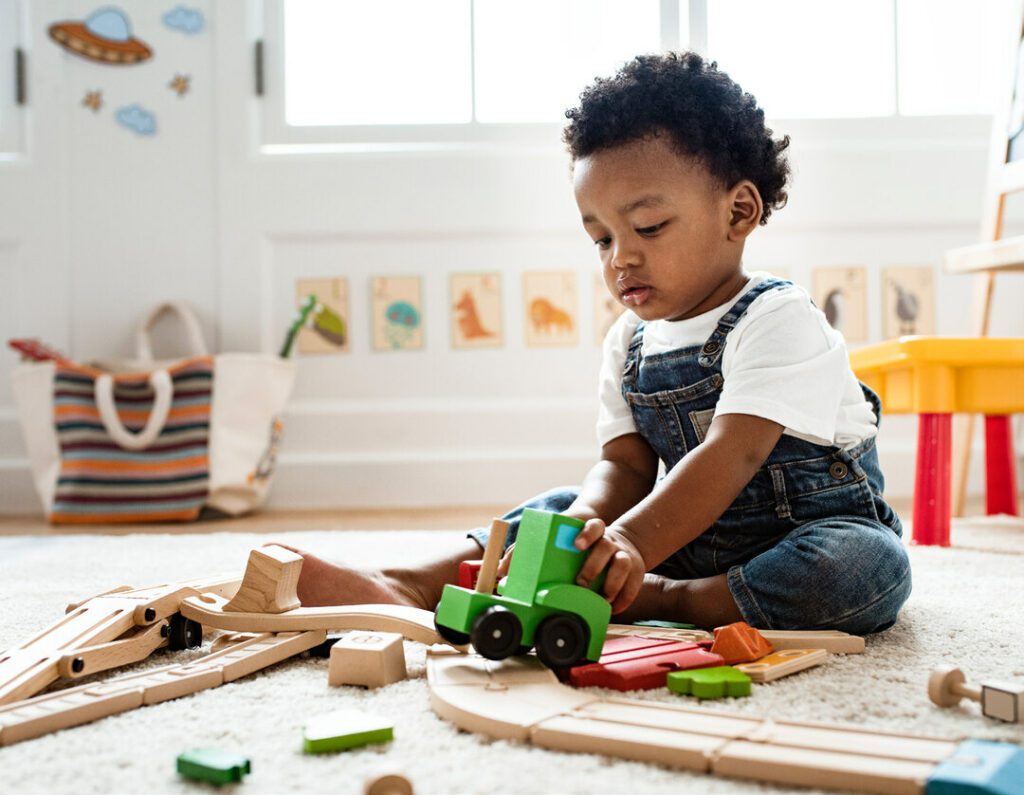
A Montessori Approach to Clean-Up Time
by Carine Robin
We know that Montessori is all about order.
We know that children have a sense of order. The Montessori classroom is an orderly environment where every activity has its place.
Montessori teachers encourage children to use one activity at a time and to tidy up each activity after they have finished with it.
As parents, we expect that the Montessori philosophy will help our children to be tidy! In my experience as a teacher, it’s easier for children to tidy up in the classroom. The Montessori school is designed for children and leads naturally to order. There are clear rules and expectations, and children are more willing to clean up after themselves in the classroom.
What if I tell you that, despite being a Montessori teacher, my children’s bedrooms are not orderly? They don’t tidy up spontaneously. There are several reasons for that, and I have learned over the years what helps children to tidy up and to stay organized.
Three reasons why children don’t tidy up?
1. You might have heard of the sense of order? This is one of the ‘’sensitive periods’ observed by Maria Montessori. It is now described more as a tendency that all human beings must make sense of their environment. It’s not so much about “tidying up after themselves” or keeping their bedroom clean” as about routine, rhythm, and knowing what comes next.
They will express that sense of order about what matters for them. For example: sorting their little people; being obsessed about their collection of pebbles; sleeping with their special teddy is all about that sense of order!
“It seems to him, at this stage, a particularly vital matter that everything in his environment should be kept in its accustomed place; and that the actions of the day should be carried out in their accustomed routine.” – E.M. Standing, Maria Montessori: Her Life and Work, p. 123
Sense of order doesn’t equal being tidy!
2. Are you a tidy person? I’m very honest on this blog and on my social media about the fact that I am not a naturally tidy person. I used to have lots of clutter in my life.
I did a big work on myself to understand my hoarding tendencies and to learn to be more organized. So, if like 50 percent of the parents I work with, you tend to be “messy and disorganized,” you cannot expect that your children will be able to tidy up spontaneously. Children need role models. The more you clean and tidy in front of them, the more they will see it as being part of the routine.
3. They don’t see you cleaning and tidying! I have said it already but even the tidiest parent tends to “clean” when the children are not around. Have you ever sent your co-parent to the park with the children, to allow you to do a good clean-up session?
Do you tend to do everything when they nap? Or do you tend to tidy up all their toys at the end of the day when they are in bed? Stop now and do as much as you can in front of them. Montessori is about teaching life skills and independence, so taking care of the environment is something that I would advise you to focus on. Teach your child to fold the laundry, to do the dishes, empty the dishwasher, setting up the table, and cleaning the windows!
How to help children to tidy up?
• Work on yourself: if you are not naturally tidy, start with you! Do a big decluttering session, and try to understand why it’s hard for you to be orderly. Seek support if needed. Your children will thank you!
• Equally, if you are a very tidy person, lower your expectations; having a spotless house when we have children is just not possible. Review your definition of what is a tidy home.
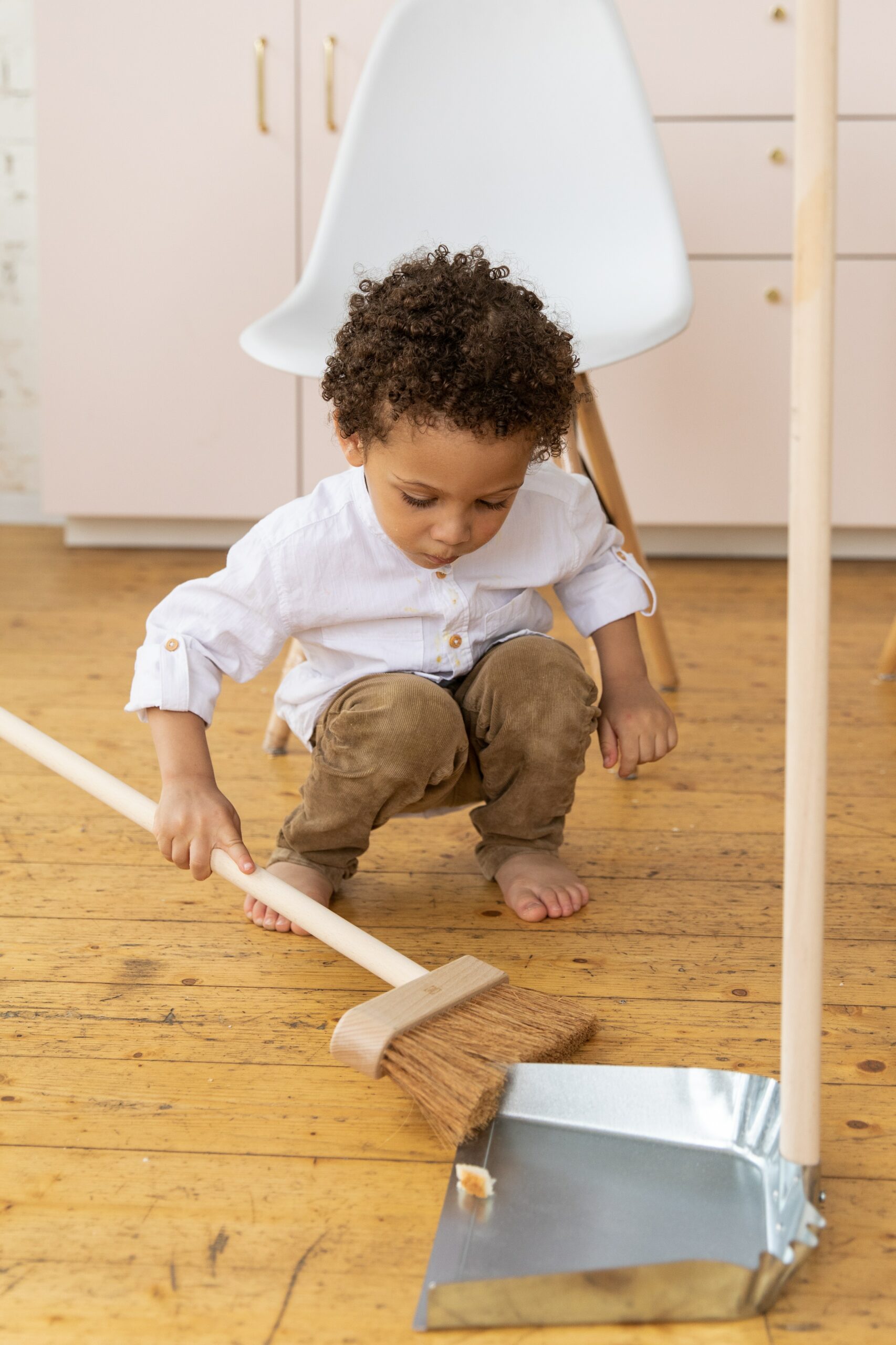
• Be a role model: clean in front of your children. Even if you have a cleaner, try to do a task with them as a way to teach them. Involve them in the cleaning tasks: young toddlers, generally, love to clean! Give them child-size tools and don’t expect a brilliant result. Let them enjoy the process.
• Have fewer activities and toys available. The less there is to tidy, the easier it will be. Halve the amount of Legos™, blocks, train parts… Those sets tend to be difficult to tidy, and children get discouraged and stop cleaning up after themselves if they are overwhelmed by the task.
• Have a place for everything. Make sure you know the spot for each toy/activity. At the beginning of your Montessori journey, you might still move things around but try to limit a big overhaul, as it disturbs their sense of order and will prevent them from putting back what they have used.
• Make it playful: have a tidy-up song! or a silly dance. Have the animals go back to their basket, making sounds. Find what works for your child.
• Wait for when they are ready. When children are in a flow, playing intensely, it’s hard to know when it’s time to tidy up. It might be dinner time, but they might not be ready to stop playing. Wait for the moment they naturally seem to move onto a new activity to encourage them to put the previous one back on the shelf.
• Help them! It’s a skill, don’t expect them to do it consistently even if they have done it a few times. Like us, they are allowed cheat days.
What about older children?
Children in the second plane of development are messier than younger children. They are less interested in organizing the environment. They are less interested in practical life. They tend to spread out when they explore a topic. It’s because it’s an age when they make connections between concepts.
Their play area and toys might be in their bedroom. Their bedroom is their private area, and you might be less around when they play. Children in the second plane have access to toys that have small parts (Legos™ beads, …).
You can still rotate toys for that age group. You can have a rule that the Legos™ are stored in the living room, or the crafts are only accessible at the dining table. I recommend that you limit what they have access to in their bedroom. Make it part of the daily routine to tidy up for half an hour before dinner.
The bottom line: Mess is part of life but being tidier, as a family, will help everyone.
Having said that, let’s close with this quote: “Excuse the mess, the children are making memories!” •
Carine Robin has a master’s degree in psychology, specializing in child psychology. She worked for various social services in her home country of Belgium, before moving to Ireland in 2006.
It was there that she started working in a nursery and discovered Montessori education. After having her first child, her passion for the philosophy grew. She qualified as a Montessori teacher and managed a Montessori preschool.
Carine has been running Montessori-based parents and toddler groups and coaching families for 9 years. She now also runs an online group for over 20,000 parents, sharing her knowledge and passion with people from around the world.
In 2018, Carine realized families needed more support and launched her popular online parenting courses and monthly subscription boxes, full of personally designed Montessori materials.
Carine has also trained with Sarah Ockwell-Smith in BabyCalm and Toddler Calm, with Dr. Laura Markham on Peaceful Parenting, and most recently, at the prestigious Maria Montessori school in London, as an AMI Elementary and 0-3 assistant. She writes on a popular blog “the Montessori Family”. www.themontessorifamily.com Instagram: @montessorifamilyuk
Beyond Bribes, Rewards, and Punishments

A Montessori Approach to Clean…
Beyond Rewards, Bribes, & Punishment
A Montessori Approach to Building Intrinsic Motivation
42 ways that the Montessori approach builds intrinsic discipline in our children.
by Simone Davies
In my last article on a Montessori approach to discipline, I mentioned that we don’t use rewards, bribes, or punishment in a Montessori classroom. And there is not a teacher at the front telling everyone what they need to do. Yet, if you observe in a Montessori classroom, there is a gentle hum of conversation and movement and a lot of concentrated children who are motivated to work.
So, not surprisingly, I received many questions about a Montessori approach to building intrinsic motivation in the child. Intrinsic motivation is doing something because you have the inner drive to do it, not because of some external reason like a reward or threat.
I love a good list so here are 42 ways that the Montessori approach builds intrinsic discipline in our children.
Note: It’s a holistic approach where each part is intrinsically linked. So, while it may seem overwhelming to do all these things, rest assured they also naturally build on one another.
42 Ways to Build Intrinsic Motivation
1. Build an environment where they can have success; knowing where they can find things and having things at their level.
2. Create opportunities for them to build independence – they see themselves as capable.
3. Cultivate opportunities to work together, cooperate and care for others – they see their input matters; a 0-3 child is observing and beginning their social development in their family. With a care giver, and/or nursery; the 3-6 child is part of their family and their class; and the 6-12 child wants to work and be a part of a group.
4. Value process over product; there is more learning in the doing than in the result.
5. Use encouragement rather than praise. When they hear, “You worked hard to get your shirt on all by yourself ” rather than “good job,” they learn to look to themselves to understand what worked, rather than looking to us for praise.
6. Give them freedom to work on things they are interested in – rather than what the teacher/adult tells them – or a timeline.
7. Provide safe limits. Offer security and show that someone cares about them.
8. Allow them the freedom to choose what, where, and with whom they’d like to work.
9. Provide a clear rhythm to their day so that they know what to expect.
10. Help them learn respect for themselves, each other, and the environment – they feel truly accepted and learn to accept others.
11. Encourage those agreements are made together – they feel like a valued member of the community.
12. Let them know that it’s a safe place to practice boundaries – we can support them with words if needed, “I’d like to work by myself right now. It will be available soon.”
13. Honor who they are; each member is unique and valued – builds their sense of self.
14. Help them learn to look after themselves, others, and the environment – it’s empowering to be able to do this for themselves.
15. Show trust in them – by removing external rewards and punishments.
16. Help them to make amends when needed – they know that when they get it wrong, they will take responsibility and learn from the experience.
17. Value curiosity – learning is about finding out rather than memorizing facts
18. Allow them to have choices – they have ‘agency’ in their days
19. Provide honest, instructive feedback – we see what’s going well and how they can do better; give them gentle guidance to keep improving.
20. Offer different ways to learn; we all learn in different ways and on different days; the materials appeal to kinesthetic, visual, and aural learners, and they can choose how they’d like to present their work, from a booklet to a survey to a poster etc.
21. Be their guide – not their boss or servant
22. Help children build ‘scaffold skills’ – where each activity builds on the next to allow mastery.
23. Support them to develop their own routines/ rhythms, such as taking an activity to a table or mat and returning it when it’s done.
24. Help children develop their thinking skills – they are learning to learn through hands-on learning and making discoveries for themselves; they help younger children and consolidate their own learning; they reflect on what they have learned.
25. Keep it real; children are not learning just for the sake of learning. They are learning how it applies in the real world giving meaning to their work.
26. The absence of tests or punishments allows a natural love of learning, while maintaining their creativity and interest in learning
27. Model intrinsic motivation ourselves as adults; our actions are more powerful than our words.
28. Provide control-of-error activities, which will allow children to discover their errors and try again.
29. Offer challenges at the appropriate level. Children do not feel unmotivated, because they know that they can do hard things, and they do not want to give up.
30. Encourage service in the community. This allows children to see and appreciate the impact of their work.
31. Children can have a healthy relationship with failure: the guide and classmates are supportive; children are able to stay with something until they master it and are ready to move onto the next activity; and they learn to ask for help if needed.
32. Remove competition for sticker charts or praise; children do not need rewards from others. Help them look to themselves instead of someone else.
33. Allow time to help children build skills, e.g., planning skills, learning to dress themselves, how to make a report, etc.
34. Children are in charge of their own learning: they learn uniquely, have their unique interests; and are on their own unique timeline.
35. Adults can trust the Montessori process, without forcing their own agenda.
36. Help children support themselves as they become members of their society.
37. Be patient; learning happens at its own pace and isn’t forced.
38. Plant seeds of curiosity, enough to get them interested, and not too much to allow them to discover the rest for themselves.
39. Encourage the possibility for big work and big ideas that looks at the interdisciplinary nature of the universe.
40. Allow space for all voices; we want everyone in our community to feel valued, accepted, and safe.
41. Avoid criticism or correction; instead, observe where children are in their process, and offer another opportunity to teach it again.
42. Learn from others. We can see others learning and be inspired to learn that too.
It’s never too late to start applying these principles. We can even scaffold the skills with a child in Upper Elementary (9-12 years), first helping them plan, then letting them take over more and more steps themselves. •
Simone Davies is the author of The Montessori Toddler and co-author of The MontessoriBaby, comprehensive guides to raising toddlers and infants in a Montessori way. The books are based on her 15+ years’ experience working as an AMI Montessori teacher in Sydney and in Amsterdam. She also has a popular blog, Instagram, and podcast “The Montessori Notebook”.She is also mother to two young adults.Simone currently runs parent-childMontessori classes in Amsterdam at her school, Jacaranda Tree Montessori, and is working on another book with Junnifa Uzodike, The Montessori Child for children from 3-12 years.
With hundreds of practical ideas for every aspect of living with a toddler, here are five principles for feeding your child’s natural curiosity, from “Trust in the child” to “Fostering a sense of wonder.” Step-by step ways to cultivate daily routines with ease, like brushing teeth, toilet-training, and dealing with siblings

50 Ways to Celebrate Summer Learning
50 Ways to Celebrate Summer Learning
by Cheryl Allen
Summer is a time of more daylight, warmer temperatures, and more time outdoors. We may think that, for children who are out of school in the summer, it is not a time of learning. Yet, it can be an incredible time of learning. Here are fifty ways to help your child learn and grow while not in school.
Explore
1. Let your child plan an activity for the day or some activities for the summer. They can use maps, stick to a budget, and do the research.
2. Go on a searching hike, in nature or an urban setting; look for objects in the shapes of the letters in your name, or in sets of your favorite number, or particular colors.
3. Learn about the plants and animals that are near you. What are those birds by your home? What are the names of the plants you see every day?
4. Walk at your child’s pace. Notice the smells of different plants, admire the bugs, follow your child’s lead.
5. Play board games.
6. Learn card or magic tricks.
7. Learn jokes and present a comedy show.
8. Play unplugged games, such as Hangman, your own version of Pictionary, I Spy, or other paper-and-pencil games.
9. Think of free or inexpensive ways you could help neighbors and act on them.
10. Create a scavenger hunt and follow the clues.
11. Try out new playgrounds nearby.
12. Go to a grocery store you do not usually go to, especially if it has a focus on an ethnicity different than your usual cooking.
13. Allow time for daydreaming.
14. Try outdoor science experiments.
15. Plan a dream vacation.
16. Find some art to admire, outside or in a museum. Discuss what each person likes about it.
17. Explore distances and make a map. How far are you from family members, favorite types of animals, friends, or any other thing that can be mapped?
Communicate
18. Make time for reading every day, or nearly every day.
19. Visit the library and allow your child to make choices of reading material on their own.
20. Encourage your child to tell a friend or a family member about a book they read; retelling helps develop understanding.
21. Write letters to friends and family.
22. Address the envelope for that letter. Writing the address correctly on an envelope takes practice.
23. Keep a summer journal or a travel journal. Write in it regularly and include printed photos, pressed flowers, or leaves, ticket stubs, maps, or any reasonably flat items that remind them of the events written about.
24. Have your child create lists for things to do, grocery lists, books read or books to read, movies to watch, anything that can be listed.
25. Write a letter to their future self and store it or use a site that will email you in a certain amount of time.
26. Create a kindness list; how many acts of kindness can be performed this summer?
27. Count cars, bikes, dogs, flowers, anything you see regularly in your travels.
28. Find letters of the alphabet or make up a silly sentence using letters or words on items in the grocery store. Only one word or letter per item!
Create
29. Build a design of your child’s own creation or follow the directions from a set, with Legos™, blocks, or other building materials.
30. Learn to build card houses.
31. Plan and build a birdhouse.
32. Make your own playdough and sculpt with it.
33. Water down paint, place paper outside, and use squirt guns filled with the watery paint for a creation.
34. Set up objects outside and trace their shadows onto paper.
35. Put on a show–write it, practice it, design costumes and props, and perform for others. Record the show to share it with family that cannot attend in person.
36. Use chalk to draw outside, then use water and a scrub brush to erase it.
37. Plan dinner for a night and help make it.
38. Make a salad. Make dressing to go with it for an extra skill-building opportunity.
39. Grow vegetables and harvest them for dinner.
40. Find a recipe and cook with a new-to-you food.
41. Shuck corn, peel potatoes, wash, and spin lettuce dry, participate in cooking preparation.
42. For older children, set a cooking challenge to use ingredients and make a meal.
43. Sketch or paint flowers at your home or a nearby location.
44. Draw self-portraits directly on the mirror using window markers.
45. Clean the mirror after drawing on it.
46. Wash windows (an adult may need to wash the top).
47. Water the garden or potted plants.
48. Organize an area of your home together, especially one that your child uses regularly.
49. Explore with cash, count coins, save for an item, buy something with cash and check the change received.
50. Make leaf or bark rubbings and label them with the type of tree or bush they came from. •
Cheryl Allen is the Associate Coordinator of the Montessori Family Alliance and is also a parenting educator and a Montessori consultant with the Montessori Foundation. Cheryl attended Montessori school as a child. After some time as a traditional Secondary teacher, she worked in Montessori classrooms, 3-6, 6-9, and 9-12, earning certifications from both AMS (3-6 and 6-9) and IMC (6-12). She is a teacher educator, workshop presenter, and member of IMC accreditation teams. Cheryl’s two children attended Montessori from age two through high school graduation.

Part 2: Supporting Our Parenting Partners Differences in Parenting Approaches
To continue reading, you will need to choose a subscription plan.

Part 1: Supporting Our Parenting Partners, Stages of Parenting
To continue reading, you will need to choose a subscription plan.

Stewards of the Earth Preparing for Earth Day with Our Families
To continue reading, you will need to choose a subscription plan.
United Nations Convention on the Rights of the Child

Most of us are aware that the United Nations adopted a declaration on the universal rights of the child, but many of us have not read it. Here is the introduction and the link to the full text. We encourage you to revisit it from time to time and reflect on the vital message and vision within.
Convention on the Rights of the Child
ADOPTED
20 November 1989
BY
General Assembly of the United Nations
resolution 44/25
Entry into force: 2 September 1990, in accordance with article 49
Preamble
The States Parties to the present Convention,
Considering that, in accordance with the principles proclaimed in the Charter of the United Nations, recognition of the inherent dignity and of the equal and inalienable rights of all members of the human family is the foundation of freedom, justice and peace in the world,
Bearing in mind that the peoples of the United Nations have, in the Charter, reaffirmed their faith in fundamental human rights and in the dignity and worth of the human person, and have determined to promote social progress and better standards of life in larger freedom,
Recognizing that the United Nations has, in the Universal Declaration of Human Rights and in the International Covenants on Human Rights, proclaimed and agreed that everyone is entitled to all the rights and freedoms set forth therein, without distinction of any kind, such as race, colour, sex, language, religion, political or other opinion, national or social origin, property, birth or other status,
Recalling that, in the Universal Declaration of Human Rights, the United Nations has proclaimed that childhood is entitled to special care and assistance,
Convinced that the family, as the fundamental group of society and the natural environment for the growth and well-being of all its members and particularly children, should be afforded the necessary protection and assistance so that it can fully assume its responsibilities within the community,
Recognizing that the child, for the full and harmonious development of his or her personality, should grow up in a family environment, in an atmosphere of happiness, love and understanding,
Considering that the child should be fully prepared to live an individual life in society, and brought up in the spirit of the ideals proclaimed in the Charter of the United Nations, and in particular in the spirit of peace, dignity, tolerance, freedom, equality and solidarity,
Click the link below to read the full text:
https://www.ohchr.org/en/instruments-mechanisms/instruments/convention-rights-child

A Montessori Adult Is… with Cassi Mackey
To continue reading, you will need to choose a subscription plan.

Having Mindful Conversations: Talk-Based Strategies to Enhance Children’s Relationships and Language Skills
To continue reading, you will need to choose a subscription plan.

How can I get involved with my child’s school?

There are some things that even money can’t buy, and one of the most valuable contributions that families make to a school is the gift of their time and expertise. Parents, grandparents, and friends of the school are often found helping in the office, assisting in the classrooms, serving as field-trip drivers, offering a special class, planning the next special event, coaching, or serving on parents’ associations or school committees.
Parents play a crucial role in Montessori. Our schools are communities of parents and educators (many of whom will also have children enrolled at the school). Our ideas and input often help to shape the school. Montessori schools are normally very responsive to suggestions and concerns.
Most Montessori schools encourage families to participate in the broader life of the school through social and educational activities. Although many parents spend considerable amounts of time as volunteers, except for parent cooperative schools, there is normally no expectation for a set-time commitment.
Parents and grandparents, who give of their time and talent, share with their children special memories of experiences and friendships that endure well beyond their graduation.
A few ways in which you might be able to help your school:
• Volunteer a few hours a week to help in the office
• Lend your time and support to our fundraising efforts
• Help out in the library
• Volunteer to be an Ambassador Family to parents new to the school
• Serve on one of the school’s committees
• Help put together the school newsletter
• Help the teachers organize field trips or special lessons
• Join in at open houses to meet prospective families
• Help organize special events
• Volunteer your time to help the school prepare major mailings
• Teach a special course
• Help students work in the garden
• Share your talents and special interests, such as a musical instrument that you play, a second language that you speak, a craft that you enjoy, or a field that you’ve studied
• Volunteer your time to coach a team or after-school club
• Serve as a class parent
• Help to organize a reunion for former students and their families
Like all schools, Montessori schools blossom when parents are generous with the gift of time, talent, and expertise.

Raising Helpers
by Theresa of Montessoriinreallife.com
One of the most wonderful things about toddlers is how they so inherently want to help. They are eager to be involved, be near us, and participate in our day-to-day activities. What we deem “chores,” toddlers see as what they are: meaningful contributions to our family or community.
After toddlerhood, we often notice a shift. Children seem less intrinsically motivated to help and view helping more as a chore. This is a natural part of development: they are more independent and focused on their own work and play. They are discovering who they are and where their own interests lie, which is a beautiful thing. It also doesn’t mean it’s the end of helping!
How do we continue to foster this motivation and raise helpers beyond the toddler years? Here are a few tips that I’ve been keeping in mind in our own home lately. These can be incorporated in toddlerhood and well beyond!

Help Our Children
Our children learn how to help through us helping them. When we respond to their requests for help, they are more likely to do so in return. Helping doesn’t mean doing a task for them, but rather offering just enough help to get them through a tough spot.
Model It
Not only should we think about how we are offering help to our children, but how can we offer help to our partner, a friend, or our community? The more our children see us being helpers, the more likely they will want to be a helper too.
Talk About It
“In our family, we help each other.” This is a phrase that we repeat often at home. The more we say and hear this, the more ingrained it becomes and the more natural it feels to be a helper in the family. Importantly, this phrase is said in a gentle way, not as a command.
Make It Part Of The Routine
When we make helping a part of our daily rhythm, it becomes natural. In our family, certain tasks are the kids’ responsibility every day: putting shoes and coats away, setting the table, feeding the dog, wiping up spills, tidying toys, etc. These tasks aren’t rewarded but rather just part of the routine.
Don’t Force It
Inviting doesn’t guarantee our children will help. Even when these tasks are part of the daily (or weekly) routine, everyone has off days. We can offer grace and let it go. Often, the next day, or at a different time, they are ready to help again.
Offer Opportunities
Sometimes we move so quickly through our own chores, we forget that we could involve our children. As much as possible, I try to do chores in front of the children so that they have the opportunity to join in and help. Often, what we consider mundane tasks are satisfying for our children. Having cleaning tools that are appropriately sized for our children makes them feel especially capable.
Accept It As Is
When our children do help, we may find that they’re ‘help’ doesn’t lead to the outcome we desire. The dishes might not be as clean, or the laundry might not be folded in a neat stack. When this happens, we can thank them for helping and appreciate the effort that went into it. Rather than correct them at the moment, we can model again another time, and try to be patient, as every skill takes time.
How can your child help today? •

Theresa is a mom to two, a former Montessori guide, and the founder of the blog Montessori in Real Life(www.montessoriinreallife.com). Prior to momming and blogging, she went to graduate school for developmental psychology and earned her Montessori infant/toddler guide certification. Since transitioning from teaching to motherhood, Theresa found a new passion sharing her love of Montessori with parents,while continuing to implement the Montessori philosophy in her own home.

TENDING TO GRACE & COURTESY
),

Grace and courtesy is often used to mean either rules or manners, or mannerly following of the rules. There are many lists out there about the grace and courtesy lessons that should be presented in the beginning of the year, making it seem to be a “one and remind” lesson. Yet, with not much thought we can see that grace and courtesy lessons need to be given throughout the year, need to be role modeled always, are presented based on observation, and fall into different categories. Dr. Montessori reminded us that, “social grace, inner discipline, and joy. These are the birthright of the human being who has been allowed to develop essential human qualities.” The Secret of Childhood (1966, xvii).
To help our students and our children develop the inner-discipline Dr. Montessori spoke of, grace and courtesy lessons need to be given throughout the year and in a multitude of ways. We start the year with a list of basic lessons, which need to be presented so that we may function as a group, and we present them again when there is going to be a change. In the beginning of the year, we present how to knock on the door and wait for an answer if the bathroom door is closed; this helps the class or family function with greater comfort. If we are going to see a live performance, a series of lessons would be given on entering the performance area, showing respect during a performance, and how to show your appreciation of the performance. What is sometimes forgotten is that in between these events, we should be regularly presenting lessons that build upon those we previously presented.
When a child pulls a third chair up to a two-person table to work with one friend, and the third child complains, you have the perfect opportunity for a grace and courtesy lesson rather than a reminder. It is easy to say, “Chair Mover, do we move a new chair for a table in this class?” A new lesson involves working with the left-out child. Starting with an acknowledgement, “I see it bothers you that Chair Mover is working at the table. What is happening?” When the child tells you the others are talking too much, or taking up the workspace, or simply that the chair doesn’t belong there, you may help them figure out how to speak to the other students. Asking, “What could you say to them to let them know how you feel?” You can help the child figure out a courteous way to ask the other children to help solve the concern. Admittedly, this is the slow way it would be faster to remind Chair Mover that this is a two-person table. Pressing our own personal pause button can help us slow down and take the long view when opportunities to present grace and courtesy lessons occur. With a reminder, the table is back to two people with everyone having space for their work. With a grace and courtesy lesson and practice opportunity, a child has practiced a way to respectfully speak up about a perceived injustice, and two children have learned to work with another to solve a concern that one of the three people feels is important.
Grace and courtesy needs to be role modeled by the adults in the school or home for it to become important to all the people involved. Before I had children of my own, I had friends that were interviewing to enroll their son in the only Montessori school on the island we all lived on. They rode their bikes to the interview and a car came close to my friend’s bike, while his son was on the back of the bike. Obviously, he was scared and angry, and he shared this with the driver, calling him some choice names. They got to the interview, and you can guess what the child shared when the Montessorian asked him what he saw on the way to the school. She was just trying to engage the child; instead, she got to present a grace and courtesy lesson. She asked Dad if he had been scared and angry and hinted to him to apologize for his outburst. Dad did and the child learned that they could all learn from mistakes. Being a role model does mean that we consider not sitting on tables or walking around eating unless this is common practice for all in the room; more importantly, it means taking the time to acknowledge actions that we did not want to role model and to change that behavior.
GRACE AND COURTESY DO NOT END AT THE CLASSROOM, OR SCHOOL DOOR, IT SHOULD BE A PART OF OUR LIVES IN ALL AREAS.
All grace and courtesy lessons should be presented from observation. Sometimes it is developmental, such as our beginning the year whole class grace and courtesy lessons, sometimes they are based on “in-the-moment” needs, and they should also be based on whole-group observation. My teaching partner and I gave a couple of well-received individual grace and courtesy lessons around speaking in a way that respects classmates’ feelings. Yet, as we observed the class and discussed with each other, we noticed that teasing that one person thought was fun and acceptable, was happening regularly throughout the classroom. In more casual conversation with students, rather than formal lessons, we began to talk about the way we talk to others. In our weekly group team-building time, we played some games and did some projects that brought attention to the way our words could help or hurt another person, with or without us meaning the hurt. The multi-pronged approach helped us, as a class, find a balance between joking and inadvertent hurting; yet, without observation for grace and courtesy skills we would have been managing one person at a time, probably never reaching the same balance.

Grace and courtesy are so much more than a set of rules and the manners we demonstrate when we follow those guidelines. It is noticing and caring for the environment, which is one of the first places students can begin to see how their actions affect others. It is helping children become aware of how they are feeling, what is going on inside them and developing language to express these feelings. It is working to develop social awareness, thinking about how your actions affect others and the environment around you, and finding the willingness to give grace to others when their actions affect you negatively. It is using kind and respectful language to express your own feelings and needs to communicate with others. It is bringing the grace of physical action to awareness, how one’s actions affect themselves, others, and the environment. It is being aware of those who may need you to be an advocate or help them take action, in your immediate community and the community at large.
Grace and courtesy do not end at the classroom or school door; it should be a part of our lives in all areas. At home, my time has been allocated differently in the past couple of years. One thing I have been able to do is tend to the roses in my garden with more regularity. I do not trim them, water them, or fertilize them for a greater length of time than I did previously. I just have smaller amounts of time to spend on them more often. Grace and courtesy in the school, classroom, or home works the same way. You don’t need more time over the year, you just need to be more consistent with your time. My roses bloom much more often than they did a couple of years ago, there is nearly always at least one rose in bloom, which I love to see as I walk out the door. With regular attention to grace and courtesy, you will probably find at least one bloom of kindness and consideration every day, most likely a whole bouquet’s worth. •

Cheryl Allen is the Associate Coordinator of the Montessori Family Alliance and is also a parenting educator and a Montessori consultant with the Montessori Foundation. Cheryl attended Montessori school as a child. After some time as a traditional Secondary teacher, she worked in Montessori classrooms, 3-6, 6-9, and 9-12, earning certifications from both AMS (3-6 and 6-9) and IMC (6-12). She is a teacher educator, workshop presenter, and member of IMC accreditation teams. Cheryl’s two children attended Montessori from age two through high school graduation.
Messy Spaces for Art and Hobbies
by Tim Seldin and Lorna McGrath
An excerpt from Montessori For Every Family, published by DK Press, 2021
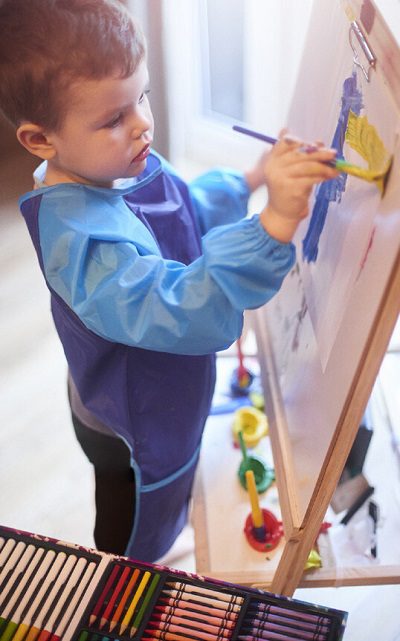
In most families, there are hobbies, interests, and activities that can be messy, need to be left in place to continue to work on later, or where special tools and supplies can be kept on hand and are easily found as needed. A messy space like this could be a spare room in your house, in the basement if you have one, or in your family garage.
It could be a craft and art studio for sculpting or making pottery or an area for woodworking with a workbench with tools arranged on shelves or hanging from a pegboard. It might be a room where you keep your paints and an easel, a photography or video studio with lighting and backdrops, or a space for tools to work on your cars or bicycles.
Keeping order in mind as you plan and organize the space is key to reducing frustration when you can’t find a tool you need or something you’ve just created gets knocked over. When there is clutter and disorder, accidents are more likely to happen and safety to be compromised. It also becomes more difficult to concentrate on the project at hand.
In a Montessori-inspired home, we want to think about what kind of space is needed for your interests or hobbies with all members of the family in mind. Your children are likely to want to be around you as much as possible, as well as needing a space where they can do the things that they prefer. So the idea is to think about the activities that your family members enjoy and consider which ones can be done in the same space.
Many families do not have a spare room, a basement, or even a garage that could be turned into a messy room. What are you to do then? Of course, everything depends on the ages and interests of your children, which may be very different from child to child, but the basic concepts remain the same. Our goal is to allow children to do activities that may be too messy to allow in their bedrooms, the kitchen, or the living room. When you live in a small apartment or home, you have to think outside of the box. You may make an exception to the general rule, and create a small area in the child’s bedroom where you lay down a protective heavy plastic covering on the floor and allow your child to paint, work with clay, glue models together, and other things using a washable covering to protect the surface of the kitchen table. The goal is to encourage children to feel that they can explore hobbies and interests while having your house (or backpack) become a mess.

Real-life story: When Jennie first went to school, she was fascinated with the art materials in her Montessori class. She loved to paint and draw with the beautiful beeswax crayons and colored pencils that were part of the classroom environment. When she would come home, she would often ask her mom if she could have an art studio. Jennie and her mom bought her a set of simple water paints and brushes, a small tabletop easel, and a stack of water-paint paper. They set up a little art studio with tile on the floor that could be easily cleaned if any paint spilled. Mom also bought some picture frames made from matte board so Jennie could hang her favorite paintings. As time went by, Jennie moved from water paints to charcoal and pastels and finally tempera and oil paints. but her interest in drawing and painting never faded away. Today, Jennie has grown up and has a career in science, but she still enjoys painting and loves going to art galleries.
Real-life story: I started noticing my son’s school backpack was full of what I considered trash. Broken rubber bands, the inner ring from a roll of tape, bits of string, etc… for and he just said that he needed them. Then, I started noticing items moving from the recycle bin to his bedroom. Egg cartons, milk jugs, cardboard boxes of all sizes…..it was looking like a recycling center in his room. I would ask him what they were. He kept saying he “needed” it all, so I walked out, took a deep breath, and went with it when what I really wanted to do was put it all back in the trash and have a clean house! Then, one day, he emerged from his room with a giant “smoothie shop” that served all types of smoothies (made out of cardboard and “trash”). This shop was so amazingly detailed and each bit of “trash” served a thought-out purpose. He used amazing grace and courtesy to take our orders and serve us smoothies. We all drank some delicious smoothies that day, and I silently thanked all of his Montessori teachers for teaching me to follow his interests… even when those interests looked like “trash!” —Tara, mother of John 9 years old
Lorna McGrath, M.Ed., is Director of IMC School Accreditation, Program Director of the Montessori Family Alliance, and Senior Consultant of The Montessori Foundation. Lorna has 41 years of experience in the field of education, teaching children from 18 months through 6 years old and from 12 through 18 years old in both public schools and independent Montessori schools. Lorna is a Montessori teacher educator, conference presenter, and school consultant. She can be reached at lornamcgrath@montessori.org.
Tim Seldin is President of the Montessori Foundation and Chair of the International Montessori Council. His more than40 years of experience in Montessori education includes 22years as Headmaster of the Barrie School in Silver Spring, Maryland, his alma mater from toddler through high school graduation. Tim was Co-Founder and Director of the Institute for Advanced Montessori Studies and the Center for Guided Montessori Studies. He earned a B.A. in History and Philosophy from Georgetown University, a M.Ed. in Educational Administration and Supervision from The American University, and his Montessori certification from the American Montessori Society. Tim Seldin is the author of several books on Montessori Education, including How to Raise An Amazing Child, The World in the Palm of Her Hand, and his new book, Montessori for Everyone, co-authored with Lorna McGrath.
Featured
-
The Montessori Way, Revised and Expanded: An Education for Life; A Comprehensive Guide for Parents and Teachers
$25.00
-
The Montessori Child: A Parent's Guide to Raising Capable Children with Creative Minds and Compassionate Hearts (The Parents' Guide to Montessori)
$20.00
-
The Montessori Toddler: A Parent's Guide to Raising a Curious and Responsible Human Being (The Parents' Guide to Montessori)
$20.00
-
Montessori in Action: Building Resilient Montessori Schools 1st Edition
$29.95
-
Bulk Order, 30 Copies of Montessori for Every Family: A Practical Parenting Guide To Living, Loving, And Learning
Original price was: $600.00.$510.00Current price is: $510.00.


Products
-
The Montessori Way, Revised and Expanded: An Education for Life; A Comprehensive Guide for Parents and Teachers
$25.00
-
The Montessori Child: A Parent's Guide to Raising Capable Children with Creative Minds and Compassionate Hearts (The Parents' Guide to Montessori)
$20.00
-
The Montessori Toddler: A Parent's Guide to Raising a Curious and Responsible Human Being (The Parents' Guide to Montessori)
$20.00
-
Montessori in Action: Building Resilient Montessori Schools 1st Edition
$29.95
-
Bulk Order, 30 Copies of Montessori for Every Family: A Practical Parenting Guide To Living, Loving, And Learning
Original price was: $600.00.$510.00Current price is: $510.00.