Encouraging Risk Taking

Encouraging Risk Taking
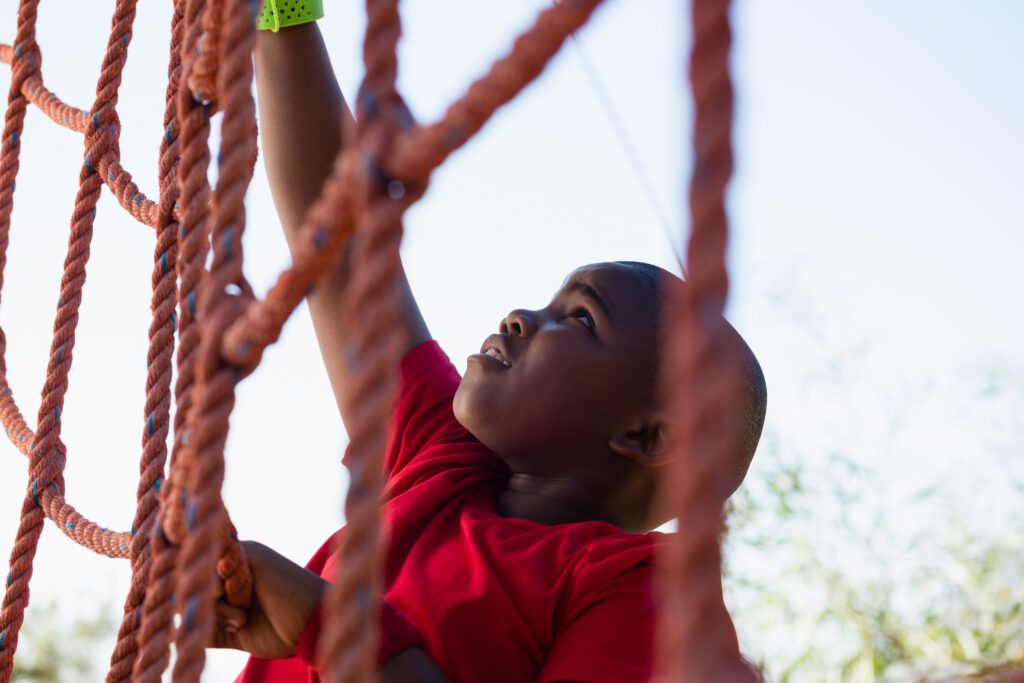
Boy climbing a net during obstacle course training

from Tomorrow’s Child – The Montessori Family Magazine – September/October 2021

By Peter Pizzolongo

Facing risks is an unavoidable part of life for most adults. So, why do we choose to take risks? Is it for the sensational thrill of trying something new or the tenacious hope that new opportunities will present themselves? Sometimes, maybe, we choose to take a risk just to exhibit a show of confidence. Whatever the reason, the lessons we learn from taking a risk have the potential to lead us on a new path (Rolison 2013) (Zeilinger 2017).

Learning to assess a risk is an essential skill for living.

The ability for adults to take calculated risks has its roots in early childhood. Yet we are in an era of limiting risk taking by children. Most parents (and caregivers of young children) worry about children, wanting them to stay safe—so they resort to limiting the risks that children take. “We are a nation of pushy helicopter parents, . . . waiting below our children on the monkey bars in case they should slip” (Bilinco 2015). By keeping our children ‘safe,’ are we inadvertently preventing them from learning how to calculate risks on their own?

The benefits of taking safe risks.

It is important for children to learn how to take safe risks, i.e., “situations that a child can perceive and choose whether or not they want to participate” (Keeler 2020). Risks that are not safe, aka hazards, are “truly dangerous for a child: situations or objects that the child does not see, cannot make a logical choice about, and that have a definite chance of hurting them.” As Rusty Keeler reminds us in Adventures in Risky Play: What is your yes? Risk is good… Risk is a natural part of life. In fact, learning to assess risk and deciding if you want to take a risk are essential skills for living” (Keeler 2020).

Children engage in play that involves taking risks to experience positive emotions, including: fun, enjoyment, thrill, pride, and self-confidence (Sandseter 2011). In risky play, children “dose themselves with manageable quantities of fear and practice keeping their heads and behaving adaptively while experiencing that fear” (Gray 2014). When a child takes a risk and attempts something outside her comfort zone, she uses the higher-order thinking skills of application and synthesis—applying what she knows to new situations (Church 2020).

The ability to calculate and take risks supports children’s learning in many ways. Taking risks develops and enhances a child’s self-confidence and ability to manage and overcome fear. Risk-taking promotes the kind of play that involves children’s use of problem-solving skills, self-regulation, and reflection. I would consider what helped me succeed. If the experience did not end as I expected, I would try to figure out what failed.

The ability to calculate and take risks supports children’s learning in many ways.

In “The Role of Risk in Play and Learning,” Joan Almon notes, “play means taking risks . . . Children are constantly trying out new things and learning a great deal in the process.” This is most evident in the risk-taking that children engage in as they use their muscles and senses in physical activities. When children are encouraged to take safe risks, they learn to assess what they can do and match that with activities that have an element of risk.

Children think about how high they can climb, from what height they can jump, and so on. They might find that what they were attempting is not possible and use problem-solving skills to try an alternative. These children are developing and using resilience; they will determine what they need to do to succeed or decide to abandon the task. Through taking safe risks, children “acquire better motor control and learn what is dangerous and what isn’t” (Sandseter 2011). A preschooler encountering a pile of logs might investigate how secure the logs are on the ground and decide whether she can climb on the pile or not. She is learning how to manage risk and develop an understanding of safety (Knight 2011). Taking risks while building physical skills is an important component of development and learning for young children.

The Role of Teachers

Recognizing the general processes of children’s development and learning in all areas is vital. It is the parent’s and teacher’s responsibility to identify the safe risks vs hazards and to set clear and reasonable limitations so that children understand what they may and may not do in the play environment.

Taking risks while building physical skills is an important component of development and learning for young children.

Understanding Developmentally Appropriate Practice is Key

Understanding developmentally appropriate practice is key: recognizing the general processes of children’s development and learning in all areas. In addition, they must consider the strengths, interests, and limitations of each child and be aware of the social and cultural contexts in which each child lives (NAEYC 2020). They must also “up the ante” when they discern children are ready for bigger challenges.

The two examples below show the difference between what is appropriate for a toddler and what is appropriate for a preschool child.

Eighteen-month-old Darius is beginning to use depth perception in his play. Today he demonstrated how he scans for obstacles and moves based on that information. He has gained control of a variety of movements: stooping, going from sitting to standing, running, and jumping. Darius shows an understanding of what size openings are needed for his body to move through, and today he successfully crawled through the tunnel.

Toddlers develop their physical abilities by continuously stretching themselves. Darius has learned (probably through trial and error) what size opening he can fit through. As toddlers freely navigate their relatively safe and supervised environment, they begin to figure out what are reasonable risks to take.

Four-year-old Ximena enjoys balancing on one leg and on the balance beam. Today she walked the entire length of the balance beam and ended by jumping off and standing on one leg for a few seconds. She coordinates her movements when jumping, hopping, and running. Ximena has mastered several large muscle skills, and after her jumping-hopping running experience, she climbed the ladder and slid down the slide—several times.

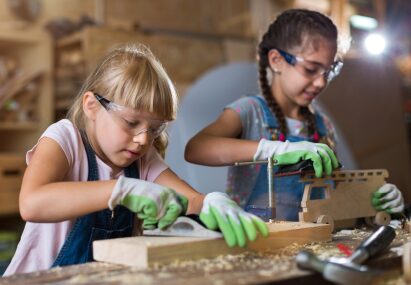
Preschoolers are adept at responding to physical challenges when such experiences are promoted. They can reach great heights on the climber, dangle upside down, and move from rung to rung with increasing ease. They can climb trees, cycle at fast speeds, and engage in ‘play fighting’ without actually hitting each other. They can balance on a beam, set increasingly higher as children begin mastering balance. They can climb up the slide, rather than only using the steps. Preschoolers can figure out how to get across a shallow creek using rocks and logs. With adult supervision, they can also begin to take risks at the fine motor level, for example, slicing fruits with a sharp paring knife.

What is your risk tolerance?

As a parent and/or teacher, you will need to determine your own tolerance to risk. What type of risky behaviors are you willing to let children engage in? If you have low risk tolerance when it comes to children’s play, it would be helpful to review expectations for young children at various stages of development and think about what children would like to do to ‘up the ante’. Then, recognizing that children are stretching themselves, your primary role “is to enable the stretching process to be manageable and safe enough . . . to help [children] to take reasonable risks” (Almon 2013).

Finally, the role of the teacher is to help children be aware of their actions and encourage safe risk-taking. Here are some examples, adapted from NAEYC’s Developmentally Appropriate Practice:

• Encourage children to choose their own learning activities: “We have several activities set up in the outdoor area today. You can choose what you want to do first.”

• Acknowledge children’s activities:

“You’re building with a lot of loose parts today!”

• Encourage them with specific feedback:

“Wow, you are certainly climbing higher today than I’ve seen you climb before!”

• Ask open-ended questions: “If you want to cross the creek, what will you need to step on so you stay dry?”

• Pose problems and ask questions, providing just enough assistance so the child can attempt a task at a skill level just beyond what she can do on her own (scaffolding): “You’ve been somersaulting down this hill. How else can you get from the top to the bottom of the hill?”

Supporting children as they explore ways to take safe risks sets them on the path to becoming adults who develop the confidence that comes from assessing risks and determining a course of action they learn from taking risks and who explore the opportunities to which risk-taking can lead.

References

Almon, J. 2013. “The role of risk in play and learning.” Community Playthings. Online: http://www.communityplaythings. com/resources/articles/2013/ the-role-of-risk-in-play-and-learning.

Blincoe, K. 2015. “Risk is essential to childhood—as are scrapes, grazes, falls and panic”. The Guardian. Online: https://www. theguardian.com/commentisfree/2015/ oct/14/risk-essential-childhoodchildren-danger?fbclid=IwAR0CZE vfmAN0udIDxWrI9xQHfob4QYM DT_R4eDpdLBvUInIkQutU0LNCapc

Church, E.B. n.d. “When to challenge children.” Early Childhood Today. Online: https://www.scholastic.com/ teachers/articles/teaching-content/ when-challenge-children/.

Gray, P. 2014. “Risky play: Why children love it and need it”. Psychology Today. Online: https://www.psychologytoday. com/us/blog/freedom-learn/201404/ risky-play-why-children-love-it-and-need-it.

Keeler, Rusty. 2020. Adventures in Risky Play: What Is Your Yes? Lincoln NE: Exchange Press.

Knight, S., 2011. “Why adventure and why risk in the early years?” ChildLinks. 3. Online: https://www.researchgate.net/ publication/275039981_children’s_ risky_play_in_early_childhood_education_ and_care.

National Association for the Education of Young Children (NAEYC). 2020. Developmentally Appropriate Practice. Washington DC: NAEYC. Online: dap-statement_0.pdf (naeyc.org) Rolison, J.J., Y. Hanoch, S. Wood, & P. J. Liu. 2013. Risk-taking differences across the adult life span: a question of age and domain. Journals of Gerontology, Series B: Psychological Sciences and Social Sciences, 69(6), 870–880, doi:10.1093/ geronb/gbt081. Online: https:// academic.oup.com/psychsocgerontology/ article/69/6/870/545646.

Sandseter, E. 2011. “Children’s risky play in early childhood education and care”. ChildLinks. 3.

Zeilinger, J. 2017. “7 reasons why risk-taking leads to success”. The Huffington Post. Online: 08/13/2013 03:15 pm ET Updated Sep 25, 2017

Peter Pizzolongo is President of Early Education Consulting and former Vice-President of the Delaware AEYC Governing Board. He has held the positions of Training and Technical Assistance Coordinator of the National Center on Early Childhood Education, Teaching, and Learning (NCECDTL) at Zero to Three; Associate Executive Director for Professional Development at NAEYC; and Director of the Analytical Support and Technical Assistance Services Division of CSR, Incorporated—a social sciences research and management support firm. He has over 30 years of experience as an author; training and technical assistance provider; program evaluator; Head Start and childcare agency administrator; teacher; and human services program manager. Mr. Pizzolongo has authored or co-authored more than 30 publications, digital programs, and other resources. He has conducted training programs on numerous topics, including child development; early childhood education; developmentally appropriate practice, ethics; developmental assessments; health and mental health; nutrition; parenting; and program evaluation. Mr. Pizzolongo has been a member of the University of Delaware (UD) College of Education and Human Development Dean’s Advisory Council since September 2015. He received his B.A. in psychology in 1972 and his M.S. in human resources with a child development major in 1974, both from the University of Delaware and coursework in the use of technology in education programs from the University of Maryland.
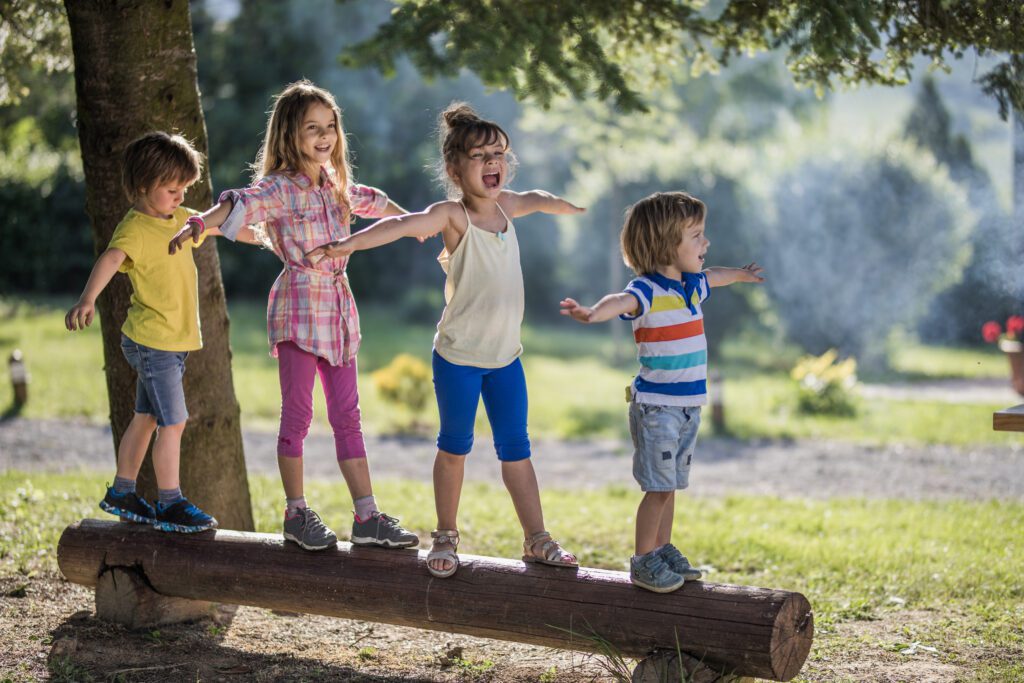
 

Group of small kids walking on a tree trunk in nature.
7 Practices to Develop Character

7 Practices to Develop Character

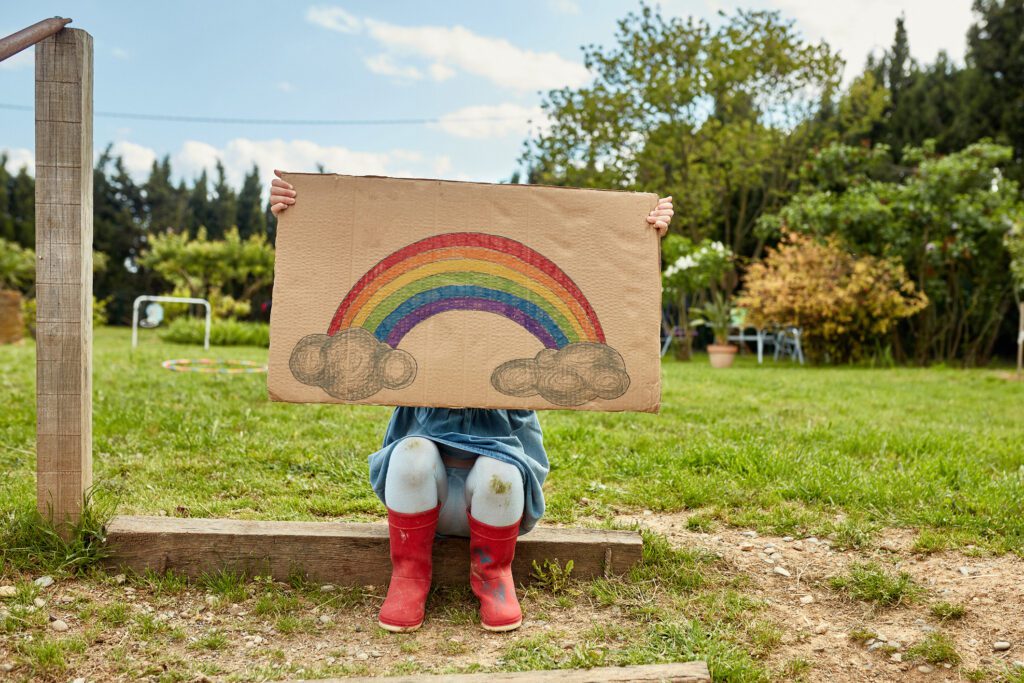
Portrait of Preschool Age Girl Holding Rainbow Sign of Hope

from Tomorrow’s Child – The Montessori Family Magazine – September/October 2021

by Cassi Mackey, M.Ed.
We want to raise our children to be great human beings, but how do we develop strength of character in our children? According to Dr. Montessori, “Character formation cannot be taught. It comes from experience and not from explanation.”

Centering strong character traits in your family through modeling, experiences, and conversations is the foundation of developing strength of character. Practicing character is a daily decision that needs to be made, time and time again. Practice brings permanence if it is purposeful and deliberate.

What follows are seven practices in helping children start to develop strong character.

Practicing Integrity

• Model integrity. Live your values. Do your actions and words reflect your family values?

• Articulate your family values so they become a natural way of thinking and behaving.

• Develop a moral vocabulary. Children need to understand words, such as honesty, trust, fairness, integrity, etc. Teach children behaviors that embody these words.

• Acknowledge children when they are demonstrating integrity, not rewarding them but acknowledging them by telling them how much you value their behavior.

• Discuss and give examples of the effects your child’s actions have on themselves and on others.

• Respond to children’s behavior with calmness and consistency. Be open to listening to your child’s reasoning for an action before instinctually admonishing and correcting, then remind them of the expectations and decide on a natural consequence that is consistent and clearly understood.

Practicing Kindness

• Model kindness. Children learn how to relate with others by observing the adults around them and how they treat other people. Show them what it means to be kind and name the action as kindness.

Try to always speak kindly to your children, especially when you are tired, frustrated, or angry.

• Share stories of kindness, whether personal stories, stories in books, stories on the news, etc. Stories are a wonderful way of building an understanding of kindness.

• Assess the teasing in your household. Is it demeaning, provoking, or humiliating?

Remember, children learn how to play and interact with peers by their own experiences at home.

• Discuss how their behavior affects those around them, whether it is positive or negative.

• Give your children opportunities to serve others. Show them that holding a door open for someone, smiling and saying hello, and thanking the cashier, are all demonstrations of kindness.

• Expect kindness when your child speaks to you. When your child speaks to you rudely, simply state how you would like to be talked to. Do not get into an exchange with them, just simply state your preferred specifics of communication. Be consistent.

Do not let poor tone or attitude slide.

Practicing Positivity

• Model being positive. Take the time to monitor how you present your life experience to your children. Do they hear you regularly speaking positively or negatively?

Try to point out the good side of events and experiences.

• Address failure as an opportunity for growth. Help your children self-evaluate situations. Ask the questions: What went well and what would you change if you could? Encourage your child to develop a plan of action to effect change the next time around.

• Challenge your children when they are personalizing (“It was all my fault”) globalizing (“I always make mistakes”), or catastrophizing (“I will never do anything right”). You do not have to contradict your children’s explanation, but encourage them to come up with positive outcomes to the situation.

• Encourage children to set their own goals and think through how they plan on achieving them. This process gives them agency and a sense of competence that often leads to success. Encourage them to focus on the best possible outcomes and, as such, they will align their thoughts in that way and work toward achieving the outcome they want.

Practicing Gratitude

• Model gratitude. Make it a habit to notice and verbalize the things for which you are grateful.

• Ask your children questions to help them start to notice things that deserve gratitude: What have you noticed today that you were given that you are grateful for? and, Are there things in your life that you are grateful for that aren’t gifts or material things?

• Create space for conversations regarding how they feel when they receive something (including non-material things).

Help them associate positive feelings with someone else’s actions. As often as possible, highlight the idea that people and events can give us good feelings.

• Teach gratitude through action. Ask your children if there is a way that they would like to show how they feel about a gift, an event, or a person. Children can use their special talent or interest, for example, and make up a song and/or paint a picture to express their gratitude.

Practicing Flexibility

• Model flexibility. Tell children when and how you are being flexible as things come up throughout the day, whether as part of a minor or major event. Explain how you are being flexible and, when appropriate, involve children in the new plan. the routine at home every once in a while, helping them become accustomed to managing change.

• Change the rules to board games; start out with small changes, so they can see how they can adjust. Then, make more changes.

• Give positive reinforcement when your children demonstrate flexibility and change their course of action.

• Teach your child strategies to take when a change occurs. Teach them to stop and breathe, state the problem, consider at least three possible solutions, then select one to try.

Practicing Effort

• Model effort. Show your willingness to take risks and try new things, even when they are hard.

• Acknowledge effort, bravery, risk-taking, open-mindedness, and keeping a positive outlook.

• Teach children to monitor their effort.

Help them reflect on whether they gave their best in an activity.

• Help children recognize and celebrate their effort by asking them, What was something you did today where you felt proud of how hard you tried?

• Make it easy to work hard by preparing the environment with the tools they need to succeed with a task.

• Help your children work through challenges by modeling self-talk. Children can learn how to persist if they talk out the problem, coupled with positive self-talk.

• Show your children the progress they have made. Remind them of where they started and how far they have come.

Practicing Accountability

• Model personal accountability. Demonstrate accountability by apologizing and making amends when necessary. You will show your children you are responsible for the consequences of your actions.

• It is important that your children know exactly what is expected of them and the consequences of not meeting expectations.

They also need to know what is non-negotiable and what is open for discussion and mutual agreement.

• Allow your children to be responsible for their actions. Even a three-year-old can clean up a spill; spilling is normal, but cleaning up the spill is also normal.

• Parents should not point fingers or make children feel defensive about behavior.

They should acknowledge when a child owns up to a mistake, and help them come up with a solution on how to make amends; and do something differently next time.

• Give children age-appropriate choices and chores.

• Encourage children to participate in decision-making to develop accountability.

The road to strong character is paved with practice. It is a journey, and it is going to have ups and downs. The term practicing is not inadvertent. Have patience and remember what your ultimate goal is for your child. 

Cassi Mackey, M.Ed. is passionate about helping families create sacred spaces where love, joy, and honest connections are nurtured. Cassi has witnessed the transformational power when families engage in Montessori philosophy as an imputable practice. It is a promise of more meaningful relationships, greater depth of experience, and a broader, more compassionate view of oneself and the world. Cassi has lived, learned, and taught the Montessori pedagogy for the last 30 years as a Montessori 9-12 teacher, a school principal, and a consultant. She consults with (and provides advice to) Montessori communities and families that are intent on providing safe harbors for children. Contact Cassi via email at: cassimackey11@gmail.com.

practical life

Peacemaking Circles

Peacemaking Circles

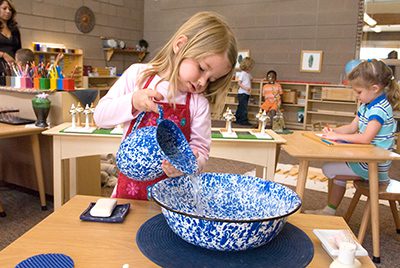
Toward Best Practice: The Exercises of Practical Life

Toward Best Practice: The Exercises of Practical Life

Montessori, Darwin and Telling The New Story Of Evolution

by David Loye In the beginning there was the Domination System and the Organism. Then the Love System entered life and meaningful Evolution began… This is the disarming and I hope engaging way my telling of the new story of the new story of evolution begins. Behind it lies a long unknown connection between the theories of Charles Darwin and Maria Montessori that a startling new reconstruction of Darwin’s theory reveals. As has long been evident to anyone familiar with standard Darwinism and Montessori their theories as taught throughout the 20th century have been poles apart. Surely nothing could be farther from Montessori’s approach in her original rescuing of Italian slum children than the stereotypical keystone ideas for standard Darwinism of “survival of the fittest” and the supremacy of selfishness, or the idea of “selfish genes” popularized by ostensibly Darwinian sociobiologist Richard Dawkins. Yet what happens if, at last, we are confronted with the startling but incontestable fact that in The Descent of Man Darwin actually wrote only twice of “survival of the fittest” – once to apologize for actually ever using the term. So what does he write of? 95 times of love! 92 times of moral sensitivity! And 200 times of brain and mind! Morever, in designating what in contrast to the origin of species advances human evolution, he specifically says natural selection (i.e., survival of the fittest) drops off in importance at our level of emergence and “other agencies” become more important. And what are these other agencies? Above all, Darwin wrote in hundreds of editions of his book in a majority of the languages of this earth for scientists, educators, and all the rest of us to read – but ignore – for over a century, are “the moral qualities.” These, Darwin said, are “advanced, either directly or indirectly, much more through the effects of habit, by our reasoning powers, by instruction, by religion, etc., than through natural selection.” As an educator via classroom but much more so by the books I have written over many years, I personally find this Darwin to be clearly in the tradition articulated by Montessori as well as by Pestalozzi earlier, and by Dewey, Piaget, on up to morally oriented, progressive and holistic educators such as Nel Noddings and Ron Miller in our time. But while this discovery of the “new” Darwin is startling and encouraging, what we now do with it is a far more important matter. Indeed, it is, I am convinced, a matter bearing on whether our species is to live up to and fulfill its incredible potential, or —as thousands of species have before us and currently — eventually fall by the wayside in evolution. A vital scientific challenge is to wed the two halves of Darwin’s theory. For that is what now confronts us. On one hand is the vital first half described in Origin of Species for laying a good part of the foundation for evolution. But on the other is the completing half for his theory, this thrilling superstructure in tune with progressive spirituality, progressive philosophy, progressive science, and progressive education over by now thousands of years. As I develop at length elsewhere, underlying both Darwin and the work and theories of a long stream of great thinkers including cultural evolution theorist Riane Eisler in our time there lies, in basic systems terms, the maturational sequence and interaction of a Domination System and a Love System. And what is the challenge for education? Most of us have been forced to teach only the destructive Darwinian first half for over a century. But having been unwitting collaborators, what can we do now to make up for this now? One way is to get behind the effort of the newly formed Darwin Project. With a Council of over 50 American, European, and Asian scientists and educators, our goal is to shift teaching at all levels of education, as well as globally throughout the power of the media, from a disastrous focus solely on Darwin’s first half to the prohuman, prosocial, and clearly progressive emphasis for Darwin’s completion of theory. Here one of the most effective things the Montessori movement, with its international scope, can help pioneer is the telling of the new story of evolution which weds both halves. The Great Adventure The new website for The Darwin Project (www.thedarwinproject.com) outlines the challenge and, in many ways, the prospects for pioneering educators. Specific to the opportunity for the Montessori movement is the “Great Adventure” segment of the website and component “Telling the New Story.” Going by how Darwin’s perception of the Love System was suppressed for a century, we can begin to see how long it takes to change anything in science if it bumps up against an established paradigm. It is evident then that normally wedding the two halves could take science another century. Going then by how long it takes for what is written in scientific language about anything really new to be translated into and widely published in the everyday language we all use, we may add another fifty years or so. Then of course beyond all that are the schools. Once such a project got this far one must add another forty years or so of committees and school boards to decide whether this odd and controversial new hybrid thing of a theory of human evolution involving so subversive a matter as love, as well as the more serviceable matter of domination, is suitable for the instruction of the young. Then one must add another thirty years for consultants to assess and parcel it out by grade levels for the curricula. As it is evident we no longer have a century to waste in this way— indeed quite possibly less than a decade—I have gone ahead and wedded the two halves into what, out of now many years involvement in evolution theory and education, into what I believe is as close as presently possible to the full and true story of human evolution. The aim is to provide teachers with a story line that can be adapted for use anywhere along the line for K-12 into college and graduate studies. The idea is not to set this forth as some inviolable and forever enduring integration of theory and story, but just to get the full story down in one place and for a teacher to read, and think about, and then rework to present at one’s particular grade level. One would start with the easiest part for the earliest level, then work up by stages, so that by the time students reach college they would possess the whole story and theory from which to launch out on their own. What follows here is a sampler for the opening of what in its entirety will be available for free downloading from the Darwin Project website by the time this article is published. As you read, please keep in mind this is not the actual telling of the story, which is up to you, but merely the meta-story, or story line for individual shaping. Telling the New Story In the beginning there was the Domination System and the Organism. Then the Love System entered life and meaningful Evolution began… A good place to start is to think of what was mostly taught and thought for a whole century to be the whole picture for the Darwinian theory and story of evolution, then ask ourselves what is the story that now emerges from a melding of the old with the new. If we look at both Origin and Descent carefully in relation to one another, and also at precisely when they emerged within the pattern of Darwin’s creative life, it is evident we are looking at a perspective on human evolution based on his perception of three primary entities, forces, or—in the most useful term we use in science today— systems at work in the lives of our species over thousands of years. Out of the creativity of the middle years of his great fame and immense impact on the lives of all of us, there is the Domination System he wrote of in The Origin of Species. Out of the creativity of his early and final years— as will be detailed in Darwin’s Unfolding Revolution, the key book for this website section also to be available for download— there is the Love System he writes of in The Descent of Man. And then there is the third, most vital part of all, the major player in this drama on which he actually focused from beginning to end, but which again was very close to also being ignored: the Organism. There is this life form for every living thing, plant or animal, from the earliest point in the emergence of life on this earth, to all creatures living today from the smallest to the largest. There is this life form that includes ourselves, as the species with the most advanced brains and greatest capacity to change things around on this earth— therefore the species not only with a clear evolutionary responsibility for the well being of all other life forms as well as for the earth itself, but also the only species capable of recognizing and acting on this responsibility. This puts the weight on us to approach the question of how we are to tell the new story as more than a matter of entertainment, or of only trying to get the science right. It says squarely—to repeat what certainly bears repeating, as it is all too easy to flinch and turn away—that it is up to us to get clear on this story as a bedrock matter of species survival. And then as parents, teachers, writers, activists, as well as scientists and other scholars concerned about gaining the better life for us all, to as widely and as quickly as possible start telling this story to try to save us from ourselves by speeding up the process of our evolution. Here we see a basic sketch for the three primary systems I touched on in the two stage-setting lines which head and open our story, to which I will refer to as we move along. IMAGE 1 Here is the fiercely self-protective “closed mind” of the Domination System in contrast with the still formative and venturing “open mind” of the Love System—and the wiggly lines of their differing impact on us, as well as the wiggly lines of our impact (or lack of impact) back on them. I have purposely left this and all successor sketches in their squiggly homespun “natural state,” just as I drew them, in order to give the flavor of something drawn quickly on a blackboard. My goal is to encourage the teller of the new story to, as much as possible, use the quick, hand drawn pictures many of us naturally resort to. There is something about how the fact of a hand moving in tandem with a mind can engage others better than the best of professional drawings or slides, which risk the sterile “uptown” polish that signals to some readers “this is dead, finished and 7 intimidating, so skip on.” The Domination System, the Love System, and the Organism But one must be careful here. The true story of human evolution—that is, of the evolution of all species up to, reflected within, and including ourselves—does not begin with abstractions such as these or any others at this level of thinking. Nor does it begin, as in the old theory and the old story, with the grim, foreboding weight of Natural Selection as this large mysterious force external to ourselves. Why was this the ominous emphasis for the old story? Within this new approach to telling the new story an important reason could be what comes to mind if we look at ourselves in relation to all other life on this planet, over the 100,000 years of our rise as the species homo sapiens sapiens. It would seem that because of our situation on this earth as the chief thinking representative for all other organisms, in the way the mind works, inevitably we were driven to seek large, mysterious ideas to account for the haunting mystery of where we came from, who we really are, and where we may be going. This certainly seems to be why for centuries before Darwin this space in mind was filled with either the fearful or the comforting idea of God. But with the success of Darwin’s Origin of Species— as scores of ministers discerned and decried at the time—the idea of Natural Selection began to shove God out of that place for the Big Answer. In further looking at our situation over the past century from the perspective of systems psychology, I am convinced that within the unconscious of the Western educated man and woman the hole in mind this displacement left behind came to be filled with two kinds of patterns for thought that have worked against us. One is what I identify in the article “Montessori, Darwin, and Human Evolution” in Montessori Leadership as the “bog holes” of PseudoDarwinian Mind—i.e., the powerfully compelling but distorted partial reading of reality rising from Origin of Species or “first-half” Darwinism, such as the governing idea that as all life involves “the war of all against all” or “survival of the fittest.” This is a complicated matter that many teachers will not want to fool with, nor will most students short of college and graduate school be equipped to deal with it. So I leave it to others to figure out where and how to best fit in this vital aspect of underlying systems dynamics and what can become the stranglehold of paradigm on our minds. This leaves us with the question of what to do with first half Darwinian science’s nightmare creation of Natural Selection as the main or even sole over-riding explanation for evolution. The history of many centuries and the psychology of the last few has repeatedly shown us that whatever we may find or teach is in the end a small chink of knowledge tossed into the vast boiling pot of much else working within and shaping the minds of our time. So it was I believe that during the 20 th century within the unconscious of the nonscientist as first child, then adult, there also came to exist within the hole for the Big Answer an unsettling picture linked to the powerfully enduring image of Mary Shelley’s Frankenstein’s monster from earlier. IMAGE 2 Here we see Natural Selection as this giant invisible force that strides among us, occasionally reaching down to pick and choose and gobble us up as though we are no more than the food that it may arbitrarily eat now, or let us go for later, as though saving us for desert. This, I suggest, is a sketch for the psychic bugaboo of Natural Selection in pursuit of Variation that operates today in unconscious mind of millions of us. It is obviously the connection with no place in the education of the child, which for many vital reasons must be sheltered and protected as long as possible. But by the time the late teen-ager is beginning to contemplate the responsibilities of adulthood, it can become meaningful to that cohort of the particularly bright, caring and courageous upon whom the better future for our species depends. For then it can become crucial they understand how this gift of misguided modern science came to reinforce the dark earlier gift of regressive religion in the abysmal figure of a vicious deity who must be placated with blood sacrifice—which drives the terrorists and more generally still exists in the unconscious of other millions of us on this planet. Important this fledgling leadership cohort understand, yes. But most important they are encouraged by the great teacher to go on beyond understand to decide what they personally are going to do about it. . . L’Envoi And so the new story goes on our website: on and on through first half and second half with my sketches and guesses as to what parts could be best to bring in early in a child’s education, and where it’s best to wait until later, on into graduate school. As one can see from this sample, this is an idea in much need of thinking through for presentation from the Montessori perspective. I hope this is enough to encourage creative Montessorians to pursue this new telling of the story of human evolution by going to our Darwin Project website (www.thedarwinproject.com) and downloading the rest of the story, or rather, the story line, and going to work on it. I hope, too, I have begun to convey how extremely important this pioneering contribution by Montessorians could be to the advance toward the better world that the first woman in Italy to gain her medical degree set in motion, really not so long ago as evolution goes.