To access this page, you will need to log in or become a member.

by Biological Diversity | Archived Issues / Tomorrow's Child, Early Adolescence (12-15), Empowerment, Family Resources, Health / Nutrition, Later Adolescence (15-18), MFA, Montessori Family Life, Nature, Outdoor Education / Resources, Peace Education, Tomorrow's Child
Every day we make choices in our lives that affect the environment, the climate, and other species. Here’s how you can ‘choose wild’ and reduce your environmental footprint to leave more room for wild animals and plants.
1. Think twice when shopping. Before you buy something new, ask yourself if you really need it. If so, consider buying gently used and look for minimal packaging.
2. Boycott products that endanger wildlife. Avoid places that sell products from threatened species, such as sushi restaurants that sell bluefin tuna, and look for products made from sustainable materials that don’t endanger the habitat.
3. Take extinction off your plate. You have three chances a day to reduce your environmental footprint by eating less or no meat. Eating locally sourced fruits and vegetables also lowers the amount of fossil fuel used to transport food over long distances.
4. Pay attention to labels. Choose Fair Trade certified goods and buy organic food whenever possible. If you’re a coffee drinker, look for “shade-grown” coffee.
5. Make sure big purchases have big environmental benefits. Look for the Energy Star label on home appliances and look for more fuel-efficient car models.
6. Be water-wise. Skip the bottled water. Conserve water by taking shorter showers, fixing leaky toilets, and choosing low-flow or low-water appliances.
7. Ditch the plastic. Cut down on plastic waste by shopping with reusable bags, ditching one-time-use water bottles, and avoiding products made from, or packaged in, plastic.
8. Drive less, drive green. Walk, bike, carpool, or use public transportation whenever possible. Combine errands to make fewer trips and keep your car in shape with regular tune-ups and tire inflations.
9. Choose a smaller family. With more than 7 billion people in the world, we’re not leaving much room for wildlife. We need to talk about human rights, overconsumption, and choosing a better future for wildlife, the planet—and us.
10. Green your home. Improve your home’s energy efficiency with adequate insulation, energy-saving windows, and a programmable thermostat. Call your energy provider to see if it offers free energy audits and efficiency incentives or knows of a company that does.
11. Choose renewable energy. If your state allows you to pick your electricity supplier, use a Green-e certified company. Explore the options—and tax credits—for installing solar in your home.
12. Use your voice and your vote. Vote for candidates with strong environmental platforms and urge them to pass policies that protect the environment and wildlife. Sign and share action alerts, and talk to your friends about endangered species protection and the need to address human population growth and overconsumption.
Learn more:
www.biologicaldiversity.org/population_sustainability
Facebook: Facebook.com/PopulationSustainability
Twitter: @choosewild
Instagram: @CrowdedPlanet
Retrieved from http://www.biologicaldiversity.org/programs/population_and_sustainability/sustainability/pdfs/12WaysToLiveMoreSustainably_factsheet.pdf
Tomorrow’s Child/ November 2017/ Pg 26
by Mayo Clinic | Archived Issues / Tomorrow's Child, Emotional Intelligence (EQ), Emotionally Healthy Children, Family Resources, MFA, Montessori Parenting, Parenting on the Same Page, Tomorrow's Child
After a tragedy, you might feel helpless—but your child needs your support. Here’s help knowing what to say.
When a tragedy—such as a natural disaster, mass shooting, or terrorist attack—occurs, it can be hard to talk to your child about what happened. How do you explain it? How much will he or she understand? Find out how to start the conversation and what you can do to help your child cope.
Do I need to talk to my child about a tragedy?
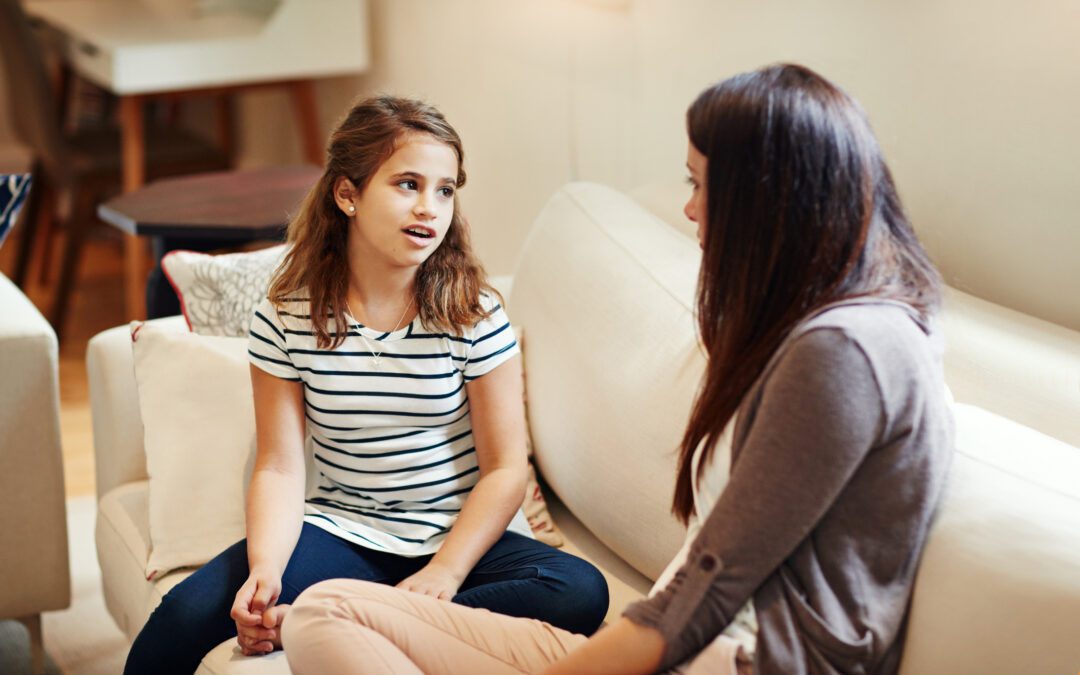
Talking to your child about a tragedy can help him or her understand what’s happened, feel safe, and begin to cope. If you don’t speak to your child about a tragedy, there’s a chance that he or she might hear about it elsewhere.
How do I start a conversation with my child about a tragedy?
Take time to think about what you want to say. If possible, choose a time when your child is most likely to want to talk, such as before dinner. Ask your child what he or she already knows about the tragedy—and what questions or concerns he or she might have. Let your child’s answers guide
your discussion.
How do I explain the tragedy to my child?
Tell the truth. Focus on the basics, and avoid sharing unnecessary details. Don’t exaggerate or speculate about what might happen. Avoid dwelling on the scale or scope of the tragedy.
Listen closely to your children for misinformation, misconceptions, and underlying fears. Provide accurate information. Share your own thoughts and remind children that you’re there for them. Reassure children that what happened isn’t their fault.
Children’s age will affect how they process information about a tragedy. Consider these tips:
Preschool children. Get down to children’s eye level. Speak in a calm and gentle voice using words they understand. Explain what happened and how it might affect them. For example, after a severe storm you might say that a tree fell on electrical wires and now the lights don’t work. Share steps that are being taken to keep everyone safe and give hugs.
Elementary and early middle school children. Children in this age range might have more questions about whether they’re truly safe. They might need help separating fantasy from reality.
Upper middle school and high school children. Older children will want more information about the tragedy and recovery efforts. They’re more likely to have strong opinions about the causes, as well as suggestions about how to prevent future tragedies and a desire to help those affected.
How might my child react?
After a tragic event, children might experience a range of emotions, including fear, shock, anger, anxiety, and grief. Age will affect how they handle the stress of a tragedy. For example:
Preschool children. Children in this age range might have trouble adjusting to change or loss. They might become clingy or mimic your emotions. Some children might also revert to wetting the bed or sucking their thumbs. Avoid criticizing this behavior.
Elementary and early middle school children. Children in elementary and early middle school might have nightmares or other sleep problems. They might fear going to school, have trouble paying attention in school, or become aggressive for no clear reason.
Upper middle school and high school children. Older children might deny that they’re upset. Some children might complain of physical aches and pains because they’re unable to identify what’s really bothering them. Others might start arguments or resist authority.
These reactions are normal. However, if children continue to display these behaviors for more than two to four weeks, they might need more help coping. If your child has experienced previous trauma, remember that he or she might be at greater risk of a severe reaction. If you’re concerned about your child’s reaction, talk to a mental health provider.
What can I do to help my child cope?
You can take steps to help your child process what happened. For example:
Remain calm. Children will look to you for cues about how to react. It’s OK for children to see adults sad or crying, but consider excusing yourself if you’re experiencing intense emotions.
Reassure children of their safety. Point out factors that ensure children’s immediate safety and the safety of the community. Consider reviewing your family’s plans for responding to a crisis.
Limit media exposure. Don’t allow young children to repeatedly see or hear coverage of a tragedy. Even if your young children are engrossed in play, they are likely aware of what you’re watching and might become confused or upset. Older children might want to learn more about a tragedy by reading or watching TV. However, avoid repetitive loops of news information once you have the facts. Constant exposure to coverage of a tragedy can heighten anxiety.
Avoid placing blame. If the tragedy was caused by human violence or error, be careful not to blame a cultural, racial or ethnic group, or people who have mental illnesses.
Maintain the routine. To give your child a sense of normalcy, keep up your family’s usual dinner, homework, and bedtime routine.
Spend extra time together. Special attention can foster children’s sense of security. Spend a little more time reading to them or tucking them in at night. If your children are having trouble sleeping, allow them to sleep with a light on or to sleep in your room for a short time. Extra cuddles might help, too.
Encourage the expression of feelings. Explain that it’s OK to be upset or cry. Let children write about or draw what they are feeling. Physical activity might serve as an outlet for feelings or frustration. If they are acting out, explain that there are other ways of coping.
Seek out school resources. If their school offers counseling after a tragedy, take advantage of the opportunity to meet with a counselor.
Do something for those affected by the tragedy. Consider ways that you and your child can help victims and their families. You might take your child to your place of worship or write thank-you notes to first responders.
What else can I do?
It might be the last thing on your mind, but caring for yourself after a tragedy is important. Pay attention to your own feelings of grief, anger, or anxiety. Lean on loved ones for support or talk to a mental health provider. Get enough sleep, eat a healthy diet, and stay active. Taking care of yourself will enable you to care for your child and serve as a role model for how to cope.
Retrieved from http://www.mayoclinic.org/healthy-lifestyle/childrens-health/in-depth/helping-children-cope/art-20047029?pg=1
Tomorrow’s Child/ November 2017
by Joyce St. Giermaine | Archived Issues / Tomorrow's Child, Emotional Intelligence (EQ), Empowerment, Family Resources, MFA, Montessori Parenting, Tomorrow's Child
It has been a long, challenging few months for many of us in the Americas and around the world. Along with an unusually active and violent hurricane season, earthquakes, wildfires, and flooding, we have watched in horror as gun violence, terrorism, and the threat of nuclear war have taken a very disturbing uptick.
In this issue, we have included some information on helping children cope with the aftermath of disasters, natural and human-made. We have also included some information on environmental sustainability because we all need to pay attention, even if it no longer seems to be a priority project for all leaders of the world.
The voices and efforts of Montessori parents, teachers, and students are more important now than ever. Without action, the words to victims and survivors, that they “are in our thoughts and prayers” are empty. This strung-together expression of condolence no longer provides comfort; instead, in my opinion, it has become an over-used excuse for the inability or unwillingness to take personal and governing responsibility.
What we do and say matters to the children in our lives.
Be their voice.
Peace,
Joyce St. Giermaine, Editor
PS: For those of us living in the US, should you want to know where to start, here’s a link to the people who represent you at the state and national level: https://www.usa.gov/elected-officials.
PPS: For many years, we’ve provided a free print subscription to every school in our database within the US and Canada. To help with saving some trees, we are discontinuing this practice and encourage those schools that wish to continue reading our magazine to consider ordering a membership.
Tomorrow’s Child/ November 2017
by Lorna McGrath | Book Reviews, Family Resources, Language, Lower Elementary (6-9), MFA, Upper Elementary (9-12)
To continue reading, you will need to choose a subscription plan.
by Lorna McGrath | Book Reviews, Family Resources, Lower Elementary (6-9), MFA, Upper Elementary (9-12)
To continue reading, you will need to choose a subscription plan.
by Lorna McGrath | Book Reviews, Family Resources, Infant, Language & Reading, MFA
To continue reading, you will need to choose a subscription plan.
by Jan Katzen Luchenta | Brain Development, Family Resources, Health / Nutrition, MFA, Parent Education
To continue reading, you will need to choose a subscription plan.
by Laura Bakosh, PhD | Family Resources, Health / Nutrition, MFA, Mindfulness, Montessori Family Life, Montessori Parenting, Montessori Teachers, Peace Education
To continue reading, you will need to choose a subscription plan.
by Margot Garfield-Anderson | Family Resources, Infant-Toddler (0 to 3), MFA, Montessori Parenting, Outdoor Education / Resources, Primary (3-6)
To continue reading, you will need to choose a subscription plan.
by Maren Stark Schmidt | Family Resources, Health / Nutrition, Infant, Infant-Toddler (0 to 3), Kindergarten, MFA, Montessori Family Life, Montessori Parenting, Montessori students, Montessori Teachers, Primary (3-6)
To continue reading, you will need to choose a subscription plan.
by Zahra Kassam | Archived Issues / Tomorrow's Child, Emotionally Healthy Children, Family Resources, Infant, Infant-Toddler (0 to 3), MFA, Montessori Parenting, Toddler (18 months-3 years), Tomorrow's Child
Eighty-Five Percent Of The Brain Is Formed By Age Three
The core structure of the brain is formed in the first three years. By age three, the brain has established a pattern of processing information that will be used throughout life. As such, a child’s early experiences affect the quality of his brain architecture, forming the foundation upon which future development rests. Early experiences also have a greater impact on the developing brain because new experiences are stored in relation to previous ones. Because the architecture of the brain is formed between birth and three, children’s early experiences are ingrained at a deeper level and have lasting effects. Many children do not have access to good Montessori schools at this age. Enhancing the home environment with Montessori materials and guidance can help to fulfill and expand a child’s potential.
Environment Shapes Brain Development
While some say the only toy a baby needs is a cardboard box, numerous research studies show that children who grow up in more stimulating environments do better than those who have fewer opportunities to learn. Brain development is activity-dependent, so everything a child touches, tastes, sees, hears, and smells impacts the brain’s circuitry. The environment directly influences the structure of the brain. Exposing babies to a variety of age-appropriate stimuli, meeting their developmental needs, and providing just enough challenge to stretch their skills will lay the best foundation for the future.
Montessori Builds Better Brains
Motor development and cognitive development are fundamentally intertwined. It is for this reason that researchers emphasize the importance of learning through play and that Montessori activities always involve mind, body, and senses. Babies and toddlers learn most when presented with just the right amount of challenge, not so easy that they are bored and not so difficult that they are frustrated. The Montessori birth-to-three materials are thoughtfully designed and timed so that children are repeatedly entering this ideal zone for learning.
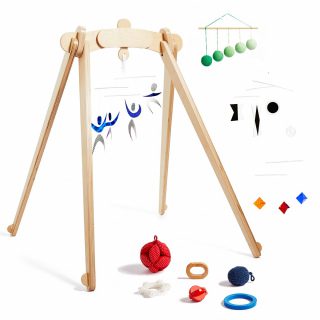
For example, at two weeks old, a baby cannot distinguish colors well but can detect light, movement, contrast, and patterns. The Montessori Munari is the ideal first mobile, having a contrasting black and white pattern that captures a baby’s attention, allowing him to distinguish its shapes, practice visual tracking, and build concentration.
The Munari is also designed according to a mathematical formula so that all its components are in proportion. This mathematical relationship appeals to a baby’s innate number sense. Research shows that the strength of an infant’s number sense predicts performance on math activities in preschool. Montessori recognized this sense and called it the “human tendency of the mathematical mind.” A professor at the Duke Institute of Brain Sciences calls it “the conceptual building block upon which mathematical ability is built.” We can support even the youngest baby’s mathematical potential by offering toys that appeal to this innate number sense.
As children get older, the Montessori materials continue to support physical and cognitive development. When a child plays with the Curved Dowel, she strengthens her wrist preparing her hand for writing, sports, and everyday tasks like dressing independently. As she holds the base of the dowel with one hand and uses the other hand to thread the ring, her arm crosses the midline of her body. Crossing the midline, the ability to move her hands and eyes together, across and to the other side of her body, is important for her development. It helps her integrate sensory feedback across brain hemispheres and enhances bilateral coordination (using the two sides of her body together). Crossing the midline is also a prerequisite for lateralization, or the process of one eye, hand, foot, and ear becoming dominant. Lateralization allows a child to function at her most efficient level.
Guiding Parents
Unfortunately, parents are left guessing how to create a stimulating environment during the formative years of birth to three. Monti KidsTM gives parents access to world-renowned Montessori materials along with simple guidance. We provide customers with recurring home deliveries of Montessori educational toys and an online curriculum for parents, tailored to their child’s stage of development.
Learn more at www.montikids.com
Tomorrow’s Child/Sept 2017
by katrina costedio | Archived Issues / Tomorrow's Child, Child's Work, Empowerment, Family Resources, Infant-Toddler (0 to 3), MFA, Montessori Education, Montessori Parenting, Montessori students, Toddler (18 months-3 years), Tomorrow's Child
I remember clearly the crunch of the gravel under the tires as I pulled into the NewGate parking lot for the first time. Dylan was eighteen months old and I was in the middle of a divorce. We had never spent a day apart, and I was starting a new job. I didn’t know it then, but walking into Ms. Lauren’s classroom that day would unfurl a thread that would weave itself so indelibly into the tapestry of our lives that, nine years later, I’m still hearing the same gravel crunch under my tires every day.
It was rough leaving him. He reached for me from Ms. Lauren’s arms, his face smeared with tears. She was calm and authoritative, urging me to go. It will be better for him, she said. For the first time ever, I ignored his pleas. I put my faith in her and Montessori, and I left my crying child in her arms and walked away. It was hard, but it was probably the best decision I ever made for him.
I’m not going to lie, drop-off was tough for a while; we both had difficulty adjusting to being apart. I can’t tell you how many times during the day I had to suppress the urge to call the school to make sure he was alive. But day-by-day, soothed by Lauren’s calm authority, Dylan and I settled into this new routine and began to thrive in our new environments.
Before long, Dylan was dismissing me with a quick kiss and hug and disappearing into the fold of his classroom each morning. To this day, I am captivated by the sight of a smoothly running Montessori classroom—
everything so tiny and orderly—small children working with a focus most adults don’t often display.
I learned that, while from the outside a Montessori classroom may seem to lack the structure you’d expect to see in a traditional classroom, the structure of a Montessori classroom is in the planned environment. Each classroom is carefully crafted and structured so that the children can follow their interests and foster their own independence. I began to see my ‘helpless child’ become capable in ways previously unimaginable. In his classroom, he would prepare a snack for himself and his friends, then carefully wipe the table and dishes. He could select a lesson from among the dozens on the tiny shelves and then work quietly at it for long stretches of time.
Lauren taught me ways to be more Montessori at home. I put his cereal, snacks, and dishes in low cabinets at home, and watched, amazed, as he poured his own cereal the next morning. I organized his toys onto shelves so that he could see and reach everything. We had fewer meltdowns, we had more peace.
Montessori made its way into our home in other ways, too. For instance, Dylan started to tell me sternly, No, thank you! (in a tone remarkably similar to Ms. Lauren’s) anytime my suggestions or behavior deviated from what he found to be acceptable. “Dylan, stop jumping on the couch,” “No thank you, Mommy!” “Dylan, please put on your pajamas” “No thank you, Mommy!” Lauren laughed when I asked if she knew the origin of this charming new phrase. She did, of course, because it originated with her.
One day at drop-off, Lauren told me that Dylan had begun to express interest when other children used the toilet. She told me to send him to school with four clean pairs of underwear and shorts. By the end of the week, my child was completely out of diapers. It was a painless transition for us at home, I joke with my friends that this alone was worth the tuition that year.
Dylan and I walked into NewGate that first day alone and scared; we only had each other. By the end of the year, we had a community—a family. Some people send their children to school to receive an education, and that is enough for them. When I send my child to school, he’s receiving an education, but he’s also receiving love, support, and guidance. In fact, both of us are, and we are better people because of it.
Katrina Costedio is a graphic designer on the staff of the Montessori Foundation. She has a son, Dylan, who is an upper elementary student at NewGate school in Sarasota, Florida. She has been a Montessori parent for 9 years. Katrina received a BA in Liberal Arts from St. John’s College, Santa Fe, New Mexico.
Tomorrow’s Child/Sept 2016
by Margot Garfield-Anderson | Communication, Family Resources, Montessori Family Life, Montessori Parenting, Parent Education, Parent-Teacher Communication, Tomorrow's Child, Tomorrow's Child Online Issue, Uncategorized
To continue reading, you will need to choose a subscription plan.
by Margot Garfield-Anderson | Child's Work, Discipline, Empowerment, Family Resources, Infant-Toddler (0 to 3), MFA, Montessori Family Life, Montessori Parenting, Toddler (18 months-3 years), Tomorrow's Child, Tomorrow's Child Online Issue, Uncategorized
To continue reading, you will need to choose a subscription plan.
by Jonathan Wolff | Family Resources, Imagination, Infant, Infant-Toddler (0 to 3), Lower Elementary (6-9), MFA, Montessori Family Life, Webinars / MFA
To continue reading, you will need to choose a subscription plan.
by Margot Garfield-Anderson | Book Reviews, Family Resources, MFA, Montessori Family Life, Montessori Parenting
To continue reading, you will need to choose a subscription plan.
by Margot Garfield-Anderson | Family Resources, MFA, Montessori Education, Reading
To continue reading, you will need to choose a subscription plan.
by Joyce St. Giermaine | Family Resources, Tomorrow's Child, Uncategorized
To continue reading, you will need to choose a subscription plan.