One of the most challenging parts of having children in school is making lunches. With some guidance, children can make their own lunch. It then becomes a win/win situation. You do not need to make lunch daily, your child gets to practice practical life skills, and your children are more likely to eat their lunches. As with all new skills, it may take more time initially, yet the work and time will benefit both of you for years to come.
How can a young child prepare their lunch each day? Preparation of the environment, the necessary tools, and a lesson will all be necessary.
Preparing the Environment:
• Make appropriate food for lunches available at child height. This may mean reserving space on a low cabinet and low shelf in the refrigerator for lunch materials. At our house, we used colored baskets in the cabinet and refrigerator to quickly designate which items were for lunches.
• If needed, divide the food into servings before lunches are made. Your child can help you do this after school or over the weekend. If five baby carrots are an appropriate serving for your child, make a few bags with five carrots in each.
• Make sure your child can open and close any containers used and manage their lunch box.
• Consider when lunch should be prepared. If your child has trouble getting out of the house in the morning, make lunch the night before and store it in the refrigerator if needed. If your child is usually ready early, the morning is a great time for this job.
The Necessary Tools:
• Have utensils your child can use to make lunch, such as: a knife for spreading and cutting; a cutting board; containers that your children can open and close; and lunch boxes that allow them to pack easily.
• A list of ideas in written or picture form may be helpful for your child.
• Decide what you expect for lunch. What constitutes a main meal? What is a snack? Do you have a guideline of how many fruits or vegetables need to be included?
A Lesson or a few lessons):
• Discuss the plan with your child.
• Show where the tools and materials for making lunch are.
• Talk about what should be included in lunch and why, i.e., you need energy for growth and your day; these foods are not allowed at school for allergy or other health reasons; these items do not transport well. Share the reason for the guidelines.
• Work with your child the first few times and discuss what you are doing and checking: e.g., “I don’t see any fruit in here. Would you like to add a fruit or another vegetable?”
• Show your child how to clean out their lunch box at home before just adding to it.
Follow Up:
• Peek inside the lunches that are going to school. Do they meet nutritional needs as you expect?
• Discuss options and ideas with your child before grocery shopping.
• If you have leftovers from dinner, ask if your child would like some for lunch and plan together how to make that work.
• Let your child’s teacher know that your family is making this change. Your child may be pleased and possibly even distracted by the lunch they made at first, so letting the teacher know means they can help with these changes.
Enjoy the small break this gives you and the independence it gives your child.
Cheryl Allen is the Associate Coordinator of the Montessori Family Alliance and is also a parenting educator and a Montessori consultant with the Montessori Foundation. Cheryl attended Montessori school as a child. After sometime as a traditional Secondary teacher, she worked in Montessori classrooms, 3-6, 6-9,and 9-12, earning certifications from both AMS (3-6 and 6-9) and IMC (6-12). She is a teacher educator, workshop presenter, and member of IMC accreditation teams. Cheryl’s two children attended Montessori from age two through high school graduation.
We, as parents, love to see our children become independent and self-sufficient as they grow and age. But sometimes, we may need help to get them to that point. We can do so by implementing the Montessori Method into their lives. Montessori emphasizes teaching children to be self-regulating and to be able to learn the concepts of independence. It is a great tool to help your children be more confident in their abilities. Indeed, independence is the best gift we can give to our children, as it enables them to be self-sufficient and know how to take care of themselves.
Today, we live in a time when there is a lot of pressure on children at home, school, or work. The idea behind the Montessori Method is to teach children that being themselves will give them the ability to succeed in life. Children need to feel confident, capable and become more independent so that they can defend their ideas, thoughts, and feelings against pressure from others. But the question now is how this Method helps children become independent. Well, that’s what you are going to learn in this article. But first, let’s understand what the Montessori Method is.
WHAT IS THE MONTESSORI METHOD?
It is an educational method that Maria Montessori developed. It has been implemented globally and has helped children develop learning skills for independence, self-regulating, and creativity. The Montessori Method uses a hands-on approach, where children learn through experiences to find their way of learning.
THE MONTESSORI METHOD WILL HAVE THE CHILDREN LEARN FROM THEIR MISTAKES AND ENCOURAGE THEM TO KEEP LEARNING, BECAUSE THEY ARE NOT PERFECT IN EVERYTHING.
How can the Montessori Method help your child to be independent?
The Montessori Method is designed to be flexible and adaptable to meet each child’s needs. It allows children to be exposed to different learning environments and solve problems by themselves. The Montessori Method emphasizes making lessons fun-filled and interesting to capture the child’s attention and develop their thinking skills.
Here are four ways that Montessori helps your child become independent:
ONE
The Montessori Method encourages children to become more independent, through a stress-free environment.
The Montessori Method is a great tool to help children become independent by giving them a stress-free environment. It helps children become less dependent, because they need not rely on parents or teachers for help. It teaches kids how to solve problems by themselves.
For example, when you are doing your work, it is certainly stressful to stop your work and ask for help from another person if you do not know how to do something. The Montessori Method teaches us that we must not stop what we are doing until we have finished it. It is an excellent tool to teach children how to do their work without disruptions, but to only stop if necessary. It teaches children that they only need to pause when they are stuck on something or need help.
TWO
The Montessori Method encourages children to learn how to solve problems.
Learning how to deal with problems is one of children’s most rewarding experiences. The Montessori Method gives children opportunities to learn on a broad scope of different topics to develop their problem-solving skills; they will not need to rely on others for help.
For instance, if a child is trying to understand how to use a slow cooker, he is expected to figure it out by himself. Even if you want to teach him how to use it, the child must remember what you taught him. The Montessori Method allows children to take an active role in their education and figure out most problems on their own. It seems easy at first, but doing this will develop their problem-solving skills and increase their independence.
THREE
The Montessori Method helps children become more respectful of their ability.
The Montessori Method positively impacts children’s self-confidence and self-esteem, because it helps them appreciate what they are accomplishing. It helps them become better learners by giving them more confidence in their learning ability. The Montessori Method is a great tool to encourage children to learn more about what they have and who they are.
For example, if a child is having trouble learning how to play the violin, it may affect her self-worth and self-esteem. Children may think that they cannot learn or do not have what it takes to become good violinists, so they give up. But the Montessori Method will have the children learn from their mistakes and encourage them to keep learning, because they are not perfect in everything. As a result, this will teach them how to accept their capability for learning new things.
FOUR
The Montessori Method helps children to be independent by reinforcing self-confidence.
The Montessori Method helps children become more confident by giving them opportunities to learn new things and feel proud about themselves when they accomplish something great. This Method gives children the opportunity to learn new things and achieve something great by themselves. Therefore, they are more confident in believing that they are independent, because they know how to solve their problems without depending on other people’s help.
For example, let’s imagine that your children decide to ride a unicycle for the first time.
They are not ready yet, but they still want to try. By doing this, they will understand that even though it is not easy, there is a way that they can overcome challenges with riding a unicycle and challenges in life. This develops self-confidence. As they learn how to approach new challenges, they will be able to do more and more for themselves.
HOW CAN PARENTS HELP ENCOURAGE CHILDREN’S INDEPENDENCE AT HOME?
We should encourage our children to be increasingly independent right from the start, but they need guidance and coaching. They need to learn the basics: proper hygiene and the daily habits of independent living when they are older. Help them learn to do things carefully with confidence.
Though more children today can be considered self-sufficient, learning through experiences and making mistakes will help them develop a sense of responsibility and become more self-reliant later in life. Even with care, mistakes happen. Let’s help them to learn from their mistakes with patience and calm.
If we allow our children to do tasks independently, we will witness steady growth in their capability.
For example, let children:
• Place foods on their plate: You can give them advice, but let children learn how to pick up and put things onto their plates.
• Wash their hands: You can talk with them about the importance of washing hands, but let them learn how to scrub, wash, and rinse themselves.
• Brush their teeth: This is another task you can do with your child but let them do it alone after you’ve given instructions on how to brush, what part of the mouth to use the toothbrush, and when to spit out afterward.
• Pick out clothes they want to wear: In case you don’t have enough time to lend a hand in picking, let your children select the clothes they wish to wear, once they have learned the basics of choosing outfits on their own, using simple instructions from you, such as, “Choose a shirt that has long sleeves.”
• Choose their toys: Let your children choose the toys they want to play with, but make sure you don’t allow them to play with dangerous items like knives or scissors.
These simple steps will help your child feel comfortable when they start to face challenges on their own and help them understand the importance of independent living.
Final Thoughts
Children develop their independence in different ways as they grow and learn about the world. The Montessori Method is an effective way for children to learn how to be independent with their own decisions and find new ways of solving their problems on their own. The Montessori Method is the best way for children to develop skills that will help them cope with anything they encounter. •
Andrea Gibbs was born, raised, and still lives in New York. She is a work-at-home mom with a background in business development, strategy, and social media marketing. She contributes to a blog at the Montessori Academy to motivate and educate other parents about how they can get their children ahead of the game in school. montessori-academy.com/why-the-montessori-method-works
Over the years, it’s quite common for parents to come to us to say that, since their child is so advanced academically, they worry that the class they are in now is not sufficiently challenging. It is not unusual for parents to ask the school to move them up a year early next term.
There’s no one response that schools offer, but I think there are a few things to consider.
Typically, parental fear of their child being disadvantaged by being the most advanced in a Montessori classroom is based on a misperception.
Unlike traditional schools, where the pace of education is based upon the norm of the class, the Montessori curriculum follows an international model rather than what is commonly taught in American schools. In general, Montessori programs are more sophisticated and individualized in many ways.
In the United States, in the first three grades (kindergarten through second grade), it is fairly common to teach children number recognition and simple mathematical operations with one or two-digit quantities. Math can be very abstract, and some children memorize answers but may or may not understand what they’re doing.
Likewise, with reading, many children are asked to read from simplistic texts or workbooks that have more to do with spelling and vocabulary than with really giving them a love of the written word, no less a desire to express themselves in writing.
While there is a real concern about math education in the United States, many students are not culturally literate in history, geography, economics, science, civics, and our cultural heritage found in the arts and literature.
Like most schools that follow European tradition, Montessori places a huge emphasis on what some people call the ‘cultural subjects.’ These topics include, science; technology; history; geography; international studies; the foundations of industry and trade; architecture; engineering; and so much more. Montessori’s breadth of curriculum tends to produce young people who have far more knowledge of their country’s history, government, and heritage than most Americans.
So, we have three basic issues. The first is that in Montessori, children don’t learn at a preestablished pace. They are not only able to choose the things that most interest them but to learn in ways that they find most appealing. Children are different. Some learn best by listening to someone else talk; others learn by observing, and many need to directly experience to understand and remember. There are so many variations in the way children learn, and it’s challenging to know what’s right for an individual child.
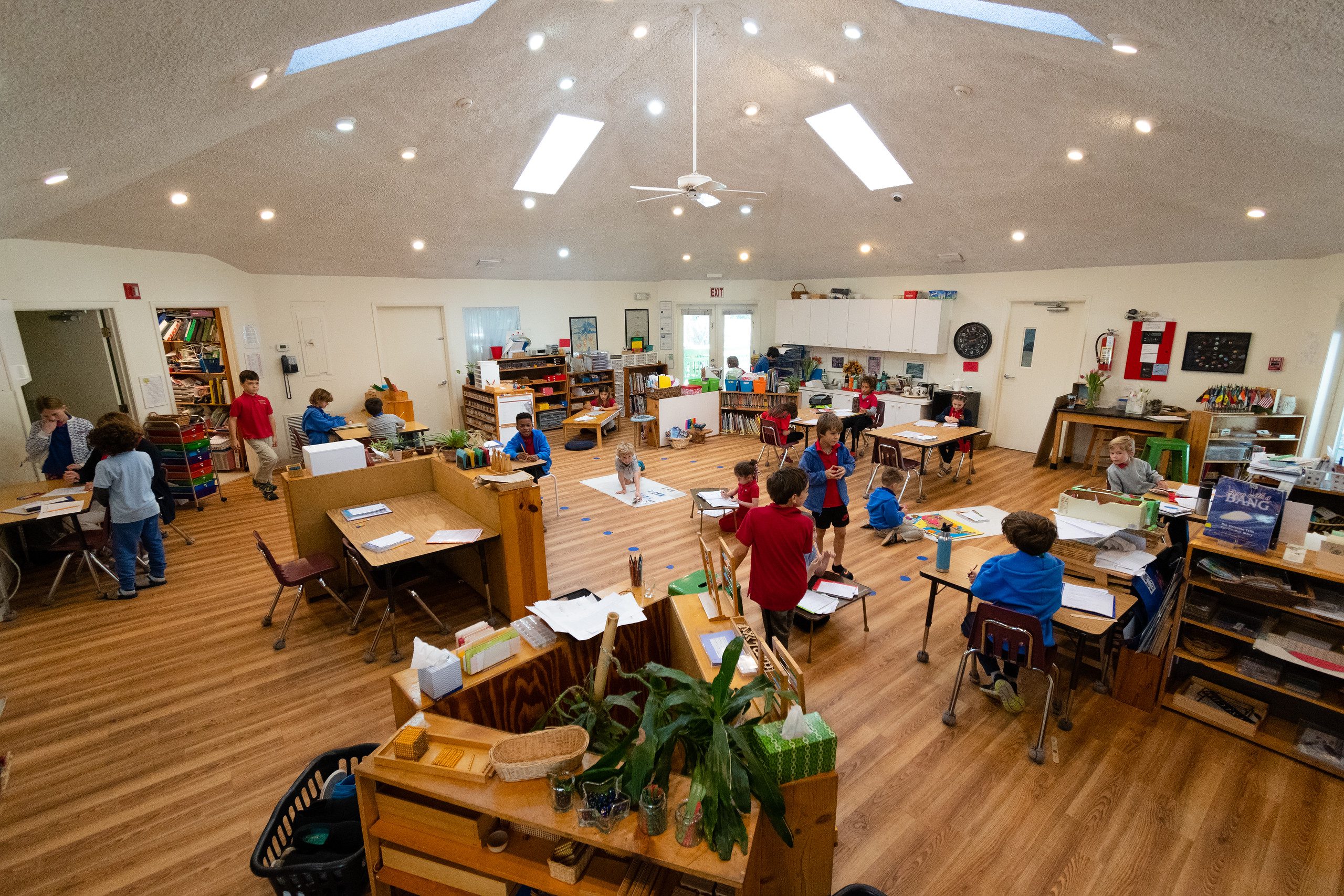
The second issue is that no teacher can work with each child every moment of the day. That’s the beauty of Montessori’s prepared learning environment. It allows children to find meaningful work without having to depend on a teacher telling them what to do throughout the day.
Another consideration is that most of us learn best not by simply receiving a lesson; repeated experiences along with the opportunity to help (or teach) other children solidifies the skill or concept. The best teacher of the typical student is usually not the adult with a master’s degree in education; rather, it is often other students who have a grasp of the material and are willing to share their understanding with a fellow student.
The third point is that a child who remains in a Montessori multi-age class is surrounded by other students (younger and older) who have their own gifts and talents to share. They stimulate each other. The beauty of the Montessori experience is that the class is a community, not simply a group of children who are focused on the lesson that the teacher happens to be giving. This ongoing set of relationships builds a sense of safety and security for most children, both with their peers and with the adults in their lives. As parents, we need to understand how incredibly valuable that is.
So, the trade-off to having a child move up a year early is not so much that the child will get lessons that they couldn’t get in the younger class, as much as that they would be moving up into a class, where the age range is going to be three or four years beyond their current level.
Every child is different and there are times when moving a child up early actually is worth considering. In my experience, I never followed a hard and fast rule. We always try to explore with the family why they feel this is a good idea? Here are some points parents and educators should consider:
• Is it accurate that the current class really can’t meet the child’s intellectual and academic needs?
• Do the parents feel a strong urge to push their child ahead more quickly? If so, why? What do they hope to gain? What are the pros and cons?
• Or is it fear that their child will miss opportunities that they would have at the next level?
These are all legitimate questions, but we must weigh them against the advantage of stable, continuing relationships. Having been one of those students, who was moved up a year early at one point along my journey, I found it difficult to be a year younger than the youngest child in the classroom. So, if you ever come to the conclusion that, perhaps, your child might do well to move up, try to really think it through with the school and weigh the pros and the cons.
Montessori is based on the idea that each child follows her own pace and that education is a journey, not a race.
Montessori classes are not only about academics. The focus is social and emotional, as well. While a five-year-old may be reading like a six-year-old, this same child may socially and emotionally be better suited to remaining in a class with familiar children. Being among the oldest and most advanced creates the possibility of becoming a leader. Don’t undervalue how wonderful that experience can be.
Montessori is based on the idea that each child follows her own pace and that education is a journey, not a race.
Other than saving a year’s tuition if your child attends a private Montessori school, there are few (if any) benefits for a child who finishes high school early. Beginning university younger than the other students in their class may again present same social, emotional, and academic challenges, depending on the student.
Appreciating Montessori’s ability to meet children at their intellectual level is one of the greatest gifts of Montessori education. I always recommend that parents follow their hearts, but I do advise every parent to be thoughtful and careful before leaping to a decision.
Try to find the best path for your child, and always remember that it’s important to ask them what they really want to do. Listen carefully to their reasoning. Sometimes the reasoning makes perfect sense; sometimes it doesn’t make any sense at all. Weigh your conclusions and follow your parental instincts. That’s all any of us can do. •
“As well as being part of our history and a way of understanding other people’s experiences, art is also a form of personal expression, like poetry, song, dance, and telling stories. It is a form of human connection that can evoke feelings, thoughts, and hopefully appreciation and understanding. Montessori encourages families to expose children to as many forms of art as possible. Encouraging your child’s interest in art and giving them room to be creative provides them with experiences that will endure.” — Excerpt from Montessori for Every Family by Lorna McGrath & Tim Seldin
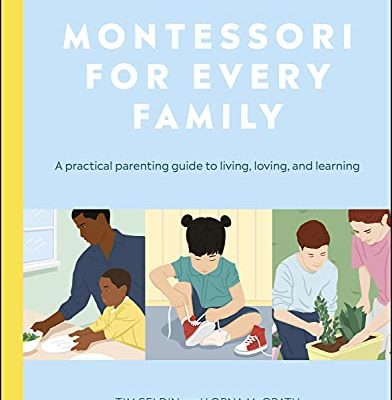
The new book, Montessori For Every Family: A practical parenting guide to living, loving, and learning, by Lorna McGrath and Tim Seldin, shares some ways to encourage an enjoyment of art and to set up a space to create. We have searched out materials to help you set up an inviting art space in your home.
A child-sized wooden table can be your art area for years. Look for a sturdy table and chairs that fit under the table. If you do not have space for a separate art table, consider a coffee table with storage nearby.
Pictures by different artists can be chosen by you or your child if you visit an art museum, or ordered from art.com. Also consider a piece of wood with clips attached and a variety of postcards for a changing display.
You may want a paper roll so you can create different sized pieces of paper.
The MÅLA
Paper roll holder with storage is a good choice. It is available from several vendors, including Amazon. Here is a link to one from IKEA: tinyurl.com/ mrxfc27e
MÅLA Apron
Keeping clothes neat during art exploration is difficult for some of us, so a smock can be a beneficial part of any art set up. tinyurl.com/2zzsetah
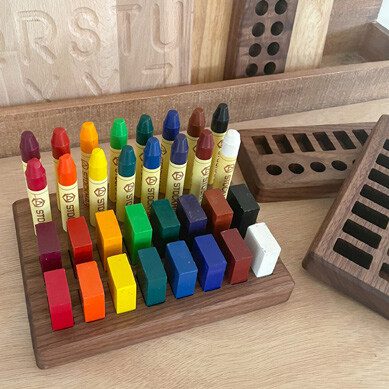
Stockmar Beeswax Crayons
Beeswax crayons allow for layering of colors and draw smoothly. They also last longer than traditional crayons. tinyurl.com/289usjem
Eco Finger Paint
Changing out art materials for different ages can help keep their interest up. Young children enjoy the opportunity to finger paint; this finger paint is made with food-grade materials, so you do not need to worry too much when painty fingers go into mouths. ecokidsusa.com/ eco-finger-paint/
Watercolor Pencils
Older children may like the many different ways to draw with watercolor pencils. tinyurl.com/2p9a6d5n
This all-natural, set of opaque watercolors has magnetic pots of color, so just a few can be used at a time. tinyurl.com/3ruhf9yu
Honeysticks
For younger children, who may even like to taste their paints, Honeysticks is a set made from food-grade ingredients. tinyurl.com/bdfjy9w9
Beeswax or Soft Dough
Younger children may find beeswax or soft dough easiest to use. Stockmar modeling beeswax warms up in your hands and smells delicious. tinyurl.com/mws8axc3
Include a container or two, to collect items for collage and sculpture making. Egg cartons, confetti, rubber bands, pom poms, whatever could be reused and is appropriate for their use, can go in the containers for building and creating. Be creative, and follow your child’s interests. Have fun with these ideas and supplies, and add your own art area in your home.
Dr. Angeline Lillard presents Maria Montessori’s key insights about childhood education, the subsequent educational research that has validated her approach, and how these ideas are implemented in a modern Montessori classroom.
Dr. Angeline Lillard presents Maria Montessori’s key insights about childhood education, the subsequent educational research that has validated her approach, and how these ideas are implemented in a modern Montessori classroom.
Membership in The Montessori Family Alliance means direct access to Montessori experts and other friends and parents of Montessori. Now, you have a one-stop resource for all of your Montessori needs. Brought to you by The Montessori Foundation.