Encouraging Risk Taking
from Tomorrow’s Child – The Montessori Family Magazine – September/October 2021
By Peter Pizzolongo
Facing risks is an unavoidable part of life for most adults. So, why do we choose to take risks? Is it for the sensational thrill of trying something new or the tenacious hope that new opportunities will present themselves? Sometimes, maybe, we choose to take a risk just to exhibit a show of confidence. Whatever the reason, the lessons we learn from taking a risk have the potential to lead us on a new path (Rolison 2013) (Zeilinger 2017).
Learning to assess a risk is an essential skill for living.
The ability for adults to take calculated risks has its roots in early childhood. Yet we are in an era of limiting risk taking by children. Most parents (and caregivers of young children) worry about children, wanting them to stay safe—so they resort to limiting the risks that children take. “We are a nation of pushy helicopter parents, . . . waiting below our children on the monkey bars in case they should slip” (Bilinco 2015). By keeping our children ‘safe,’ are we inadvertently preventing them from learning how to calculate risks on their own?
The benefits of taking safe risks.
It is important for children to learn how to take safe risks, i.e., “situations that a child can perceive and choose whether or not they want to participate” (Keeler 2020). Risks that are not safe, aka hazards, are “truly dangerous for a child: situations or objects that the child does not see, cannot make a logical choice about, and that have a definite chance of hurting them.” As Rusty Keeler reminds us in Adventures in Risky Play: What is your yes? Risk is good… Risk is a natural part of life. In fact, learning to assess risk and deciding if you want to take a risk are essential skills for living” (Keeler 2020).
Children engage in play that involves taking risks to experience positive emotions, including: fun, enjoyment, thrill, pride, and self-confidence (Sandseter 2011). In risky play, children “dose themselves with manageable quantities of fear and practice keeping their heads and behaving adaptively while experiencing that fear” (Gray 2014). When a child takes a risk and attempts something outside her comfort zone, she uses the higher-order thinking skills of application and synthesis—applying what she knows to new situations (Church 2020).
The ability to calculate and take risks supports children’s learning in many ways. Taking risks develops and enhances a child’s self-confidence and ability to manage and overcome fear. Risk-taking promotes the kind of play that involves children’s use of problem-solving skills, self-regulation, and reflection. I would consider what helped me succeed. If the experience did not end as I expected, I would try to figure out what failed.
The ability to calculate and take risks supports children’s learning in many ways.
In “The Role of Risk in Play and Learning,” Joan Almon notes, “play means taking risks . . . Children are constantly trying out new things and learning a great deal in the process.” This is most evident in the risk-taking that children engage in as they use their muscles and senses in physical activities. When children are encouraged to take safe risks, they learn to assess what they can do and match that with activities that have an element of risk.
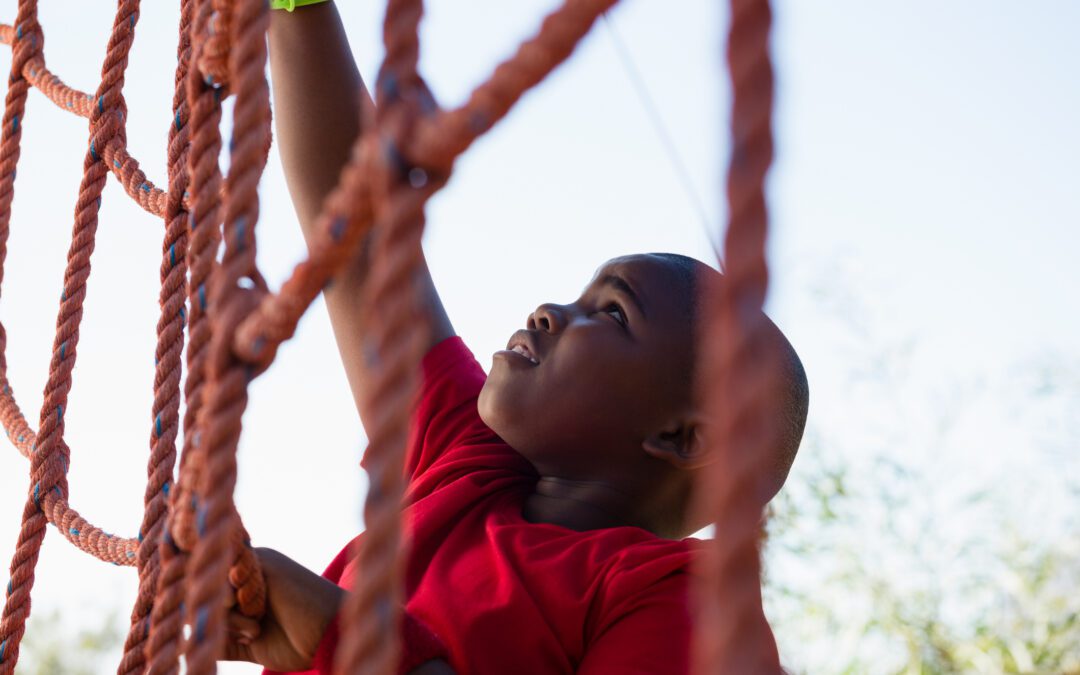
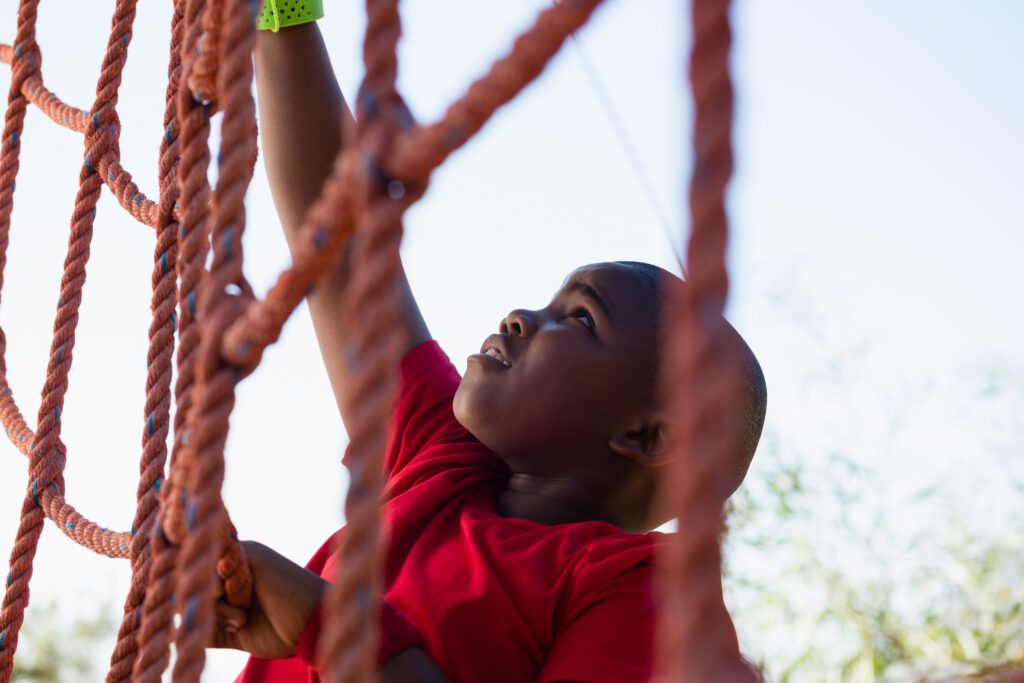
Children think about how high they can climb, from what height they can jump, and so on. They might find that what they were attempting is not possible and use problem-solving skills to try an alternative. These children are developing and using resilience; they will determine what they need to do to succeed or decide to abandon the task. Through taking safe risks, children “acquire better motor control and learn what is dangerous and what isn’t” (Sandseter 2011). A preschooler encountering a pile of logs might investigate how secure the logs are on the ground and decide whether she can climb on the pile or not. She is learning how to manage risk and develop an understanding of safety (Knight 2011). Taking risks while building physical skills is an important component of development and learning for young children.
The Role of Teachers
Recognizing the general processes of children’s development and learning in all areas is vital. It is the parent’s and teacher’s responsibility to identify the safe risks vs hazards and to set clear and reasonable limitations so that children understand what they may and may not do in the play environment.
Taking risks while building physical skills is an important component of development and learning for young children.
Understanding Developmentally Appropriate Practice is Key
Understanding developmentally appropriate practice is key: recognizing the general processes of children’s development and learning in all areas. In addition, they must consider the strengths, interests, and limitations of each child and be aware of the social and cultural contexts in which each child lives (NAEYC 2020). They must also “up the ante” when they discern children are ready for bigger challenges.
The two examples below show the difference between what is appropriate for a toddler and what is appropriate for a preschool child.
Eighteen-month-old Darius is beginning to use depth perception in his play. Today he demonstrated how he scans for obstacles and moves based on that information. He has gained control of a variety of movements: stooping, going from sitting to standing, running, and jumping. Darius shows an understanding of what size openings are needed for his body to move through, and today he successfully crawled through the tunnel.
Toddlers develop their physical abilities by continuously stretching themselves. Darius has learned (probably through trial and error) what size opening he can fit through. As toddlers freely navigate their relatively safe and supervised environment, they begin to figure out what are reasonable risks to take.
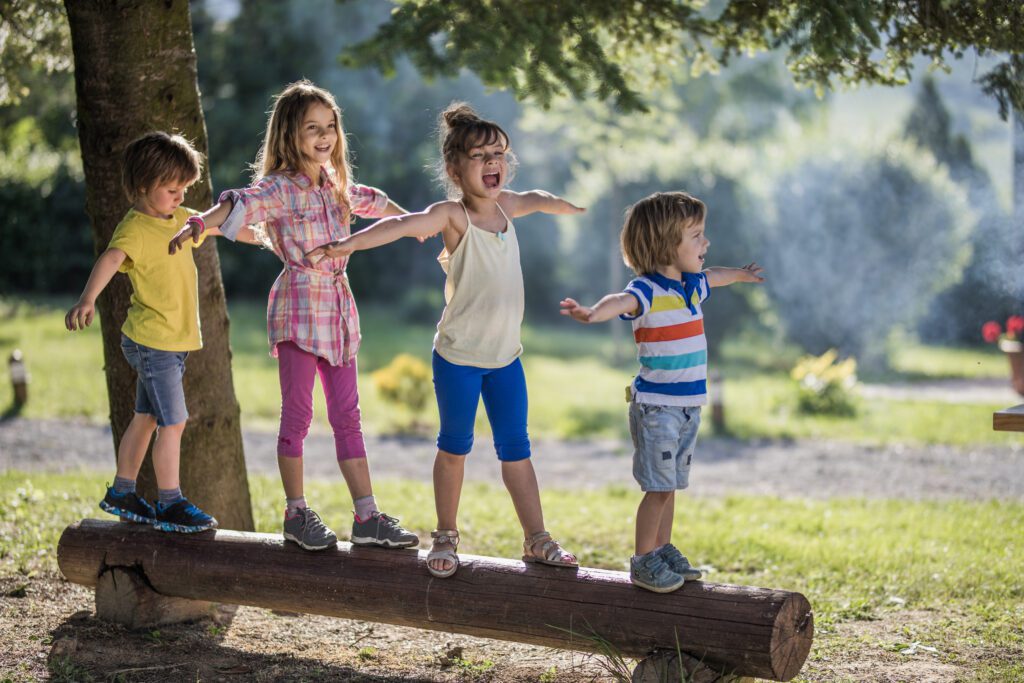
Four-year-old Ximena enjoys balancing on one leg and on the balance beam. Today she walked the entire length of the balance beam and ended by jumping off and standing on one leg for a few seconds. She coordinates her movements when jumping, hopping, and running. Ximena has mastered several large muscle skills, and after her jumping-hopping running experience, she climbed the ladder and slid down the slide—several times.
Preschoolers are adept at responding to physical challenges when such experiences are promoted. They can reach great heights on the climber, dangle upside down, and move from rung to rung with increasing ease. They can climb trees, cycle at fast speeds, and engage in ‘play fighting’ without actually hitting each other. They can balance on a beam, set increasingly higher as children begin mastering balance. They can climb up the slide, rather than only using the steps. Preschoolers can figure out how to get across a shallow creek using rocks and logs. With adult supervision, they can also begin to take risks at the fine motor level, for example, slicing fruits with a sharp paring knife.
What is your risk tolerance?
As a parent and/or teacher, you will need to determine your own tolerance to risk. What type of risky behaviors are you willing to let children engage in? If you have low risk tolerance when it comes to children’s play, it would be helpful to review expectations for young children at various stages of development and think about what children would like to do to ‘up the ante’. Then, recognizing that children are stretching themselves, your primary role “is to enable the stretching process to be manageable and safe enough . . . to help [children] to take reasonable risks” (Almon 2013).
Finally, the role of the teacher is to help children be aware of their actions and encourage safe risk-taking. Here are some examples, adapted from NAEYC’s Developmentally Appropriate Practice:
• Encourage children to choose their own learning activities: “We have several activities set up in the outdoor area today. You can choose what you want to do first.”
• Acknowledge children’s activities:
“You’re building with a lot of loose parts today!”
• Encourage them with specific feedback:
“Wow, you are certainly climbing higher today than I’ve seen you climb before!”
• Ask open-ended questions: “If you want to cross the creek, what will you need to step on so you stay dry?”
• Pose problems and ask questions, providing just enough assistance so the child can attempt a task at a skill level just beyond what she can do on her own (scaffolding): “You’ve been somersaulting down this hill. How else can you get from the top to the bottom of the hill?”
Supporting children as they explore ways to take safe risks sets them on the path to becoming adults who develop the confidence that comes from assessing risks and determining a course of action they learn from taking risks and who explore the opportunities to which risk-taking can lead.
References
Almon, J. 2013. “The role of risk in play and learning.” Community Playthings. Online: http://www.communityplaythings. com/resources/articles/2013/ the-role-of-risk-in-play-and-learning.
Blincoe, K. 2015. “Risk is essential to childhood—as are scrapes, grazes, falls and panic”. The Guardian. Online: https://www. theguardian.com/commentisfree/2015/ oct/14/risk-essential-childhoodchildren-danger?fbclid=IwAR0CZE vfmAN0udIDxWrI9xQHfob4QYM DT_R4eDpdLBvUInIkQutU0LNCapc
Church, E.B. n.d. “When to challenge children.” Early Childhood Today. Online: https://www.scholastic.com/ teachers/articles/teaching-content/ when-challenge-children/.
Gray, P. 2014. “Risky play: Why children love it and need it”. Psychology Today. Online: https://www.psychologytoday. com/us/blog/freedom-learn/201404/ risky-play-why-children-love-it-and-need-it.
Keeler, Rusty. 2020. Adventures in Risky Play: What Is Your Yes? Lincoln NE: Exchange Press.
Knight, S., 2011. “Why adventure and why risk in the early years?” ChildLinks. 3. Online: https://www.researchgate.net/ publication/275039981_children’s_ risky_play_in_early_childhood_education_ and_care.
National Association for the Education of Young Children (NAEYC). 2020. Developmentally Appropriate Practice. Washington DC: NAEYC. Online: dap-statement_0.pdf (naeyc.org) Rolison, J.J., Y. Hanoch, S. Wood, & P. J. Liu. 2013. Risk-taking differences across the adult life span: a question of age and domain. Journals of Gerontology, Series B: Psychological Sciences and Social Sciences, 69(6), 870–880, doi:10.1093/ geronb/gbt081. Online: https:// academic.oup.com/psychsocgerontology/ article/69/6/870/545646.
Sandseter, E. 2011. “Children’s risky play in early childhood education and care”. ChildLinks. 3.
Zeilinger, J. 2017. “7 reasons why risk-taking leads to success”. The Huffington Post. Online: 08/13/2013 03:15 pm ET Updated Sep 25, 2017
Peter Pizzolongo is President of Early Education Consulting and former Vice-President of the Delaware AEYC Governing Board. He has held the positions of Training and Technical Assistance Coordinator of the National Center on Early Childhood Education, Teaching, and Learning (NCECDTL) at Zero to Three; Associate Executive Director for Professional Development at NAEYC; and Director of the Analytical Support and Technical Assistance Services Division of CSR, Incorporated—a social sciences research and management support firm. He has over 30 years of experience as an author; training and technical assistance provider; program evaluator; Head Start and childcare agency administrator; teacher; and human services program manager. Mr. Pizzolongo has authored or co-authored more than 30 publications, digital programs, and other resources. He has conducted training programs on numerous topics, including child development; early childhood education; developmentally appropriate practice, ethics; developmental assessments; health and mental health; nutrition; parenting; and program evaluation. Mr. Pizzolongo has been a member of the University of Delaware (UD) College of Education and Human Development Dean’s Advisory Council since September 2015. He received his B.A. in psychology in 1972 and his M.S. in human resources with a child development major in 1974, both from the University of Delaware and coursework in the use of technology in education programs from the University of Maryland.