
Do’s and Don’ts to Get Your Adolescent Talking
To continue reading, you will need to choose a subscription plan.

Discipline Alternatives: For The Montessori Classroom & Home
“The undisciplined child enters into discipline by working in the company of others; not being told he is naughty … Discipline is, therefore, primarily a learning experience and less a punitive experience if appropriately dealt with.” —Maria Montessori

Teachers spend years learning to create an atmosphere in Montessori classrooms that embody the wisdom of Dr. Montessori while fostering the spiritual awakening in their students and themselves. Administrators try, via parent education and engagement, to explain the developmental stages of children so that expectations are realistic for all. Montessori parents are a special group of people who want a very holistic education for their children. However, none of us is immune to needing some reminding of how to talk and treat people we encounter regardless of their place in this world. We are all in this together. By practicing and modeling these skills we can all benefit and change the world.
Many parents and teachers, and some Montessori Directresses make use of ‘time out’ as a means of compelling children to behave in a certain way. Sometimes, the child is required to sit on a specific chair. Sometimes this is called a ‘thinking chair,’ and the child is instructed to think about what he has done. There are many variations on this theme, and the strategy has many names. Ultimately, they all boil down to the same thing.
According to Montessori, a child who is unruly or disruptive should be taken aside by the Directress, away from the disruption of his peers. The adult will stay with the child, quietly re-assuring him, until he is ready to return to his work. This has been interpreted by some as an endorsement of the ‘time-out chair.’
Although removal from the activity of other children can help an over-excited or distraught child to calm down, it is very difficult to use the chair in a non-punitive way. Maria Montessori is quite clear in her writings that punishments have no place in a Montessori environment.
In the early years of its use, the ‘time-out chair’ was seen as a positive step in disciplining young children, as opposed to scolding or complete isolation, or in the absolutely unacceptable (but not absolutely obsolete) practice of spanking children. The technique was regarded as an aid in helping children to learn independence and self-control. Children could take part in group or individual activities as long as they obeyed the house rules. Any infraction would mean removal from activities and peers and, for a specified time, sitting in a designated place some distance away from the center of activities.
The adult then gave the child the opportunity to determine when he felt he could rejoin the group as a cooperative member or asked the child (after whatever time interval seemed appropriate) if he could now cooperate with the rules and be readmitted to the group. The problems associated with a time-out system are essentially those that arise from any method of punishment. Children may well behave in the required way, but they conform in order to avoid being sent to the chair, whether or not they have internalized the rules. It is a simple example of operant conditioning.
Time-out and other punishments are not appropriate in a Montessori environment because they focus on behavior rather than internal development. Punishments reinforce what Maria Montessori called “obedience of the wrong kind.”
Punishments don’t work because they neither help to develop the willpower associated with real choice nor do they help to teach alternative, more acceptable behaviors. Any authoritarian approach discourages creative problem-solving, the development of appropriate conflict-resolution techniques, and the growth of an internal locus of control.
In many ways, isolation from the group can be even more negative than physical punishment, as it engenders feelings of rejection in the child, which can have serious implications for children with already diminished self-esteem. These ideas are supported by Peter Haiman, who argues effectively against the use of time-out in the home. His arguments apply equally to the classroom.
Most importantly, as Ann Clewett points out, “The very existence of the chair causes anxiety in some children.”
The use of star charts and black marks (or any other version of the debit/credit system) has the same result. These systems, just by being evident in the environment, can trigger a stress response in some children, which often results in the very behavior they are designed to deter. Frequent use of these systems only serves to reinforce the child’s negative self-concept by repeatedly humiliating the transgressor in front of his peers.
Clewett’s alternatives to the time-out chair are very similar to those proposed by Dr. Montessori:
“Rather than removing the child from the learning situation when she makes mistakes, we should stop the inappropriate behavior and send her back into the situation to practice the new behavior. Once a child knows that we are helping her find new ways of accomplishing what she wants to, she will begin to think out more acceptable ways herself.”
Until she grasps the concept of alternate ways, she will revert to old habits. Intervention to prevent aggression and suggestions of acceptable alternatives must be made for a number of weeks before children begin to use the alternatives consistently themselves.
The important point in Clewett’s argument is that the adult helps the child “find new ways of accomplishing what she wants to…” Instead of trying to change the child’s behavior, we help the child choose different strategies. By avoiding the use of punishment (and, for that matter, rewards) we shift the emphasis from control to cooperation, from conflict
to collaboration.
A child who might resist control comes to see the adult as an ally, someone to turn to when help is needed. The absence of punishments and rewards is critical to the development of self-discipline.
References
Britton, J. L. . “Montessori Explained,” Child Education (July 1984)
Clewett, Ann. “Guidance and disciple: Teaching Young Children Appropriate Behavior,” Young Children (May 1988)
Haiman, Peter. “The Case Against Time Out,” www.naturalchild.org/guest/peter_haiman.html
Sharon Caldwell is a Montessori consultant in South Africa. She is also a member of the staff of the Montessori Foundation.
Tomorrow’s Child/ Jan 19 / pg 10
The Emotionally Healthy Child
To continue reading, you will need to choose a subscription plan.
Self-Calming and Learning Styles Part 2
To continue reading, you will need to choose a subscription plan.
Here’s to a Peaceful Winter Break!
To continue reading, you will need to choose a subscription plan.

Webcast: How Montessori Builds Brains And Why It Matters
To continue reading, you will need to choose a subscription plan.

Would You Ask Parents if They Own Guns before Okaying a Playdate?
To continue reading, you will need to choose a subscription plan.
Becoming A Montessori Parent
To continue reading, you will need to choose a subscription plan.
Worried about Your Teens When They’re Out and About?
To continue reading, you will need to choose a subscription plan.
Grandparenting in the Elementary Years: Planting Seeds for Learning
To continue reading, you will need to choose a subscription plan.
Self-Calming and Learning Styles – Part 1
To continue reading, you will need to choose a subscription plan.

Book Review: Joy Fixes for Weary Parents
To continue reading, you will need to choose a subscription plan.

DEAR CATHIE
Dear Cathie—
We are new to the Montessori philosophy and want to make the most of it in our family and our children’s lives. We have come to this a bit late, as we just moved to an area with a Montessori school. We have enrolled both of our children and are trying to learn as quickly as possible. What are the kinds of things we should be doing at home to support the kind of learning the children are doing at school? — new Montessori parents
 Dear Parents,
You are asking all the right questions and doing all the right things! Montessori is indeed a philosophy and you can’t adopt it too late in the life of your family or your child. In a Montessori school, the guides believe that your child will reveal himself through the work that he chooses and shows us (the adults in his life) that which he needs to learn at that time. It is our job to aid him in this journey, showing him skills and activities that interest him, challenge him, and grow his academic, social, and motor skills as he moves along this path.
We strive to allow him as much freedom as he can handle in doing things for himself and being independent. We create an environment with maximum accessibility based on the ages and skills of the children and then teach them to use the materials in that environment safely. An Infant/Toddler environment would let the child be able to reach for their own diapers and their own lunch box so they can show us when they are hungry. A 3-6-year-old environment might contain scissors, a stapler, tape dispenser, sewing needles etc. An Elementary environment is much richer with all the tools and resources a child would need to plan a complicated individual or group project or a “going-out” field trip of their own choosing.
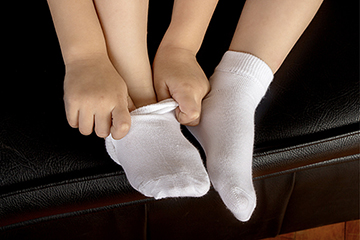
The primary ways that your family can help are to allow your child to be as independent as possible in all areas of his life. Let your child do as much for himself as his age and skill set allow in the areas of dressing, eating, food preparation, and contributing to his family. Let him choose his clothing and dress as much as he is able. If he cannot do all of a dressing task, let him do the part that he can. If he is not strong enough to pull on his whole sock, you can pull the sock over his heel and he can pull it up to his ankle. If he cannot manage his shirt, let him place his hands in the sleeve holes and then help him get his head into the head hole. Together pull the shirt over his torso. Removing clothes is an easier skill and will be mastered more quickly. With that comes the responsibility of placing the dirty clothes into the hamper. Sure, you can do it quicker, but letting him do it aids him in the path to independence! As he gets older invite him to help you sort the laundry, match the clean socks, fold the dish towels, and even carry his own lunch box to the car and into school. Try to constantly think
of things that you are doing that your child might be able to do
for himself.
Strive for independence in eating and food preparation. At mealtime, encourage your child to help prepare the meal. Teach your child to set the table. Perhaps, at first, he will only place the napkins under the fork. Eventually, he will know where all the parts of the table setting go and will be able to do it independently. This is a great way to get some quality family time while teaching valuable table-setting and food-preparation skills. A child as young as two can tear lettuce, and at three or four can cut vegetables using a child-friendly knife (https://www.forsmallhands.com/small-nylon-knife). Preschoolers can also help to cut vegetables or fruit even when they are not brave enough to eat them. Once the meal is on the table, encourage your child to serve himself from the family serving bowls. This is good practice in motor control as well as choosing the amount of food you are planning to eat. If your child is Elementary aged and your family is ordering ‘take out,’ allow your child to help in the planning and even in making the phone call to order the food.
Allow your child to get his own snacks independently (within reason). Create a place in your home that has snacks available for your child. Let him choose his own snack food from among those choices. Since you (the parent) stock the snack spot, you still have ultimate control over how much and what your child is eating. Your child is gaining valuable practice in deciding what to eat and how often to eat from these limited choices. If your refrigerator allows it, place a small pitcher and glass on a low shelf so your child can pour his own water or juice when he is thirsty.
As he moves towards Kindergarten, he is probably ready to take over parts of packing his own school lunch. Try to arrange your refrigerator so the things that your child will need for his lunch are available for him to access independently. He can select his own yogurt, or make his own sandwich, put his own fruit into the reusable container and close it (great motor practice), and fill his own water bottle. Let it be a joint effort until his skills are solid, and then let that be your child’s work because he has mastered another piece of independence. Let your child be a part of choosing what food to buy each week, so he gets to experience being a smart consumer. Once he is old enough, he will be able to contribute to the family grocery list and eventually shop for himself with confidence and skill.
Encourage your child to contribute to the family. A very young child can do simple tasks such as taking their plate to the sink, hanging up their towel or putting their toys away. Children a bit older can bring in the mail, feed the dog, empty the trashcans in the house, or take out the garbage. Families can work together to plan vacations, solve problems within their families, or create a new project, such as a vegetable garden or a fire pit. All of these things help the family to function as a unit and help children realize that they are a member of a group.
Optimal development is the goal of every Montessori classroom and every family. Guides encourage each child to grow in their social, emotional, academic, self-help, and motor skills each on his own timetable. All the adults in a child’s life help him along his path to independence, and by working together, parents and Montessori schools aid the optimal development of a child so he can become his most authentic, happy, and healthy self.
Tomorrow’s Child/ September 2018/Pg 34
An Education for Life: What Children Really Get Out of Montessori
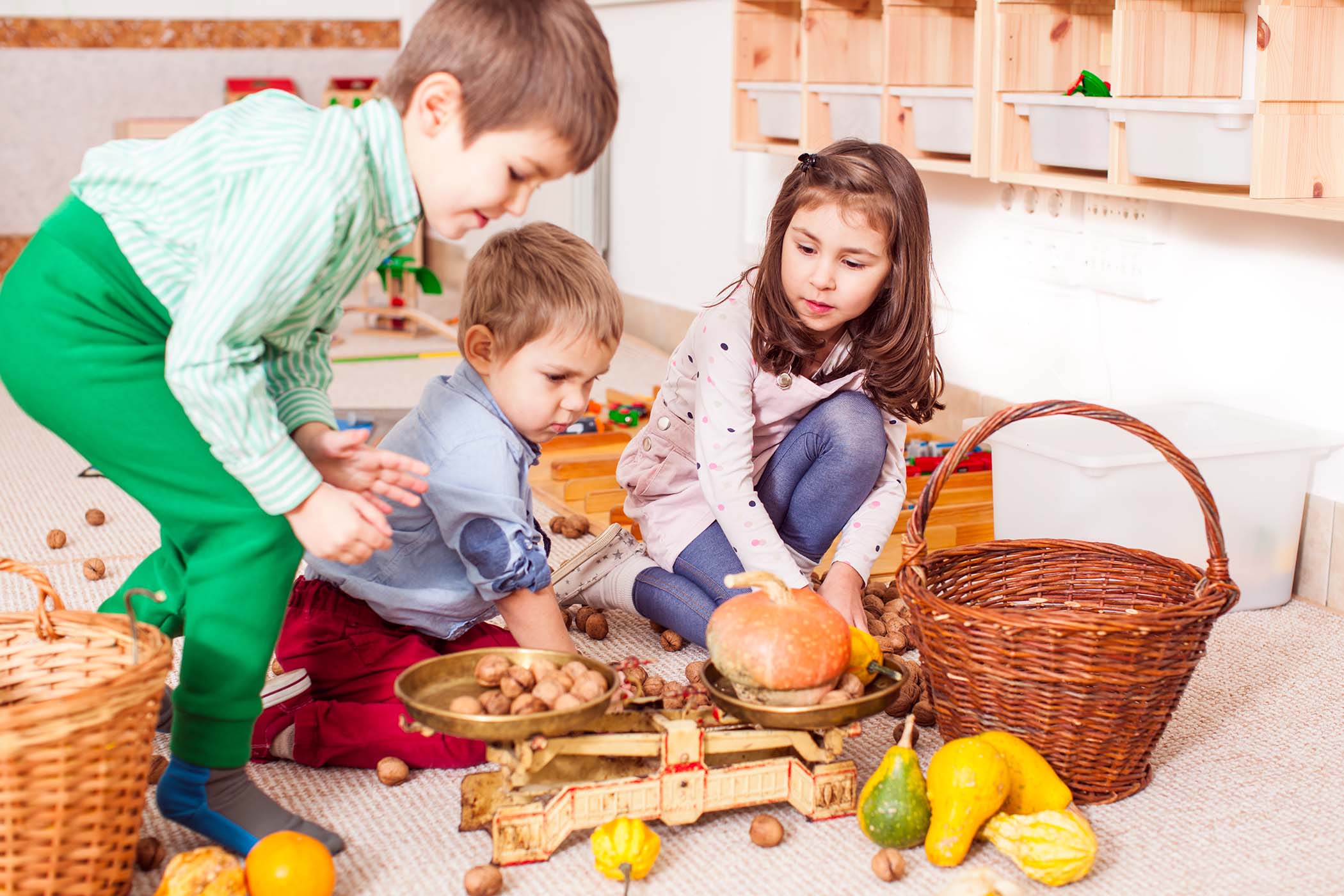
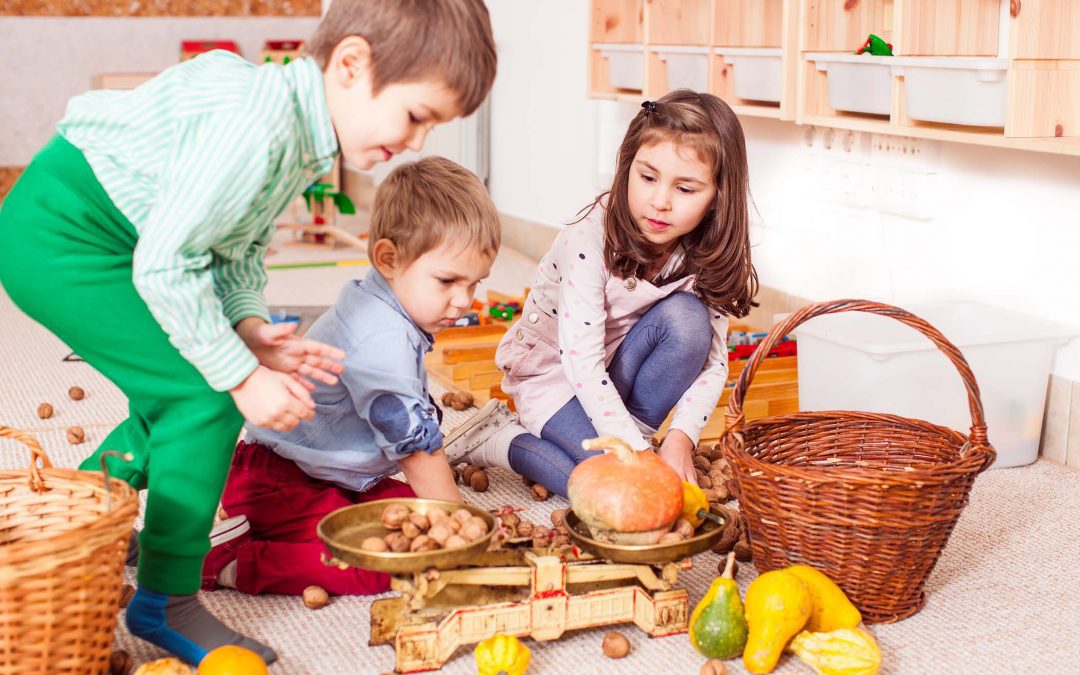
Children in kindergarten playing and exploring the concept of balance using weights
When we try to define what our children really “get” from Montessori, we need to expand our vision to include more than just the basics. Of course they learn to read, do four-digit mathematics, recognize geometric shapes, and identify the parts of a plant and a mollusk. They also learn how to be a contributing member of a community.
A Montessori school is more than a classroom. It is a society in a microcosm, and the skills and lessons they learn in this environment extend well beyond the traditional definition of academic success. They are life lessons that were very much needed at the time when Dr. Montessori developed her teaching methodology, and they are life lessons that remain relevant to our children today.
“The basic nature of our society and the family itself have changed radically, and only an equally radical change in education will suffice.”—John Dewey, School, and Society, 1899
In her book, The Schoolhome: Rethinking Schools for Changing Families (Harvard University Press, 1992, revised 2009), Dr. Judith Rowland Martin writes that she was not very impressed when she first encountered Montessori education. She understood that Montessori schools placed children in multi-age classrooms and used manipulative learning materials, which may have been very unusual during Montessori’s lifetime, but have since been incorporated into most early childhood and many elementary classrooms, thanks to the Open Classroom movement of the 1960s. However, Dr. Martin’s understanding of the value of the Montessori approach became dearer when she came across a statement in Dorothy Canfield Fisher’s book, A Montessori Mother (first published in 1912), in which Fisher disagrees with the universal interpretation given to Montessori’s “Casa dei Bambini” or “Children’s House.”
In A Montessori Mother, Fisher wrote, The phrase, ‘Casa dei Bambini,’ is being translated everywhere nowadays by English-speaking people as “The Children’s House,” whereas its real meaning, both linguistic and spiritual, is “The Children’s Home (or Children’s Community, ed.).” Fisher insisted upon this rendering, which she felt offered a much more accurate and complete insight into the character of the Montessori classroom.
Dr. Martin recognized that “This misreading of the Italian word ‘Casa’ as ‘house’ has effectively cut off two generations of American educators from a new and intriguing vision of what school can and should be. Read ‘casa’ as ‘house’ and your attention is drawn to the child-sized furniture, the Montessori materials, the exercises in practical life, the principle of self-education. But if you read ‘casa’ as ‘home,’ you begin to perceive a moral and social dimension that transforms your understanding of Montessori’s idea of a school.
Once I realized that she thought of school on the model of a home, the elements of her system took on a different configuration. Where before I had seen small children manipulating concrete learning materials, I now recognized a domestic scene with its own special form of social life and education.”
Martin realized that what Montessori had established was not simply a more attractive classroom in which children would be taught to read and write. The Casa dei Bambini represented a social and emotional environment where children would be respected and empowered as individual human beings.
It was an extended family, a community in which children truly belonged and really took care of one another. Montessori described this process of emotional growth as “valorization of the personality,” a strong sense of self-respect and personal identity. Within this safe and empowering community, the young child learned, at the deepest possible level, to believe in herself. In an atmosphere of independence within the community and personal empowerment, she never lost her sense of curiosity and innate ability to learn and discover. Confident in herself, she opened up to the world around her and found that mistakes were not something to be feared, but rather an endless opportunity to learn from experience.
This special relationship that is so common among Montessori children and their teachers and schools is very different from, and much more dramatic than, the experience most children have in school.
Frances Merenda, a 1990 graduate of The Barrie School in Silver Spring, Maryland put it this way:
“I started in Montessori at age two. I’m a product of the entire system. I did well, but still many people wondered if I had been prepared for college and whether I could ‘make it’ in a ‘real’ school? The skepticism was so disconcerting that I never bothered to step back and see what 15 years of trust, respect, teaching, and learning had done for me. When I went off to Northwestern University, I left my support system and community behind and entered a world that was much colder and uncaring.
At first, I deeply missed that sense of belonging. I didn’t realize that Barrie had not only given me a second family, but had also taught me how to build new friendships, support systems, and community wherever I go. I now use my years of experience in community building to cultivate secure relationships with people I have come to know. Barrie did more for me than just prepare me academically for college. It prepared me for anything to which I chose to apply myself.”
To understand how this evolved, it’s helpful to understand the world in which Montessori lived at the time she developed her educational approach.
Montessori was a professor of medicine, specializing in psychiatry. At that time, there was no such thing as Freud’s “talking cure.”
There were basically two approaches to the treatment of disturbed individuals.
The most common and familiar treatment was to confine people who acted strangely to insane asylums.
The second, and almost forgotten, approach was the “Moral Education” movement that spread across Europe and North America during the 1700 and 1800s.
These therapeutic communities were villages set off in the country where chronically despondent or nonviolently dysfunctional individuals lived in group settings with caring individuals.
The fundamental principle of the Moral Education movement was respect and kindness. Instead of treating their patients as prisoners, the staff acted on the belief that within each human being there is a core of goodness and a “sound mind.” The community lived and worked together as an extended family and developed a sense of belonging that is dearly reminiscent of what we see in our children’s classrooms today.
These communities were much like an Israeli Kibbutz, self-sufficient farming communities in which each individual was encouraged to become more independent while contributing to the overall operation of the village. Patients lived in small homes with a couple who served as their mentors. Surviving reports suggest that a great bond developed among those who lived and worked together. The movement recorded success rates that were far more effective than traditional approaches; returning their clients to their home communities as productive, happy citizens after an average stay of eleven months. A sense of close personal community and positive human relationships was proven successful as a means to help bring these disturbed people back to reality.
Montessori was well aware of this movement through her medical research into innovative strategies for treating the intellectually disabled. She used this same model with tremendous success in her own work with mentally disabled and autistic children in Rome and later hypothesized that even more dramatic results might be achieved with “normal” children. Her first “Children’s Community” was made up of 60 inner-city children from dysfunctional families.
In her book, The Montessori Method, Montessori describes the transformation that took place during the first few months of operation, as the children evolved into a “family.” The children had a sense of becoming the owners of their school. They were encouraged to rearrange the furniture, prepare and serve the daily meals, wash the pots and dishes, help the younger children bathe and change their clothes, sweep, clean, and work in the class garden. Through their day-to-day involvement in their classroom community, Montessori saw these children develop a sense of maturity and connectedness that helped them realize a much higher level of their potential as human beings.
While times have changed, the need to feel connected is still as strong as ever. In fact, for today’s children, it is probably even more critical.
Whether it’s an inner-city child or a child from an affluent suburb, the sense of community has all but disappeared from our children’s lives. Families regularly move from house to house, and from town to town. Grandparents usually live in other cities or other states. Both parents work out of necessity, and when they are at home, they are very, very busy. The over-programmed, hurried child has become the norm for this generation.
Many children have the sense that they do not belong to anything or anybody, which is why peer friendships, which give a sense
of belonging, are especially important to children today.
Along with whatever else Montessori gives our children, it definitely gives them the message that they belong-—that their school is like a second family.
Children will normally grow up to be productive, happy and confident individuals if given the right emotional environment. It seems clear that our attitudes about people, the ability to overcome our egocentric tendencies, our willingness to share, to compromise, to resolve conflicts non-violently, and our ability to discover an underlying sense of self-worth are not qualities that human beings develop spontaneously, but rather through years of experience with caring people who convince us that we belong and give us the opportunity to practice and master these skills of everyday living. As in all things, we learn by doing.
One of the greatest strengths in the approach that Montessori developed is the three-year age grouping that you will find in every Montessori school.
By consciously bringing children together in a group that is large enough to allow for two-thirds of the children to return every year, the school environment promotes continuity and the development of a very different level of relationship between children and their peers, as well as children and their teachers. For teachers, this relationship presents itself as a commitment that they make to stay with the children in their class for a prolonged period, rather than jumping from job to job or from classroom to administration. Montessori teachers do more than present curriculum. The secret of any great teacher is helping students open their minds and hearts so they are ready to learn; where motivation is not focused solely on good grades, but a fundamental love of learning.
As parents know their own children’s learning styles and temperaments, teachers, too, develop this sense of each child’s uniqueness by establishing a relationship over a period of years with the child and her parents. Montessori schools give our children not only the sense of belonging to a family but also of how to live with other human beings. By creating a bond of parents, teachers, and children, Montessori sought to build a community where individuals could learn to be empowered, where children could learn to be a part of families, where they could learn to care for younger children, learn from older people, trust one another, and find ways to be appropriately assertive rather than aggressive. To reduce these principles to the most simplistic form, Montessori proposed that we could foster peace by healing the wounds of the human heart and producing a child that is more secure. She envisioned her movement as potentially leading to a reconstruction of society.
Montessori schools are different, but it isn’t just because of the materials that are used in the classrooms. Look beyond the pink towers and golden beads, and you’ll discover that a classroom is a place where children really want to be—because it feels a lot like home.
Tomorrow’s Child/ September 2018/ pg 23

A Letter From The Editor: Crying With strangers Could Change The World
To continue reading, you will need to choose a subscription plan.
Hard Conversations with Your Child Part 2
To continue reading, you will need to choose a subscription plan.

The Child’s Power of Love
To continue reading, you will need to choose a subscription plan.
Featured
-
Montessori Family Alliance School Group Membership (Print & Digital 2026 1/2 year pricing)
Original price was: $30.00.$15.00Current price is: $15.00.
-
The Montessori Way, Revised and Expanded: An Education for Life; A Comprehensive Guide for Parents and Teachers
$25.00
-
The Montessori Child: A Parent's Guide to Raising Capable Children with Creative Minds and Compassionate Hearts (The Parents' Guide to Montessori)
$20.00
-
The Montessori Toddler: A Parent's Guide to Raising a Curious and Responsible Human Being (The Parents' Guide to Montessori)
$20.00
-
Montessori in Action: Building Resilient Montessori Schools 1st Edition
$29.95