
Montessori Pedagogical Guidelines for Supporting Learning at Home During COVID-19
Montessori Pedagogical Guidelines for Supporting Learning at Home During COVID-19
Montessori Collaborative Teacher Support Task Group
“It is necessary that the human personality should be prepared for the unforeseen, not only for the conditions that can be anticipated by prudence and foresight…… For success in life depends in every case on self-confidence and the knowledge of one’s own capacity and many-sided powers of adaptation.”
(Montessori, From Childhood to Adolescence, Appendix A, 1948)
Dr. Montessori’s words are certainly applicable in our time right now since we are clearly in the middle of the unforeseen! Therefore, as Montessori guides, we need to adapt our way of guiding our children and supporting their families according to our new situation. The goal of this document is to provide some guidelines for consideration so that Montessori principals can remain the base of our decisions and actions.
Respect
We respect humans of all ages, recognizing each as having their own unique way of learning and being. As such, we seek to provide individualized learning opportunities and guidance specific to each child and family’s needs. We acknowledge that children and adults, parents, teachers, and school administrators are experiencing a great amount of stress and trauma, therefore flexibility and genuine concern for the wellbeing of all takes precedence over academic learning goals.
Adaptability
Montessori philosophy and practices by design are meant to be adaptable to any culture and social needs. The needs of the children and families we serve during this time call for us to look beyond our typical classroom prepared environments, beyond our tried and true Montessori materials and beyond the lessons in our albums. We recognize that the child’s prepared environment is now the home and we must adapt lessons and expectations based on the wide variety of resources both physically and emotionally available within these home environments.
Community
In this time of physical distancing, social cohesion is more important than ever. All of us need each other. We need to expand the community spirit we cherish in our Montessori schools and classrooms bringing it into the hearts and homes of our children and families. Connection must be our main focus. Using a variety of digital platforms to be together in ways that make sense according to the age, size, interests and culture of your class. Have lunch together. Sing together. Dance together, Do yoga together. Play games together. Have sharing time. Foster ways for students and families to collaborate remotely in large and small groups.Encourage the role of social responsibility for all community members. Each member’s contribution to care for the home and family, as well as participating in the remote learning environment is valued.
Order
All humans thrive when there is order in their lives. Children especially need predictability and structure. Establish a prepared remote environment through routine. Carry on with the rhythm of your classroom as much as possible, as appropriate for your age group. Regularly schedule on-line lessons/gatherings. Present familiar songs, stories, classroom rituals. Create new structures for learning together remotely. Evaluate their effectiveness with your students and/ or parents as appropriate for your age level. Adjust when necessary, but as much as possible create routines, then stick to them. Provide resources to families to help them establish order and routines that will work for their family and child.
Independence
Help them help themselves is one of the foundational principles of Montessori. Our classrooms are designed to enable children to independently meet their own needs and contribute to the community. As children grow older in Montessori environments, they increasingly become more responsible for their own learning. Our current learning at home situation provides both challenges and opportunities related to this vital need for independence. Parents of younger children are likely to need support in preparing their environment to encourage independence. Activities recommended for young children must consider the ability of the child to do the work independently and parental limits to support children with complex activities while meeting other responsibilities. Older students can be encouraged to own their own learning with teachers providing guidance and accountability appropriate for each individual child.
Choice
Education is not something we do for or provide to children. Real learning and personal transformation are the result of engagement in freely chosen meaningful activities. Choice can happen naturally in well prepared school environments where there is an abundance of materials and activities that call to the child. The home environment may or may not provide for the same level of independence and choice. Our goal must be to help parents and children create opportunities for meaningful engagement and purposeful work at home. Resources, suggested activities, and lessons must include opportunities for choice with clear age appropriate expectations. Given the stress of the current situation, we must be flexible and offer choice for when, what, how and how much work will be done.
Creativity
Being thrust into this new way of teaching and learning can be a catalyst for creativity on our part as guides and on the part of our students. It is perfectly ok to use resources outside of our albums. Be open to experimentation and discovery. Be kind to yourself and your students if these experiments do not turn out as desired! Model for our students how we learn from our mistakes! Many students have fascinating projects of their own going on in their homes. Encourage this as an integral part of their learning and have them share to inform and motivate their peers.
Grace and Courtesy
Teach expectations for on-line interactions, both for guided class time and for when students interact with each other on social media without adult guidance. Acknowledge the need for grace and courtesy in our own homes and the homes of our students, recognizing that all of us are house-bound and experiencing more family togetherness than most of us are accustomed to! Practice and encourage kindness, patience and acceptance, with humility. We are all learners and doing the best we can in a stressful situation. Find the grace within and the courtesy to support each other.
Preparation for Life
Always keep in mind the higher goal of supporting the development of healthy capable flourishing human beings. Every moment in life is precious. Remember this in setting a positive tone and in appreciating the challenges everyone is experiencing. Address and incorporate world events and the current situation as appropriate for the needs of your students, acknowledging that these events may be taking a personal toll at many levels on many of the students’ families and on ourselves. Encourage students to participate in the work of their families at home: laundry, cooking, dishes, yardwork, sibling care. Support students’ grappling with their new living situations.
Love
Dr. Montessori said, “Of all things, love is the most potent.” It is love that will get us all through these difficult times. Work from your heart as much as your mind. Approach children and families with a generous eye, recognizing that everyone is doing the best they can. Be available to your students and families. Know that much of what will be accomplished right now is the establishment of a safe and comforting space. Set personal boundaries on when and how you can be reached to create a safe and comforting space for yourself and your family as well.
When Montessori Goes Viral: Supporting Families of Infants and Toddler at Home Following Montessori Principles
During this time of “lock-down” when most parents are suddenly in the dual roles of their professional work and caregiving, our advice and support are important for everyone’s wellbeing. Parents are quickly recognizing their need for their children’s independence, as they seek to telework while keeping their children safe and happy.
Our mission is also two-fold. We may be tasked with providing frequent and varied lesson plans and group classes. Yet our hearts and minds call us to view each child holistically and consider the context of stress and trauma that underlie our present circumstances.
Thank goodness our work is grounded in the child-centered, developmentally based theories of Dr. Maria Montessori. Let us examine core principles and how they should guide our support to families.
Children learn best in a prepared environment. At school, we strive to make our classrooms home-like. Now that children are home, let’s avoid making their living spaces school-like. We should help parents understand the importance of the prepared environment in supporting their children’s independence. We can suggest how to organize and display toys, keeping in mind each child’s unique interests and developmental abilities. We can explain how children do more with less, that children become overwhelmed when a toy or building block set has too many parts. We can give tips on how to rotate toys and activities to inspire interest, always leaving in place current favorites.
Children thrive on order and consistency. When children can find and care for their own belongings, they feel capable and responsible. When they can anticipate the routines of the day, they feel secure and confident. Children can be independent for long stretches of time when they have carefully arranged spaces for dressing, hygiene, preparing food, cleaning-up, and independent play.
Learning and development are dependent on movement and spontaneous activity. Parents need to understand that young children are driven to move in order to learn and develop. We serve this need by providing opportunities to challenge their bodies and to manipulate objects. In every area where the family spends time there can be a space where children can do gross motor and fine motor activities. We can meet with parents and help brainstorm ways to make this possible with what can be found at home.
Concentration occurs when a child’s mind, body and will are engaged. We can help parents recognize the “sweet spot” where an activity has the right amount of challenge without frustration. We can emphasize that young children are most interested in what is real and purposeful; that they want to participate in the daily life of the home. Children need freedom of choice of developmentally appropriate activities in order for deep engagement and concentration to take place. Because we want to protect this deep mental state we provide time for uninterrupted work. The type of play that children do when their bodies and minds are fully engaged we elevate to the status of ‘noble work’ as a recognition of its importance in helping children reach their fullest potential.
Once parents understand the importance of concentrated work, we can caution them to avoid interrupting it. Through observation we can help parents recognize when their child is focused on an activity, only stepping in when their child is clearly frustrated. They will come to appreciate their child’s interests and abilities and recognize their needs. They will notice the tendency for repetition as their child exhausts an activity in order to learn a new skill. We need parents to understand that their child’s focus is in the process not the product. This will help them avoid placing undue attention on their child’s end results and minimizing their efforts.
It is important to note that we are always in relationship with children. It is through collaboration that we learn and teach. We model, observe, offer points of interest, and observe again. Children watch and imitate in order to learn to be like the adults they love, to fit into the world they love. Our caregiving and guidance is a partnership based in love. Parents intuitively understand and appreciate this, but need a reminder in hectic and stressful times. Providing techniques to help them slow down and de-stress may be the most helpful support we can give. Each family’s situation is unique and what parents are able or willing to do will vary. We should meet them where they are with utmost humility and grace. As Dr. Montessori said, “Of all things love is the most potent.”
Early Childhood Considerations
Respect
• Recognize the unique developmental needs of children 3-6 when preparing and providing remote learning experiences and activities.
● Be flexible in your schedule expectations. Limited or no participating is an option and must be respected. When possible record virtual group meetings and make available for viewing at another time for those who are on a different timetable.
● Keep in mind the limited attention span of young children during group time. Use interactive songs and movement activities to keep young children engaged. Invite children to share.
● Use a variety of methods to reach out to your families to assess their needs and do it often as situations change frequently.
Adaptability
● Focus on concept versus materials. For example, young children like to classify so make suggestions on how to provide experiences for them to classify their home environment such as sorting laundry, finding items and sorting by color or shape. Encourage practical math with everyday objects and life experiences such as cooking or counting pinecones or flowers found in the yard. Encourage language development through reading, storytelling, sound games, listening games.
● Appreciating that learning does take place through all meaningful activities such as building materials, drawing, movement, free exploration.
● Provide suggestions that take into consideration varying abilities, interests, time restraints and available resources at the home.
Community
● Children are missing friends. They need to see each other, laugh together, and play. Make virtual group meetings fun and interactive.
● Have virtual sharing time encouraging children to share their pets, a favorite toy, something found on a nature walk, art projects, cooking projects…
● Connect with each individual family for weekly check-ins.
● Set up shared folders or classroom FaceBook pages for sharing of pictures and videos.
● Provide/encourage opportunities for families, children and/or parents to socially connect virtually.
Order
● The role of the teacher shifts from creating the orderly classroom environment to now coaching families on how to create order within the home and practical spaces for children to work and play independently within the home.
● Virtual options should be limited and flexible allowing families to fit things into their own personal schedules. For example, providing predictable on-line gatherings helps to establish a routine but also having recordings of those gatherings allow families to participate within their own schedule.
Independence
● Be mindful of how much parental involvement is needed with suggested activities
● Provide clear guidelines and procedures for parents so that they can set up activities with the child’s independence in mind.
● Help parents understand that clean-up of the activity is also the child’s work and provide guidance on how to help children learn cleanup processes.
● Send lists of materials for projects ahead of time whenever possible. Provide ideals for alternative materials with the consideration that everyone will not have all the supplies at home and may have a limited ability to purchase them.
● Give parents permission to be observers and allow the child space for exploration, mistakes, and independence in their interaction with the activity.
● Promote process versus product
Choice
● Remind parents that participation is optional and not mandatory
● Provide a variety of activities so children and parents can choose the best fit for the child’s ability, interest, and family situation
Creativity
● Be mindful that recommendations “outside of the box” are in alignment with core Montessori principles (concrete to abstract, process versus product, hands on, isolation of a single concept or skill, etc.)
Grace and Courtesy
● Encourage parents to discuss and model expectations and procedures instead of assuming children know these.
● Give parents suggestions and resources for positive and respectful guidance and redirection of challenging behaviors
● Provide resources for self-care and supporting emotional wellbeing for children and families
Preparation for Life
• Be mindful that the best preparation for later school success and life is to provide a safe, secure, loving environment that meets the present needs. Supporting children and families to get through this challenging time is the most important thing we can do to secure a healthy future.
Love
• Let love be your strength and guide.
Elementary Considerations
Respect and Grace and Courtesy
● Engage the elementary students in defining what respect looks like in this new online learning environment. Create agreements about ground rules and grace and courtesy.
● Encourage grace and courtesy both in virtual learning and in the home environmen
Adaptability
● Balance curriculum expectations (from district, school, parents) with individual needs and learning styles of children. Adapt expectations as needed and help each child feel successful.
● Provide options for follow up work and projects so students and families can adapt according to the time and resources they have available and according to each child’s needs.
Community
● Elementary children may be feeling particularly isolated given their great need for socialization. Consider this sensitive period when planning activities. Provide opportunities to learn collaboratively and share their experiences. Encourage students giving lessons to one another.
● Encourage presentations or reading in virtual meetings to younger levels in the school.
● Encourage a sense of responsibility to the community, especially in Upper Elementary, providing opportunities to participate as a vital part to the whole group such as in a group writing project or planning a community service project.
● Be creative in providing opportunities for virtual class and school community events such as art or talent shows or field trips.
Order
● Establish a prepared remote environment that complements the structure and routine that your children are familiar with from their experience in their Montessori classroom. Regularly schedule on- line lessons/gatherings keeping as many class routines and traditions as possible. Meet for literature circles on the same day each week. Hold community meetings on the same day each week.
● Engage the students in the process of creating, evaluating and adapting new structure for online learning.
● Be clear about expectations, ground rules, and procedures and provide consistency but be open to the students’ feedback and work together to adapt as needed.
Independence, Responsibility, & Ownership
● This is an ideal opportunity to really guide our students toward owning their own learning.
Encourage ownership of lessons, in their work and contribution in lessons, and in suggesting how lessons can be given.
● Encourage students to take responsibility for their home learning environment, to be prepared and to create an appropriate space for learning.
● Help students to work on their own effectively. Adapt student work plans used in your classroom into shared documents between you and each student for guidance and accountability.
● Support student independence individually according to their needs, just as you would in the classroom.
● Use online meeting spaces like Zoom for community time, class lessons, small group discussions, and one-on-one meetings, but allow significant off-screen time for independent 2nd period work. When there is correctable work, have students self-correct and self-report as much as possible.
Choice
● Just as in the classroom, provide acceptable work choices across the curriculum.
● Avoid the tendency to send out one size fits all curriculum and learning packets. Engage the students in determining what is meaningful work and in proposing ideas for research, projects, and presentations.
● Establish expectations together for how much time students should be reading, doing mathematics, and writing daily. Students can choose when and how and can offer their own ideas.
Creativity
● Embrace and encourage creativity. Be open to unique follow-ups on the part of your students.
● Continue providing visual and performing arts exposure and experiences. There are many avenues for this online.
Preparation for life
● Appeal to the elementary student’s natural interest in understanding the world around them by providing age appropriate opportunities to explore the current situation as it relates to social responsibility, and the political and scientific implications of this crisis.
● Assign life skills projects as part of the child’s at home /school learning projects
● Teach and model care of self and care of others. Mindfulness, a time of day to be silent, practice counting ten positive things per day, an attitude of gratefulness and appreciation.
Love – Let love be your strength and guide.
Ideas for Adapting Existing Elementary Curriculum to Accommodate Remote Learning
● Use shared documents for accountability and feedback.
● Focus on cultural studies and high interest independent research and expert projects. Have students prepare presentations of their work to share on-line.
● Incorporate math learning into cultural work: graphing, measuring, probability, statistics.
● Encourage student initiative. Have students design a project, a learning plan, or the schedule of their new days at home.
● Make use of eBooks for literature study.
● Guide chemistry experiments through cooking, botany with houseplants (with permission!) or gardens or woods, or astronomy with sky observations. Use online science videos and interactives for demonstrations.
Ideas for Incorporating the Pandemic into Elementary Curriculum
● Hold a seminar on what Peace Education brings to a pandemic.
● Keep a class pandemic journal or a blog to personally document this time in history.
● Teach the law of supply and demand, stock market/investments/gold standard/currency.
● Study the geographic spread of the pandemic.
● Write a projected ending to the current situation or respond to the crisis through poetry.
● Explore and evaluate the many ways that pandemic data have been represented. Teach log plots.
● Connect with other schools in other states or countries for cultural sharing.
● Examine local sustainability efforts or home gardening.
● Study historic pandemics and the outcomes. What can we learn?
Ideas for Service Work
● Write friendly letters to the elderly and letters of gratitude to community service workers.
● Make face masks.
● Weed someone’s garden in the neighborhood.
● Help with an online after school club for neighbors.
● Connect with younger children in earlier levels of your own Montessori school for read aloud.
● Create care packages for postal office workers and other delivery workers.
● Donate time or food to local food banks.
Pedagogy in a Pandemic: Secondary Goes Online
Despite our newly formatted online prepared environments, the primary focus of secondary guides should remain the same: to meet the developmental needs of our adolescent learners. Those include the need for:
Independence
Community
Adaptability
Self-expression
Self-reflection
Choice
Grace and courtesy
And above all else, Love
Adolescents in both middle and high schools want to understand the social world and how they fit into it. They want to understand how organizations work and how they are constructed, the different roles needed to uphold society, the values that hold social organizations together, how they relate to the society as a whole, and how they relate to those within it through their roles. This drives them.
As at other educational levels, the needs and the unstoppable growth can’t get shuttered even in a pandemic. Just as our secondary learners can’t help physically changing, neither can they shut down the irresistible urge to grow intellectually, socially, and perhaps now even more acutely, in matters of the spirit. Despite all that is going on around them, they are doing what they have always done and can’t help doing: steam ahead toward being an adult and changing from the mindset of a child to the mindset of a newly forming social member of society. That can happen as much online as it does in a brick and mortar setting, because it happens within.
Young adult learners are well-versed in change, sometimes clumsy at it and other times navigating with great skill. But they are now facing change on a new front and with surrealistic intensity as they craft their life in a pandemic. Their mission – to grow up – now includes the distraction of mid-school year changes in their prepared learning environments. The social role they have been developing outside of their home has been redirected to either a former or new role at home, perhaps that of helping working parents with younger siblings and more critical household jobs. And they are being asked to invent new virtual roles required to support an online classroom community. If they are not grieving for the loss of a family member or friend due to the virus, they may be grieving over the loss of expected rites of passage this year, i.e. a prom, a performance, a college tour, an end of year trip, or a graduation. Remember, all of this is on top of trying to navigate adolescence.
The pandemic has jarred us all, and we need stability. But we know that stability comes from adaptability. If we have done our work to help our young adult learners become adaptable and able to innovate in the uncertain and unforeseen, then they have a leg up on grappling with the new, real-time, real-life challenges.
Our job is to balance the challenges our young adult learners are facing with unconditional love as a caring and supportive guide, to continue to make the space for an intentional social community and their unique role within it, and to provide opportunities to support the developmental needs listed above. In the transformation of in-person learning to online learning, we take great care to continue our real mission of meeting developmental needs. As secondary guides, we are in a unique position, because unlike at the earlier levels, we can more easily transform to an online format. It is not desirable. But it is by degrees easier because we are not so dependent on the concrete materials and more about the abstract experiences and challenges we build for our learners. We can continue to provide for the social needs through continued relationships. Thankfully, most are experienced with virtual interaction with their peers through social media. We can use our online platforms to share lessons, work, presentations, small group discussions and private meetings in breakout rooms. We can offer such learning experiences as Socratic Seminar Discussions of current events and social justice issues, diagraming of governmental and social structures and proposals of change, collection of scientific data for analysis, interdisciplinary projects that include inquiry and reflection. And we can even establish community roles. Even in a virtual environment can we offer opportunities for jobs in resource management, class meeting facilitation, collaborative projects, and the continued development of the class business.
Change, the unforeseen, the ambiguous – all are authentic facts of the adult world. Let’s model what we do with it, share our struggles and successes as we face the challenges of the pandemic, and ask for our learners to collaborate in structuring their learning experiences. Let’s stay true to Montessori and not hang onto content as the end and only result but as just one means to the end, albeit important. But no amount of content can teach growing up. And no amount of content will attract them to learning and growing if it takes them out of the context of their social world and their interests – especially now. To the end that content can help build the deeper learning that satisfies their fundamental and developmental needs, it is useful. Consider the desired outcomes and zero in on how to use content to support not dictate. And above all as you design learning experiences, let us let our learners take time to reflect, connect, and continue their questions as they demonstrate their cosmic task in the face of the unforeseen but authentic.
Adaptable innovators will understand what holocaust survivor Elie Wiesel said. “You have to turn it into something else.” * So, we are turning an unprecedented historical moment into something else. A practical life experience for our young adult learners, where they can continue to learn independence, adaptability, community, inquiry. We can do it online as long as we stay focused on what they need. It’s never solely about history or math or language arts any way. It’s always about character, empathy, peace. It’s always about their becoming adults. So, we need to turn their prepared environment into “something else” something other than what we thought we would be doing this year. And we can do it!!! It’s a new prepared environment. We are a very precious resource for initiation and support, and above all love. If they can understand that they are still loved, still heard, still valuable, then our work can continue. We just need to be creative in how we deliver.
Secondary Considerations
Respect
Dr. Montessori admonishes us to respect the adolescent with the greatest of care and not treat that emerging adult as we would a child. Therefore, we can respect our learners’ needs to become part of the pandemic conversations if not solutions through Socratic discussion, research on current events, studies that do not circumvent the pressing issues at hand. We are not responsible for taking their minds off of the pandemic, neither should we dramatize it. But since their social world has and will continue to be disrupted, we can respect their need to take a role in thinking through what the future should look like for their generation. We respect that while change is inherent in adolescence, sudden change requires patience and intuition on the part of the guide. Not typically do the normal changes in adolescence become overpowered by grief and trauma. But when they do, we rely on our relationship with our learners and the power of their adaptability.
Adaptability
Adaptability is one of the top distinguishing qualities of a Montessori adolescent. As a society, we are recognizing what Montessori wrote about so long ago – that we must prepare our learners for the unforeseen. Our structures of inquiry that foster independence through inquiry-based learning and Socratic reasoning equip our youth to understand what they know and how to find answers to what they don’t know. And most of all, it prepares them to understand that there is much they don’t know they even need to know yet. But being adaptable enables them to be ready, flexible, and capable. In our third period lessons, adolescence focus on innovation. Tasking them to take on the role of innovating in their own learning, in their new format, with new distractions, is the training that they now need and what appeals to their developmental readiness to deal with the practical life of the 21st Century adult.
Community
Most adolescents have already embraced an online community through gaming and social media. Many adults have shaken their heads in dismay, but the modern teen has less of a journey in this transition to online learning. While nothing can replace the importance of sharing a physical space with another individual, our socially oriented young adult learners can continue social interactions and collaborative learning virtually. Being part of an intentional community – regardless of format – brings occasions for discussion, resource management, stewardship, accountability, intellectual challenge, and social exchange. Adolescents need to feel they are important, and a role in their online community continues their development of self-esteem and valorization. Let’s let the community work its magic and help its members to tackle the challenges we are facing together.
Order
Structure is no less important for teens than for children. Order is a fundamental need that is satisfied by providing certain routines, many of which can be accommodated in an online format. Morning meetings, regular Socratic Seminar Discussions, even regular deadlines provide the rituals that comfort and demand integrity. For the adolescent learner who is facing not only extreme internal but extreme external changes, the predictable and orderly structures to their newly prepared environment support their grace and growth.
Independence
Independence does not mean severance from community. Independence describes the ability to function on one’s own through one’s strengths and creativity. At the secondary level, independence is a quality brought to a group as one learns to stand on one’s own and be of unique value to a community. Independence is the support that one brings to interdependence, the heartbeat of adult society. It begins at birth when a child masters movement then continues through acquisition of language, moving on to social skills and then to social roles, where we find our young adult learners. Independence on all levels is a key to success as an adult. It is especially important in a secondary online learning environment where learners often find themselves alone and accountable for their schoolwork and community roles, independent of parents, teacher and peers. Socially driven learners are challenged despite the specific learning format to be honest, supportive, and respectful members of the community, independent of structured supervision.
Choice
Deep learning that leads to understanding and application is the result of choice. Choice allows learners to connect to interests and skills and enables them to place what they are learning in a meaningful context. Today’s choices seem limited given the stress of the current situation, so we must be innovative in making choice part of our lesson plans and schedules – even as they are occurring virtually. While we continue to guide choices and outline reasonable expectations, we must be flexible and offer choices for when, what, how and how much work will be done.
Creativity
Being thrust into this new way of teaching and learning can be a catalyst for creativity on our part as guides and on the part of our students. It is from the authenticity of real life that we form our lessons and it is real life itself that hands secondary learners their materials. Be kind to yourself and your students if these experiments do not turn out as desired! Model for our students how we learn from our mistakes! Many students have fascinating projects of their own going on in their homes. Encourage this as an integral part of their learning and have them share to inform and motivate their peers.
Grace and Courtesy
Teach expectations for on-line interactions, both for guided class time and for when students interact with each other on social media without adult guidance. Acknowledge the need for grace and courtesy in our own homes and the homes of our students, recognizing that all of us are house-bound and experiencing more family togetherness than most of us are accustomed to! Practice and encourage kindness, patience and acceptance, with humility. We are all learners and doing the best we can in a stressful situation. Find the grace within and the courtesy to support each other. But remember that our adolescent learners are trying out new ways of relating and communicating, now as young adults. Sometimes we need to be explicit in teaching appropriate language, social media practices, and humor. Online learning enhances these lessons.
Preparation for Life
Always keep in mind the higher goal of supporting the development of healthy capable flourishing human beings. Every moment in life is precious. Remember this in setting a positive tone and in appreciating the challenges everyone is experiencing. Address and incorporate world events and the current situation as appropriate for the needs of your young adult learners, acknowledging that these events may be taking a personal toll at many levels on many of the students’ families and on ourselves. Encourage students to participate in the work of their families at home: laundry, cooking, dishes, yardwork, sibling care. Support students’ grappling with their new living situations. Loopback to the idea that their family has unexpectedly become a bigger part of their social network and that they have an important role in it and need to be a steward of it.
Love
Dr. Montessori said, “Of all things, love is the most potent.” It is love that will get us all through these difficult times. Work from your heart as much as your mind. Approach adolescents and families with a generous eye, recognizing that everyone is doing the best they can. Be available to your learners and families. Know that much of what will be accomplished right now is the establishment of a safe and comforting space. Set personal boundaries on when and how you can be reached to create a safe and comforting space for yourself and your family as well.
Work
We all need work to feel useful, to grow, and to learn. It is through work that we construct ourselves. The format of work is not the issue as much as what the work entails and the meaning and authenticity of it. To be of use through work, to be empowered through work, to make connections through work is a present necessity and possibility.

Video: Montessori – The Science — Part 1: Introduction to Montessori Education
Dr. Angeline Lillard presents Maria Montessori’s key insights about childhood education, the subsequent educational research that has validated her approach, and how these ideas are implemented in a modern Montessori classroom.
From Montessori: The Science Behind the Genius
For more information, visit: http://montessori-science.org

Montessori: The Science — Part 2: Learning to Write then Read
To continue reading, you will need to choose a subscription plan.

Montessori: The Science — Part 5: Interest Enhances Learning
Dr. Angeline Lillard presents Maria Montessori’s key insights about childhood education, the subsequent educational research that has validated her approach, and how these ideas are implemented in a modern Montessori classroom.
From Montessori: The Science Behind the Genius
For more information, visit: http://montessori-science.org

Montessori: The Science — Part 6: Avoid Extrinsic Rewards
Dr. Angeline Lillard presents Maria Montessori’s key insights about childhood education, the subsequent educational research that has validated her approach, and how these ideas are implemented in a modern Montessori classroom.
From Montessori: The Science Behind the Genius
For more information, visit: http://montessori-science.org

Montessori: The Science — Part 7: Social Education is Effective
Dr. Angeline Lillard presents Maria Montessori’s key insights about childhood education, the subsequent educational research that has validated her approach, and how these ideas are implemented in a modern Montessori classroom.
From Montessori: The Science Behind the Genius
For more information, visit: http://montessori-science.org
Montessori: The Science — Part 8: Meaningful Contexts Assist Learning
Dr. Angeline Lillard presents Maria Montessori’s key insights about childhood education, the subsequent educational research that has validated her approach, and how these ideas are implemented in a modern Montessori classroom.
From Montessori: The Science Behind the Genius
For more information, visit: http://montessori-science.org

Montessori: The Science — Part 9: Positive Adult Interaction
Dr. Angeline Lillard presents Maria Montessori’s key insights about childhood education, the subsequent educational research that has validated her approach, and how these ideas are implemented in a modern Montessori classroom.
From Montessori: The Science Behind the Genius
For more information, visit: http://montessori-science.org

Montessori: The Science — Part 10: Order in the Environment and Mind
Dr. Angeline Lillard presents Maria Montessori’s key insights about childhood education, the subsequent educational research that has validated her approach, and how these ideas are implemented in a modern Montessori classroom.
From Montessori: The Science Behind the Genius
For more information, visit: http://montessori-science.org

Webcast Intentional Connections with author, Dorothy Harman
Dorothy Harman is the author of Intentional Connections. Parent/Teacher partnerships aren’t automatic in the busy lives of working families. Parent involvement requires deliberate action on the part of the teacher to develop a relationship between child, teacher, and home. There is a need to intentionally create and prepare that relationship with the same deliberate attention as preparing the classroom environment. Practical strategies will include tools for effective parent teacher conferences, tools for discussing success and challenges, effective newsletter writing, parent education opportunities, at-home volunteerism, and easy to implement parent/child activities for the home.

Dr. Fred Luskin Keynote
To continue reading, you will need to choose a subscription plan.
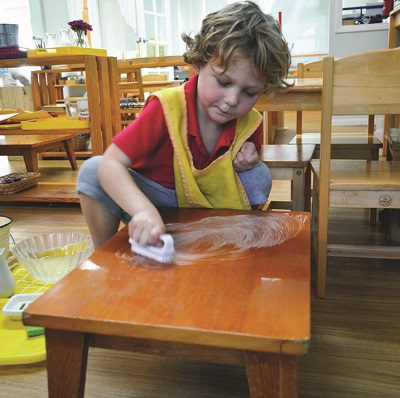
Table Washing: Why Do Montessori Students Spend So Much Time Washing Tables?
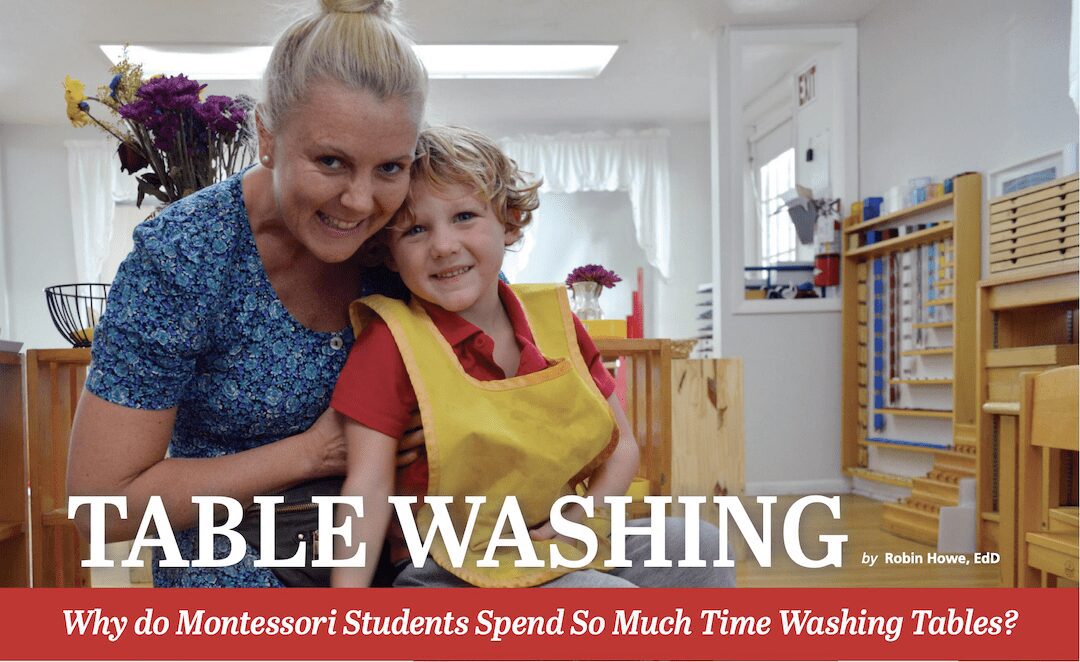
by Robin Howe, EdD
Editor’s Note: If we had a dollar for every time a skeptical parent has questioned the amount of time their young Montessori child spends washing tables …
ANATOMY OF A LESSON
Ironically, I missed the session of my Montessori teacher training when we were given the lesson on how to wash tables. I remember doing it as a Montessori child. How hard could it be? I was just getting out of my first career in the restaurant business, and someone was going to teach me how to wash a table? I had washed and set tables for the rich and famous. I had cleaned more tables than everyone in that class combined. I was, in fact, relieved to miss that day of instruction. The summer training session ended, with my teacher trainer reminding me that I still needed to have a lesson on table washing.
A month later, about three weeks into the school year, where I was doing my internship, my lead teacher, a wonderful, experienced Montessorian, invited me to join her while she gave a review lesson to one of the returning students on table washing. Great, I thought! This was my opportunity to receive the lesson, seemingly without missing a beat. About twenty minutes later, I found myself sitting there observing a four-year-old finish up his work, while I, the ‘non-lesson-needing ‘expert’ watched dumbfounded.
I once thought that table washing was one of the most remedial tasks that a Montessori student would ever have to learn. As a result of watching this lesson, and essentially being humbled by a four-year-old (also an experience that has since occurred on many occasions), I have come to realize how important and difficult this work is for children.
I have now learned how to give this lesson, and it never ceases to amaze me that it is so complicated. More amazing is the way that my students seem to pick it up so quickly and how I still, after many lessons, have to focus in order to perform it correctly. For these reasons, I would like to share the lesson, as well as some observations, on how children respond to this exercise. It is my hope that others will gain a better appreciation for the complexity of this lesson and will, as a result, appreciate its importance and contribution as a part of the Montessori curriculum.
When working with any water exercise, the first step is to have the child put on an apron. Students are already familiar with where aprons are kept in the classroom, as well as how to put one on. Next, the teacher asks the student to go together to where the table-washing kit is located on the shelf. The child is either shown or asked to identify the table-washing kit and is then asked to take it to the side of the table that will be washed, placing the kit on the floor next to the table. Included in the table-washing kit are the following: soap in the soap dish; a soap brush; a pitcher for gathering the water; a bucket for dirty water; a basin (or bowl); a sponge; a drying cloth; and a hand towel that will serve as a mat for the materials. Generally, the materials are kept in the basin that will be used for the water. With the hand towel in place on the floor, the materials are arranged along the top of the hand towel in this order: sponge, soap, brush, drying towel (from left to right), and the water pitcher. And basin along the bottom. Note: This lesson may vary depending on the classroom and teacher.
After all the materials are placed on the towel, water is brought to the table using the water pitcher. Children have to fetch the water, which exercises body control as they navigate through the classroom, returning carefully with a pitcher filled with water (about two-thirds full). Then, the water is poured from the pitcher to the basin. The pouring of water from a pitcher is an extension of work that the student has already mastered in earlier Practical Life lessons.
Next, the brush is wet and run across the soap until it is foamy. Using the wet, soapy brush, the table is methodically scrubbed in a circular motion. There should be small, but visible, suds on the surface of the table.
The brush is then rinsed and returned to its place on the mat. The dirty water is poured from the basin to the bucket, and the child carefully walks the dirty water to the sink to empty it. He will return it to the mat and fetch the pitcher so that he may again fill it with clean water to pour into the basin.
Now, the child wets the sponge and wrings out the excess water. Both the wetting of the sponge, as well as the squeezing of the sponge, are skills the child already possesses as a result of previous lessons in Practical Life. Starting at the bottom of the table, moving in horizontal motions, the child begins to rinse the soap from the table.
The sponge is wet once again. As an extension of this Practical Life exercise, the student might be asked to count how many compresses the sponge gets and then count the number of squeezes in order to expel excess water.
The child rinses the sponge, and picks up the towel to begin carefully drying the table top. After the surface is completely clear, the child checks the edge for suds and wipes it accordingly.

Step 1: Apron

Step 2: Collecting Materials for the Lesson

Step 3: Preparing the Materials

Step 4: Getting Water

Step 5: Pouring Water

Step 6: Wet the Brush

Step 7: Soap the brush

Step 8: Scrub the Table

Step 9: Dump the Dirty Water

Step 10: Fill the Pitcher with More Clean Water

Step 11: Pour the Clean Water into the Bowl

Step 12: Wet and Wring the Sponge

Step 13: Wipe the Table with the Sponge

Step 14: Dry Table with Cloth

Step 15: Dump Dirty Water into Bucket

Step 16: Dump Dirty Water

Step 17: Clean Up Any Spills

Step 18: Roll Up a Clean Towel

Step 19: Fold the Mat

Step 20: Return the Materials to the Tray
At this point, the table is now clean and dry, and the basin is filled with soapy water. The student then pours the water in the basin into the bucket and disposes of the soapy water. The process of disposing of the water is also a very important part of the lesson. The child, again, has to navigate through the classroom, focusing on his movement and the balance of the bucket so as to not spill the water. This is great practice for walking slowly and being patient.
Once the water is dumped, the child uses the towel to make sure the work area is clean and dry. The dirty towel is placed in the laundry hamper, and a fresh towel is carefully rolled, and placed in the pitcher. Next, the mat is carefully folded and all materials are returned to the tray as they were found.
This lesson is important for many reasons. As mentioned during the lesson description, the child has to practice patience, while exercising fine-motor skills and balance. The student’s ability to sequence is challenged, as the proper completion of the work is dependent upon the ability to follow the proper steps. Another important aspect of this lesson, perhaps overlooked much of the time, is the time that the student spends working with the teacher. This is one of the longest lessons and can often take up to fifteen minutes.
During this process, children must listen carefully and ask questions, which helps them develop important language skills.
I hope that my description of this exercise offers some insight into the Montessori classroom and instills a sense of respect and feeling of awe for the children. Similar to the mistake I made, many people assume that these lessons with simple names must be simple, causing us to wonder how they could be so important. Indeed, I have come to realize that they are important, not only as a part of children’s Montessori academic curriculum but also their development as people. •
Daniel Robinson (Robin) Howe, III was a Montessori student from age two through the eighth grade. He worked his way through multiple levels of certification, spent many years in the classroom, managed a number of Montessori schools, and then earned his EdD. Formerly, co-head of the NewGate School, Robin is a senior consultant with the Montessori Foundation.
TOMORROW’S CHILD © • NOVEMBER 2019 • WWW.MONTESSORI.ORG

Dealing With Tantrums
I’m going to dive right in to discuss a very tricky area for parents and children alike: tantrums.
I hope you find this article useful so you can start applying Montessori principles in your home too.
Dealing with Tantrums
Tantrums are a pretty normal part of life with children from around one to five years old. Maybe they’ll start a little later than one year and will end earlier, but anything in this range is fairly normal. Your child is learning that things don’t always go their way. And, as parents, we are helping them learn how to deal with these emotions and to make amends.
It can be upsetting for a parent. It’s hard to realize that your child is actually asking for your help. They are overwhelmed by the situation and need your support to calm down. It’s not the time to take it personally.
How to Avoid Tantrums
It can be possible to avoid tantrums before your child loses control. Here are some ideas to ward off tantrums when you see the first signs of your child losing control.
1. Be prepared: take a small bag with some simple games and some favorite snacks if you expect your child to wait patiently in a doctor’s office or a cafe.
2. Label their feelings: “Boy, you really wish you could stay longer”; “You really wanted some orange juice right now!”
3. Redirect them: “I can’t let you hit your brother, but you can hit this drum/pillow.”
4. Get down to their level: “You sound frustrated. Can you tell me why?”
5. If they are struggling, ask them if they would like some help: give them just as much help as they need and then step back.
6. Give them a choice: “Would you like to put on your shoes or your scarf first?”
7. Establish routines: “… and after lunch, we’ll go to the toilet, read a book, and tuck in for a rest.”
8. Let them show their anger creatively, “Show me how angry you are. Here is some paper and a pencil. Wow. They are big circles. You are really mad!”
Triggers
Events can often escalate to a full-blown tantrum. Sometimes it’s from your child’s frustration; other times their anger or rage; sometimes because they want to be in control; their communication may still be limited; or because they are tired, hungry, or overstimulated. They can throw themselves on the floor, push us away, try to hit us, a sibling, another child, or even break something.
It can be useful to note things that cause tantrums in your child: over-scheduling can be common; a new baby; moving to a new house; or certain children may trigger them.
Sometimes the tantrum is even caused by us as we deliver the news that it is time to leave the park, or we serve some food they don’t like for dinner, or that we would like them to get dressed to leave the house.
It’s OK for your child to have a tantrum. You can acknowledge their displeasure at what is going on. You can help them to do the thing that they don’t like. However, when we back down and give in to them, you will find they shout even louder next time.
It’s difficult to be the parent and stay strong. But your hard work will pay off in the long term. They will learn that when you say no, you mean no; and when you say yes, you mean it too.
I like the advice from Positive Discipline for Preschoolers (by Nelsen EdD, Jane, Erwin M.A., Cheryl, et al. Jul 9, 2019). “If you say it, mean it; and if you mean it, follow through with kind and firm action.”
Action may be, for example, leaving the park with a sad toddler, acknowledging that they really wish they could stay longer.
Alternatives to Time Out: How to Help Your Child Calm Down
When your child is having a tantrum, some experts advise putting them into time out. I find this difficult as your child is asking for help to calm down, and you are removing your support and punishing them instead.
When we punish our children, they often get angry at us rather than being sorry for what they have done. Or they try to work out a way to get away with it next time without being caught.
Instead, I look for ways that I can support my child to calm down. I’m not saying that their behavior is OK, but when they are in the middle of the tantrum, it is not the time to teach them anything. They cannot hear you. They have lost control. So let’s help them calm down.
Some children will respond to a cuddle during a tantrum. You can rub their back, cuddle them, and sing to them as they go through all the range of emotions from anger, to intense frustration, to sadness, and sometimes regret. I once held my son for 40 minutes as he refused to get dressed. And I watched him go through all these emotions. In the end, he announced he was ready to get dressed. He told me he loved me. He wasn’t angry with me. He was grateful that I had just been there for him. I know sometimes you have to leave, but in this case, we just changed our plans.
Other children will push you away and don’t want to be touched. In this case, I make sure they are safe and cannot hurt themselves or others. I stand nearby and keep offering my help, “I’m here if you need some help to calm down. Or we can have a cuddle when you are ready.” After the tantrum, I like to offer a cuddle. “That was tough. And now you have calmed yourself down. Would you like a hug?”
If they are throwing toys at their sibling or trying to hit me, I would remove them so that everyone is safe. “I can’t let you hit me. My safety is important to me. Would you like to hit these pillows instead?” If your child is trying to hurt the baby, you can place yourself physically between them to keep the baby safe as you help your older child calm down.
For a child over three years old, you can set up a “calm place,” which they can use when they are upset. It may be a tent with some pillows and favorite things. It may be a corner with some trains. You can ask your child if she would like to go to her calm place.
This is different than ‘time out,’ as the older child is in control; she can come out when she feels calm. If she comes back still in a rage, I would gently tell her that she looks like she still needs to calm down and can come back when she is ready.
Making Amends
Maybe you are thinking that if I support my children while they calm down, I’m saying that their behavior is OK, and I’m encouraging them to get angry. When they are upset, indeed, my objective is to help them calm down.
Once they are calm, I then help them to make amends. If they drew on the walls, I would get them to help me clean up. If they broke their brother’s toy, they can help to fix it. I’ve asked the kids to help scrub their sheets when they used marker pens in bed and made a mess.
In this way, they learn to take responsibility when things go wrong. And when it’s over, it’s over. The good thing about young children is that they can move quickly from deep anger and sadness back to their happy selves. We need to move on too and not let this upset the whole day by referring back to it or keeping on about it. Once they have made amends, it’s OK for everyone to move on. •
TANTRUM FAQs
Shouldn’t we just ignore their tantrum?
I don’t like to ignore children when they are having a tantrum. They may not let me touch them, but I keep offering support and letting them know I am available when they need me. If you were super upset and your partner just left the room for you to get over it, you would likely find them unsupportive. We are showing our kids that, good or bad, we will be there for them.
What do I do if we are out in public when they have a tantrum?
There are basically two options:
First: Go home—if you find it difficult to have people watching you, it’s best to just leave. This may mean parking a full shopping cart and following the above ideas once you are home.
Second: Stay and support them—my preferred option is to hang in there and do what you would do even though you are out of the house. If you have more than one child with you, make sure they are safe. And then offer as much help as you can to help your child calm down. People watching will more likely think about what a lovely, patient parent you are, rather than what a horrible noise your child is making.
I find it difficult to stay calm myself. What can I do?
If your child has triggered you, it is indeed difficult to help them calm down.
• If your partner is available, it can be easiest to get them to step in instead.
• You may want to make sure the kids are safe and go to the bathroom to catch your breath.
• Find a mantra that you can repeat, “I breathe in calm, I breathe out anger.”
• Remember not to take it personally. Perhaps visualize putting on a bullet-proof suit that will resist everything (including words) that your child throws at you.
These tips should help you remain calm and give your child the support they need to regain control.
Learn from Simone Davies, an AMI Montessori teacher with15+ years’ experience working with 0-3-year olds, owner of Jacaranda TreeMontessori in Amsterdam since 2008, mother of two teenagers, and author of the book The Montessori Toddler. Visit her blog at themontessorinotebook.com
This article is from the November 2019 issue of Tomorrow’s Child magazine. Reprinted with the author’s permission.

Children Learn Best When Parents Learn With Them
To continue reading, you will need to choose a subscription plan.
Webcast: The Life Cycle of a School Year How To Get Ahead Of The Curve!
To continue reading, you will need to choose a subscription plan.

Discipline Alternatives: For The Montessori Classroom & Home
“The undisciplined child enters into discipline by working in the company of others; not being told he is naughty … Discipline is, therefore, primarily a learning experience and less a punitive experience if appropriately dealt with.” —Maria Montessori

Teachers spend years learning to create an atmosphere in Montessori classrooms that embody the wisdom of Dr. Montessori while fostering the spiritual awakening in their students and themselves. Administrators try, via parent education and engagement, to explain the developmental stages of children so that expectations are realistic for all. Montessori parents are a special group of people who want a very holistic education for their children. However, none of us is immune to needing some reminding of how to talk and treat people we encounter regardless of their place in this world. We are all in this together. By practicing and modeling these skills we can all benefit and change the world.
Many parents and teachers, and some Montessori Directresses make use of ‘time out’ as a means of compelling children to behave in a certain way. Sometimes, the child is required to sit on a specific chair. Sometimes this is called a ‘thinking chair,’ and the child is instructed to think about what he has done. There are many variations on this theme, and the strategy has many names. Ultimately, they all boil down to the same thing.
According to Montessori, a child who is unruly or disruptive should be taken aside by the Directress, away from the disruption of his peers. The adult will stay with the child, quietly re-assuring him, until he is ready to return to his work. This has been interpreted by some as an endorsement of the ‘time-out chair.’
Although removal from the activity of other children can help an over-excited or distraught child to calm down, it is very difficult to use the chair in a non-punitive way. Maria Montessori is quite clear in her writings that punishments have no place in a Montessori environment.
In the early years of its use, the ‘time-out chair’ was seen as a positive step in disciplining young children, as opposed to scolding or complete isolation, or in the absolutely unacceptable (but not absolutely obsolete) practice of spanking children. The technique was regarded as an aid in helping children to learn independence and self-control. Children could take part in group or individual activities as long as they obeyed the house rules. Any infraction would mean removal from activities and peers and, for a specified time, sitting in a designated place some distance away from the center of activities.
The adult then gave the child the opportunity to determine when he felt he could rejoin the group as a cooperative member or asked the child (after whatever time interval seemed appropriate) if he could now cooperate with the rules and be readmitted to the group. The problems associated with a time-out system are essentially those that arise from any method of punishment. Children may well behave in the required way, but they conform in order to avoid being sent to the chair, whether or not they have internalized the rules. It is a simple example of operant conditioning.
Time-out and other punishments are not appropriate in a Montessori environment because they focus on behavior rather than internal development. Punishments reinforce what Maria Montessori called “obedience of the wrong kind.”
Punishments don’t work because they neither help to develop the willpower associated with real choice nor do they help to teach alternative, more acceptable behaviors. Any authoritarian approach discourages creative problem-solving, the development of appropriate conflict-resolution techniques, and the growth of an internal locus of control.
In many ways, isolation from the group can be even more negative than physical punishment, as it engenders feelings of rejection in the child, which can have serious implications for children with already diminished self-esteem. These ideas are supported by Peter Haiman, who argues effectively against the use of time-out in the home. His arguments apply equally to the classroom.
Most importantly, as Ann Clewett points out, “The very existence of the chair causes anxiety in some children.”
The use of star charts and black marks (or any other version of the debit/credit system) has the same result. These systems, just by being evident in the environment, can trigger a stress response in some children, which often results in the very behavior they are designed to deter. Frequent use of these systems only serves to reinforce the child’s negative self-concept by repeatedly humiliating the transgressor in front of his peers.
Clewett’s alternatives to the time-out chair are very similar to those proposed by Dr. Montessori:
“Rather than removing the child from the learning situation when she makes mistakes, we should stop the inappropriate behavior and send her back into the situation to practice the new behavior. Once a child knows that we are helping her find new ways of accomplishing what she wants to, she will begin to think out more acceptable ways herself.”
Until she grasps the concept of alternate ways, she will revert to old habits. Intervention to prevent aggression and suggestions of acceptable alternatives must be made for a number of weeks before children begin to use the alternatives consistently themselves.
The important point in Clewett’s argument is that the adult helps the child “find new ways of accomplishing what she wants to…” Instead of trying to change the child’s behavior, we help the child choose different strategies. By avoiding the use of punishment (and, for that matter, rewards) we shift the emphasis from control to cooperation, from conflict
to collaboration.
A child who might resist control comes to see the adult as an ally, someone to turn to when help is needed. The absence of punishments and rewards is critical to the development of self-discipline.
References
Britton, J. L. . “Montessori Explained,” Child Education (July 1984)
Clewett, Ann. “Guidance and disciple: Teaching Young Children Appropriate Behavior,” Young Children (May 1988)
Haiman, Peter. “The Case Against Time Out,” www.naturalchild.org/guest/peter_haiman.html
Sharon Caldwell is a Montessori consultant in South Africa. She is also a member of the staff of the Montessori Foundation.
Tomorrow’s Child/ Jan 19 / pg 10

Emotional Behavioral Disorders In Toddlers & How These Children Can Be Supported In A Montessori Toddler Classroom
To continue reading, you will need to choose a subscription plan.
Featured
-
Montessori Family Alliance School Group Membership (Print & Digital 2026 1/2 year pricing)
Original price was: $30.00.$15.00Current price is: $15.00.
-
The Montessori Way, Revised and Expanded: An Education for Life; A Comprehensive Guide for Parents and Teachers
$25.00
-
The Montessori Child: A Parent's Guide to Raising Capable Children with Creative Minds and Compassionate Hearts (The Parents' Guide to Montessori)
$20.00
-
The Montessori Toddler: A Parent's Guide to Raising a Curious and Responsible Human Being (The Parents' Guide to Montessori)
$20.00
-
Montessori in Action: Building Resilient Montessori Schools 1st Edition
$29.95