

Webcast: How Do You Know If Your Professional Development Dollars Are Well Spent
To continue reading, you will need to choose a subscription plan.

Dear Cathie
To continue reading, you will need to choose a subscription plan.

Wonder-filled Year of Change: 2 to 3 Years Old
To continue reading, you will need to choose a subscription plan.
Setting Limits and Making Them Stick!
To continue reading, you will need to choose a subscription plan.

Discipline Alternatives: For The Montessori Classroom & Home
“The undisciplined child enters into discipline by working in the company of others; not being told he is naughty … Discipline is, therefore, primarily a learning experience and less a punitive experience if appropriately dealt with.” —Maria Montessori

Teachers spend years learning to create an atmosphere in Montessori classrooms that embody the wisdom of Dr. Montessori while fostering the spiritual awakening in their students and themselves. Administrators try, via parent education and engagement, to explain the developmental stages of children so that expectations are realistic for all. Montessori parents are a special group of people who want a very holistic education for their children. However, none of us is immune to needing some reminding of how to talk and treat people we encounter regardless of their place in this world. We are all in this together. By practicing and modeling these skills we can all benefit and change the world.
Many parents and teachers, and some Montessori Directresses make use of ‘time out’ as a means of compelling children to behave in a certain way. Sometimes, the child is required to sit on a specific chair. Sometimes this is called a ‘thinking chair,’ and the child is instructed to think about what he has done. There are many variations on this theme, and the strategy has many names. Ultimately, they all boil down to the same thing.
According to Montessori, a child who is unruly or disruptive should be taken aside by the Directress, away from the disruption of his peers. The adult will stay with the child, quietly re-assuring him, until he is ready to return to his work. This has been interpreted by some as an endorsement of the ‘time-out chair.’
Although removal from the activity of other children can help an over-excited or distraught child to calm down, it is very difficult to use the chair in a non-punitive way. Maria Montessori is quite clear in her writings that punishments have no place in a Montessori environment.
In the early years of its use, the ‘time-out chair’ was seen as a positive step in disciplining young children, as opposed to scolding or complete isolation, or in the absolutely unacceptable (but not absolutely obsolete) practice of spanking children. The technique was regarded as an aid in helping children to learn independence and self-control. Children could take part in group or individual activities as long as they obeyed the house rules. Any infraction would mean removal from activities and peers and, for a specified time, sitting in a designated place some distance away from the center of activities.
The adult then gave the child the opportunity to determine when he felt he could rejoin the group as a cooperative member or asked the child (after whatever time interval seemed appropriate) if he could now cooperate with the rules and be readmitted to the group. The problems associated with a time-out system are essentially those that arise from any method of punishment. Children may well behave in the required way, but they conform in order to avoid being sent to the chair, whether or not they have internalized the rules. It is a simple example of operant conditioning.
Time-out and other punishments are not appropriate in a Montessori environment because they focus on behavior rather than internal development. Punishments reinforce what Maria Montessori called “obedience of the wrong kind.”
Punishments don’t work because they neither help to develop the willpower associated with real choice nor do they help to teach alternative, more acceptable behaviors. Any authoritarian approach discourages creative problem-solving, the development of appropriate conflict-resolution techniques, and the growth of an internal locus of control.
In many ways, isolation from the group can be even more negative than physical punishment, as it engenders feelings of rejection in the child, which can have serious implications for children with already diminished self-esteem. These ideas are supported by Peter Haiman, who argues effectively against the use of time-out in the home. His arguments apply equally to the classroom.
Most importantly, as Ann Clewett points out, “The very existence of the chair causes anxiety in some children.”
The use of star charts and black marks (or any other version of the debit/credit system) has the same result. These systems, just by being evident in the environment, can trigger a stress response in some children, which often results in the very behavior they are designed to deter. Frequent use of these systems only serves to reinforce the child’s negative self-concept by repeatedly humiliating the transgressor in front of his peers.
Clewett’s alternatives to the time-out chair are very similar to those proposed by Dr. Montessori:
“Rather than removing the child from the learning situation when she makes mistakes, we should stop the inappropriate behavior and send her back into the situation to practice the new behavior. Once a child knows that we are helping her find new ways of accomplishing what she wants to, she will begin to think out more acceptable ways herself.”
Until she grasps the concept of alternate ways, she will revert to old habits. Intervention to prevent aggression and suggestions of acceptable alternatives must be made for a number of weeks before children begin to use the alternatives consistently themselves.
The important point in Clewett’s argument is that the adult helps the child “find new ways of accomplishing what she wants to…” Instead of trying to change the child’s behavior, we help the child choose different strategies. By avoiding the use of punishment (and, for that matter, rewards) we shift the emphasis from control to cooperation, from conflict
to collaboration.
A child who might resist control comes to see the adult as an ally, someone to turn to when help is needed. The absence of punishments and rewards is critical to the development of self-discipline.
References
Britton, J. L. . “Montessori Explained,” Child Education (July 1984)
Clewett, Ann. “Guidance and disciple: Teaching Young Children Appropriate Behavior,” Young Children (May 1988)
Haiman, Peter. “The Case Against Time Out,” www.naturalchild.org/guest/peter_haiman.html
Sharon Caldwell is a Montessori consultant in South Africa. She is also a member of the staff of the Montessori Foundation.
Tomorrow’s Child/ Jan 19 / pg 10
Montessori Discipline: Developing Inner Discipline Through Freedom and Structure
To continue reading, you will need to choose a subscription plan.
The Emotionally Healthy Child
To continue reading, you will need to choose a subscription plan.
Parenting in the Digital Age
To continue reading, you will need to choose a subscription plan.

Would You Ask Parents if They Own Guns before Okaying a Playdate?
To continue reading, you will need to choose a subscription plan.

Emotional Behavioral Disorders In Toddlers & How These Children Can Be Supported In A Montessori Toddler Classroom
To continue reading, you will need to choose a subscription plan.

Montessori at Home: The Adult Prepared Environment
To continue reading, you will need to choose a subscription plan.
Webcast: Addressing Challenging Behaviors in the Montessori Classroom: Systems for Supporting Staff and Students
To continue reading, you will need to choose a subscription plan.
Webinar: Empowering Choices
To continue reading, you will need to choose a subscription plan.
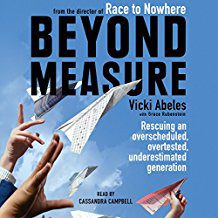
Book Review: Beyond Measure: Rescuing an Overscheduled, Overtested, Underestimated Generation
Beyond Measure: Rescuing an Overscheduled, Overtested, Underestimated Generation
Written by Vicki Abeles, Director of Race to Nowhere, with Grace Rubenstein
If you saw the documentary Race to Nowhere, this book is a compelling reminder that the work is not yet done to change the conventional system of education in the United States to one that will support our children’s happiness, health, love of learning, and the ability to thrive as adults. If you did not have the opportunity to see Race to Nowhere, see if you can view it and look forward to Vicki’s second film, Beyond Measure.
Definitely, read this book as a prequel. We need to keep pushing forward for the sake of all children, not just our own, as cultures take a long time to change and the conventional model of education is just not working.
I feel a little like I’m preaching to the choir as most of you that are reading this review have your children in Montessori schools or are teaching in one and are giving children a different educational experience than the conventional one. However, I know that Montessori high schools are few and far between, and as much as we don’t want to admit it, some Montessori schools feel pressured to prepare their students for the conventional system. So again, we are faced with either conventional high school for our children when they finish Montessori school or a modified Montessori program that still tests, uses grades, and gives busy work to do at home. So, we still have work to do in our own schools not to mention in our communities, where the vast majority of children go to conventional schools.
Much of the beginning of Beyond Measure focuses on the damaging effects of conventional education on our children. Then the author goes on to offer inspiring examples of how changes are happening in homes and schools across the country, as well as practical solutions that you can implement in your homes, schools, and communities.
This a book that every parent, teacher, administrator, and politician needs to read and take action on. We cannot wait any longer. Vicki Abeles puts it well. “We must collectively decide…to meet children where they are…” And we must see the “…new vision for great schools as hubs of deep personal learning… and frame them as centers for fostering lifelong wellness.”
Go out and get a copy to read. Then once you’ve read it, go out and get as many copies as you can to distribute to friends, relatives, educators, and politicians, because there is strength in numbers!
With permission from the authors, I included a lesson inspired by Calvin & Hobbes
Written by Jo Schofield & Fiona Danks
Reviewed by Joyce St. Giermaine
Building a fort, treehouse, or hideaway is part of children’s imaginary world, where anything might be possible. Forts are universal play places; you can make them almost anywhere, out of almost anything. In Fantastic Forts, children learn how to make the most of outdoors (and indoors) to create one-of-a-kind forts. Published by Quarto Publishing Group, this book is filled with pictures to inspire the child in your life and the inner-child in all of us.
Tomorrow’s Child / April 2016 / P 32
How to Address Challenging Behaviors Part 2
To continue reading, you will need to choose a subscription plan.
Webcast: Establishing Ground Rules in Montessori Classrooms
To continue reading, you will need to choose a subscription plan.

Setting Limits It’s Not too Late! The Hows & Whys to Setting Limits
What Are Limits?
Limits tell your family under what condition you are willing or unwilling to do something. They tell your family where you “draw the line.” They tell what you will or will not tolerate. Their purpose is to take care of you. Limits are not designed to control or manipulate someone else’s behavior. Here are three examples:
Example 1. A mother was playing basketball with her two teenage sons. The boys were getting competitive and soon the game wasn’t fun. Mother announced, “It is not fun for me when you two fight. When you are ready to make it fun again, come and get me. I’d love to play again.”
Example 2. Children need you to set limits so that they can recognize and respect other people’s limits. I was holding hands roller-skating with my daughter. She said in a very demanding tone of voice, “Skate faster!” This wasn’t the first time I had noticed that she was being demanded, so I said, “I am unwilling to have you talk like that to me. It makes me feel like not cooperating with you, and if you continue, I will skate by myself.”
Example 3. A daughter asked her mother to take her to the video store and rent a movie. Her daughter had already spent her allowance that week. Mom said, “I’d be willing to take you to the video store, but I am unwilling to rent a movie for you.” Limits give others important information about you to help them know what they can or cannot expect from you. They are about you, not about criticizing someone else’s behavior or about trying to make them act in a certain way.
Why Do Children Need Limits?
Children need you to set limits so that they can recognize and respect other people’s limits.
Limits provide a sense of security. When children don’t know your limits, they feel lost in an abyss. They feel confused and sometimes literally bounce around trying to find some.
Limits make children feel that we care about them. Children that are raised without limits often feel abandoned.
Children need limits to learn how to deal with conflict. What happens when someone tells me I have overstepped their limits? What happens when someone disrespects mine?
Children need limits to help them define themselves. Limits set by parents help children clarify their own limits because they have seen your model.
Limits help them to learn what is socially acceptable and what is not.
Children need to learn that if they go past a certain point, there will be consequences. Some of
them may be serious.
What Issues Need Limits?
You may want to set limits on the use of your belongings, TV watching, bedtime, your time, the use of profanity, mealtime, chores, care of pets. This is not a conclusive list. Make a list of your important issues.
How Do We Know When Our Limits Are Being Violated?
The best clue to determine whether or not your limits are being violated is by being in touch with your feelings.
If any of the following feelings sound familiar, you know that your limits are being dishonored or that you are not being clear about them:
I feel anger, resentment, imposed upon, smothered, taken advantage of, and/or abused.
I feel as if I am pulling more than my fair share of the weight.
I feel unappreciated.
I feel as if I am being divided between two people I love.
I feel taken for granted.
I feel like a taxi cab driver.
What about me?
Why Do We Have A Difficult Time Setting Limits?
Our ability to set and follow through with limit setting will be largely determined by how we were parented as a child. Setting limits may be difficult for you if you were in any of the following situations:
Not having any limits as a child, being unsupervised.
Being given messages, such as: Don’t make waves; Children are to be seen and not heard; You are being selfish.
If you were told it wasn’t “nice” to assert yourself.
If there was abuse in the home or at work that was mental, physical, emotional, sexual, drug or alcohol related.
If there was someone in your family that you had to give up your needs for because they were sick or disabled.
If self-sacrifice was modeled and expected of you.
If intimidation was used to motivate you.
If you don’t set limits because you don’t feel you deserve them.
If you feel guilty about your own actions such as, working too much or getting a divorce.
What We Do Instead Of Setting Limits?
Because we are afraid of creating conflict, we often choose one of the following behaviors rather than setting limits We are afraid the other person will get angry, leave us, or reject us. We may even feel that what we say or do will not make a difference anyway. Instead of directly setting limits, we sometimes indirectly handle these situations by:
Deny it (act or pretend as though it didn’t happen).
Ignore it and hope it’ll go away.
Talk yourself out of how you are feeling (I shouldn’t feel that way because of … ).
Make excuses for the other person’s behavior (he only said that because he was tired).
Ruminate about the issue (Going over and over the event in your mind, trying to make sense of it).
Blame someone else.
Blame yourself (if I had only done … he wouldn’t act this way).
Get even.
Hide behind righteousness (I’m above having those feelings).
Pretend that you don’t care.
Withhold your love or your communication.
What Can We Expect When We Start Setting Limits?
When you first start setting limits, you can expect that your children’s behavior will get worse. They will test you. They will try everything in their power to get you to go back to the way you used to be. So, make sure your seatbelt is fastened. You may be going for a ride!
Steps For Setting Limits
1. Honor your feelings. Remember, feelings are neither right nor wrong.
They just are.
2. Get clear about what you want. What you are and are not willing to do.
3. Present the information to your family member using an “I” statement. For example, “I am unwilling to wash clothes that are not in the hamper.” There should be no blame, shame, guilt, exaggerations, or complaining. Do this step as soon as possible to prevent an unnecessary build-up of resentment.
4. Be ready to ‘stick to your guns.’ Be consistent and follow through.
Tomorrow’s Child/ November 2017
Featured
-
 The Montessori Way, Revised and Expanded: An Education for Life; A Comprehensive Guide for Parents and Teachers
$25.00
The Montessori Way, Revised and Expanded: An Education for Life; A Comprehensive Guide for Parents and Teachers
$25.00
-
The Montessori Child: A Parent's Guide to Raising Capable Children with Creative Minds and Compassionate Hearts (The Parents' Guide to Montessori)
$20.00
-
The Montessori Toddler: A Parent's Guide to Raising a Curious and Responsible Human Being (The Parents' Guide to Montessori)
$20.00
-
Montessori in Action: Building Resilient Montessori Schools 1st Edition
$29.95
-
Bulk Order, 30 Copies of Montessori for Every Family: A Practical Parenting Guide To Living, Loving, And Learning
Original price was: $600.00.$510.00Current price is: $510.00.




Products
-
The Montessori Way, Revised and Expanded: An Education for Life; A Comprehensive Guide for Parents and Teachers
$25.00
-
The Montessori Child: A Parent's Guide to Raising Capable Children with Creative Minds and Compassionate Hearts (The Parents' Guide to Montessori)
$20.00
-
The Montessori Toddler: A Parent's Guide to Raising a Curious and Responsible Human Being (The Parents' Guide to Montessori)
$20.00
-
Montessori in Action: Building Resilient Montessori Schools 1st Edition
$29.95
-
Bulk Order, 30 Copies of Montessori for Every Family: A Practical Parenting Guide To Living, Loving, And Learning
Original price was: $600.00.$510.00Current price is: $510.00.