To access this page, you will need to log in or become a member.

by Angeline Lillard | Brain Development, Child's Work, Discipline, Emotional Intelligence (EQ), Emotionally Healthy Children, Empowerment, Free Reads, Infant, Infant-Toddler (0 to 3), Kindergarten, Lower Elementary (6-9), MFA, Mixed Ages, Montessori Curriculum, Montessori Education, Montessori Family Life, Montessori Middle School, Montessori Secondary / High School, Practical Life, Primary (3-6), Psychology, Research, Sensitive Periods, Sensorial, Upper Elementary (9-12), Video
Dr. Angeline Lillard presents Maria Montessori’s key insights about childhood education, the subsequent educational research that has validated her approach, and how these ideas are implemented in a modern Montessori classroom.
From Montessori: The Science Behind the Genius
For more information, visit: http://montessori-science.org
by Robin Howe, EdD | Child's Work, Family Resources, Free Reads, MFA, Montessori Curriculum, Montessori Education, Montessori Family Life, Montessori Parenting, Parent Education, Practical Life, Primary (3-6), Tomorrow's Child
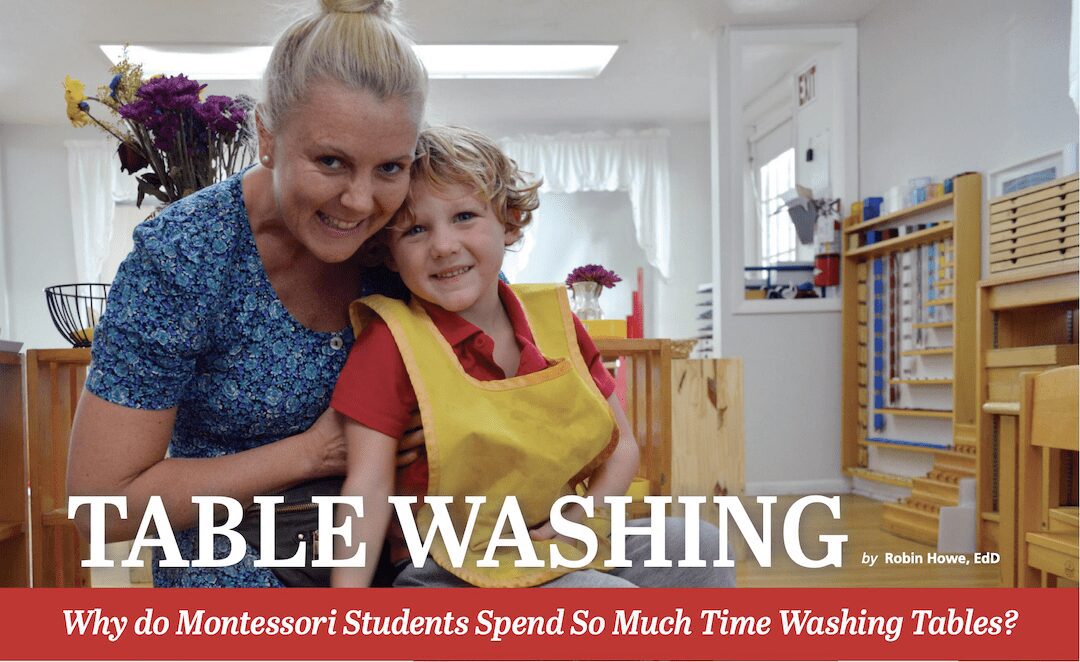
by Robin Howe, EdD
Editor’s Note: If we had a dollar for every time a skeptical parent has questioned the amount of time their young Montessori child spends washing tables …
ANATOMY OF A LESSON
Ironically, I missed the session of my Montessori teacher training when we were given the lesson on how to wash tables. I remember doing it as a Montessori child. How hard could it be? I was just getting out of my first career in the restaurant business, and someone was going to teach me how to wash a table? I had washed and set tables for the rich and famous. I had cleaned more tables than everyone in that class combined. I was, in fact, relieved to miss that day of instruction. The summer training session ended, with my teacher trainer reminding me that I still needed to have a lesson on table washing.
A month later, about three weeks into the school year, where I was doing my internship, my lead teacher, a wonderful, experienced Montessorian, invited me to join her while she gave a review lesson to one of the returning students on table washing. Great, I thought! This was my opportunity to receive the lesson, seemingly without missing a beat. About twenty minutes later, I found myself sitting there observing a four-year-old finish up his work, while I, the ‘non-lesson-needing ‘expert’ watched dumbfounded.
I once thought that table washing was one of the most remedial tasks that a Montessori student would ever have to learn. As a result of watching this lesson, and essentially being humbled by a four-year-old (also an experience that has since occurred on many occasions), I have come to realize how important and difficult this work is for children.
I have now learned how to give this lesson, and it never ceases to amaze me that it is so complicated. More amazing is the way that my students seem to pick it up so quickly and how I still, after many lessons, have to focus in order to perform it correctly. For these reasons, I would like to share the lesson, as well as some observations, on how children respond to this exercise. It is my hope that others will gain a better appreciation for the complexity of this lesson and will, as a result, appreciate its importance and contribution as a part of the Montessori curriculum.
When working with any water exercise, the first step is to have the child put on an apron. Students are already familiar with where aprons are kept in the classroom, as well as how to put one on. Next, the teacher asks the student to go together to where the table-washing kit is located on the shelf. The child is either shown or asked to identify the table-washing kit and is then asked to take it to the side of the table that will be washed, placing the kit on the floor next to the table. Included in the table-washing kit are the following: soap in the soap dish; a soap brush; a pitcher for gathering the water; a bucket for dirty water; a basin (or bowl); a sponge; a drying cloth; and a hand towel that will serve as a mat for the materials. Generally, the materials are kept in the basin that will be used for the water. With the hand towel in place on the floor, the materials are arranged along the top of the hand towel in this order: sponge, soap, brush, drying towel (from left to right), and the water pitcher. And basin along the bottom. Note: This lesson may vary depending on the classroom and teacher.
After all the materials are placed on the towel, water is brought to the table using the water pitcher. Children have to fetch the water, which exercises body control as they navigate through the classroom, returning carefully with a pitcher filled with water (about two-thirds full). Then, the water is poured from the pitcher to the basin. The pouring of water from a pitcher is an extension of work that the student has already mastered in earlier Practical Life lessons.
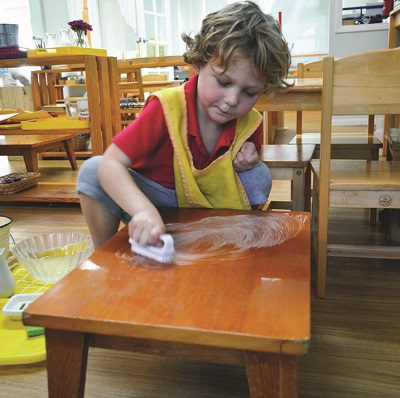
Next, the brush is wet and run across the soap until it is foamy. Using the wet, soapy brush, the table is methodically scrubbed in a circular motion. There should be small, but visible, suds on the surface of the table.
The brush is then rinsed and returned to its place on the mat. The dirty water is poured from the basin to the bucket, and the child carefully walks the dirty water to the sink to empty it. He will return it to the mat and fetch the pitcher so that he may again fill it with clean water to pour into the basin.
Now, the child wets the sponge and wrings out the excess water. Both the wetting of the sponge, as well as the squeezing of the sponge, are skills the child already possesses as a result of previous lessons in Practical Life. Starting at the bottom of the table, moving in horizontal motions, the child begins to rinse the soap from the table.
The sponge is wet once again. As an extension of this Practical Life exercise, the student might be asked to count how many compresses the sponge gets and then count the number of squeezes in order to expel excess water.
The child rinses the sponge, and picks up the towel to begin carefully drying the table top. After the surface is completely clear, the child checks the edge for suds and wipes it accordingly.
Step 1: Apron
Step 2: Collecting Materials for the Lesson
Step 3: Preparing the Materials
Step 4: Getting Water
Step 5: Pouring Water
Step 6: Wet the Brush
Step 7: Soap the brush
Step 8: Scrub the Table
Step 9: Dump the Dirty Water
Step 10: Fill the Pitcher with More Clean Water
Step 11: Pour the Clean Water into the Bowl
Step 12: Wet and Wring the Sponge
Step 13: Wipe the Table with the Sponge
Step 14: Dry Table with Cloth
Step 15: Dump Dirty Water into Bucket
Step 16: Dump Dirty Water
Step 17: Clean Up Any Spills
Step 18: Roll Up a Clean Towel
Step 19: Fold the Mat
Step 20: Return the Materials to the Tray
At this point, the table is now clean and dry, and the basin is filled with soapy water. The student then pours the water in the basin into the bucket and disposes of the soapy water. The process of disposing of the water is also a very important part of the lesson. The child, again, has to navigate through the classroom, focusing on his movement and the balance of the bucket so as to not spill the water. This is great practice for walking slowly and being patient.
Once the water is dumped, the child uses the towel to make sure the work area is clean and dry. The dirty towel is placed in the laundry hamper, and a fresh towel is carefully rolled, and placed in the pitcher. Next, the mat is carefully folded and all materials are returned to the tray as they were found.
This lesson is important for many reasons. As mentioned during the lesson description, the child has to practice patience, while exercising fine-motor skills and balance. The student’s ability to sequence is challenged, as the proper completion of the work is dependent upon the ability to follow the proper steps. Another important aspect of this lesson, perhaps overlooked much of the time, is the time that the student spends working with the teacher. This is one of the longest lessons and can often take up to fifteen minutes.
During this process, children must listen carefully and ask questions, which helps them develop important language skills.
I hope that my description of this exercise offers some insight into the Montessori classroom and instills a sense of respect and feeling of awe for the children. Similar to the mistake I made, many people assume that these lessons with simple names must be simple, causing us to wonder how they could be so important. Indeed, I have come to realize that they are important, not only as a part of children’s Montessori academic curriculum but also their development as people. •
Daniel Robinson (Robin) Howe, III was a Montessori student from age two through the eighth grade. He worked his way through multiple levels of certification, spent many years in the classroom, managed a number of Montessori schools, and then earned his EdD. Formerly, co-head of the NewGate School, Robin is a senior consultant with the Montessori Foundation.
TOMORROW’S CHILD © • NOVEMBER 2019 • WWW.MONTESSORI.ORG
by Punum Bhatia Ph.D | Montessori Parenting, Outdoor Education / Resources, Practical Life
“Set the children free, let them have fair play, let them run out when it is raining, take off their shoes when they find pools of water, and when the grass of the meadows is damp with dew, let them run about with bare feet and trample on it; let them rest quietly when the tree invites them to sleep in its shade; let them shout and laugh when the tree invites them to sleep in its shade; let them shout and laugh when the sun wakes them up in the morning, as it wakes up every other living creature, which divides its day between waking and sleeping,” (Montessori, 1997, p. 71)
Children are inherently connected to nature and fascinated by living things. Due to a variety of factors, including increased academic pressures in schools, over-scheduling of extracurricular activities, increased reliance on technology for entertainment, and fear of children being left alone outdoors, children are spending more time indoors than ever before. Connection to nature, however, is an integral part of the Montessori philosophy and methodology. The Montessori Method stresses that immersion in nature is imperative for proper physical and psychological development. Today’s outdoor classrooms are not a new concept in Montessori schools. Maria Montessori wrote:
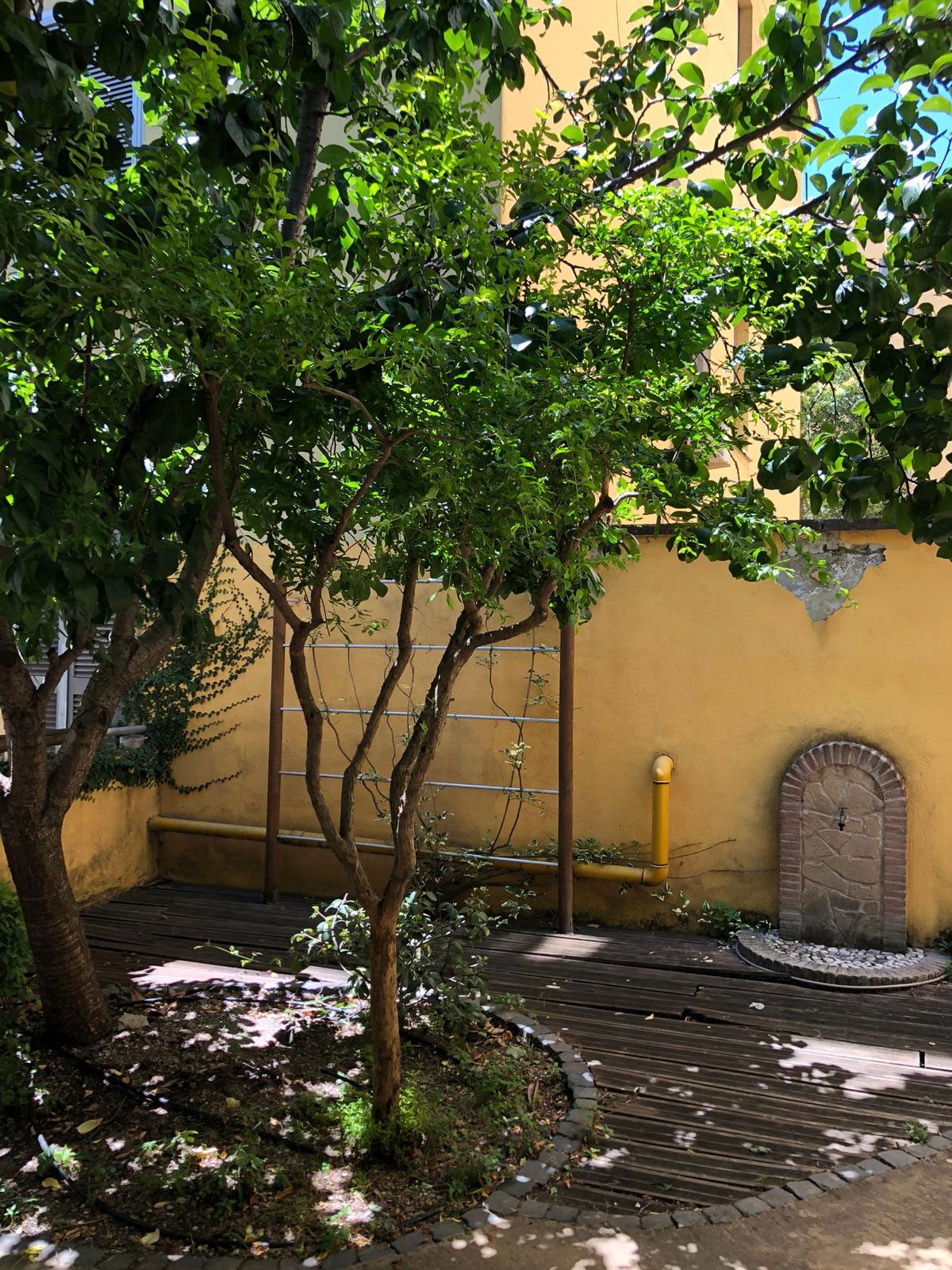
“In the first ‘Children’s House’ in Rome, we have a vast courtyard, cultivated as a garden, where the children are free to run in the open air…which is planted on one side with trees and a branching path in the middle, and on the opposite side, has broken ground for the cultivation of plants. This last, we have divided into so many portions, reserving one for each child…While the smaller children run freely up and down the path, or rest in the shade, the possessors of the earth (children from 4 years up) are sowing or hoeing, watering or examining the surface of the soil watching for the sprouting plants.”
Maria Montessori believed that the outdoors is a natural extension of the classroom and, hence, there should be harmony between the indoor and outdoor learning environments. She wrote:
“There must be provision for the child to have contact with nature; to understand and appreciate the order, the harmony, and the beauty in nature. It is also necessary for his psychical development to place the soul of the child in contact with creation, in order that he may lay up for himself treasure from the directly educating forces of living nature.” (1966)
She was a real advocate for the outdoor classroom and placed a great deal of emphasis on getting the children outdoors and connecting with nature.
There must be provision for the child to have contact with nature; to understand and appreciate the order, the harmony, and the beauty
in nature.” —Maria Montessori
I have fond memories of my own childhood growing up in nature. When I shut my eyes, I am easily transported back to that world. We had everything we needed and more! The river ran behind our home, and the banks provided us with rich clay for everything our imagination conjured up. Oh the mud pies we made and the tea parties we hosted underneath the gigantic, old trees. What fun! There was no lack of ideas to play, as we ran freely in the open, often in the rain, hiding behind trees, swinging from its branches, and digging to find the other end of the earth. It is no wonder then that, even now, it is to nature that I turn when I am in need of comfort and solace. I took my childhood for granted, thinking everyone had the same. It was only when I moved away that I realized how special it was and how privileged we were.
Maria Montessori once said, “The land is where our roots are. The children must be taught to feel and live in harmony with the earth.” (Gilder, 2009, p. 35) Today’s disconnection of the children from the natural world bothered me. My goal in opening an outdoor classroom at my school was to provide regular access to the outdoors, along with guided Montessori classroom work, in order to connect them back to nature. Richard Louv reminds us about the drastic need to bring children into contact with nature as he describes a haunting vision of children without access to nature suffering from nature-deficit disorder. He writes, “When children have regular contact with nature, in an unstructured way, they are more attentive, observant, creative, and self-content.” (Louv, 2008, p. 49)
In creating the prepared environment for the outdoor classroom, we followed the same meticulous principles as for the indoor classroom. The tenets of Montessori philosophy and methodology are the same:
- Child centered
- Well ordered and structured
- Beautiful
- Freedom within limits
- Intrinsic motivation
- Teacher as Guide and observer of the child
Young children thrive and their minds and bodies develop best when they have free access to stimulating outdoor environments for learning. Knowledgeable and enthusiastic adults are crucial to unlocking the potential of the outdoors. In creating the outdoor classroom, the intention is for the young child to learn the skills of social interaction, care for living things and the environment, curiosity, wonder, and joy.
The foundation of the Montessori environment is Practical Life, and this is easily done outdoors. Children learn to maintain their own place, just as they do indoors.
They take care of the plants and harvest vegetables and fruits. They learn to compost and to conserve water with the rain barrel. “Through outdoor education, children learn to take greater care of the environment, each other, and themselves. To gain self-confidence, children need to love nature and feel a sense of belonging in nature—a connection.” (Gilder, 2009, p.36)
Living things fascinate children. “It has been understood…that the best means of invigorating the child is to immerse him in nature” (The Montessori Method). Observing birds at the bird-feeding station teaches them so much about the natural environment. They take on the responsibility of filling the bird feeder and keeping the birdbath full of water. Binoculars come in handy as they look for birds in the trees. The curiosity regarding the birds they see can follow them into the classroom, where they learn the names of the birds as well as the parts of a bird. Similarly, butterfly observations can instill an interest in the life cycle of a butterfly, and they can watch the metamorphosis of a butterfly.
It is important to allow children to draw, record, or document their nature experiences or observations. Nature collages, leaf rubbings, and petal paintings make art come alive in the outdoor classroom. Given opportunities to discover nature, children not only experience the natural world to its fullest extent, they use those experiences to form important and lasting attitudes toward nature. Louv tells us that we can now assume that, just as children need good nutrition and adequate sleep, they may very well need contact with nature. “Healing the broken bond between our young and nature is in our self-interest…because our mental, physical, and spiritual health depends upon it” (Louv, p.3)
A Montessori primary environment is the perfect place to integrate nature exploration. The Montessori philosophy and Method emphasizes connecting to nature and inspiring wonder in children. Many of the classroom materials support nature discovery and research for connecting the outdoor and indoor environments, especially in the areas of natural history, geography, botany, and zoology. Maria Montessori stressed that immersion in nature is imperative for proper physical and psychological development and stated,
“When the child goes out, it is the world itself that offers itself to him. Let us take the child out to show him real things instead of making objects which represent ideas and closing them in cupboards…There is no description, no image in any book that is capable of replacing the sight of real trees and all the life to be found around them, in a real forest. Something emanates from those trees which speaks to the soul, something no book, no museum is capable of giving. The wood reveals that it is not only the trees that exist, but a whole, interrelated collection of lives. And this earth, this climate, this cosmic power are necessary for the development of these lives. The myriad of lives around the trees, the majesty, the variety are things one must hunt for, and which no one can bring into the school. How often is the soul of man—especially that of the child—deprived because one does not put him in contact with nature?”
The outdoor classroom provides children the opportunity to be outside, except on very cold days. The lessons build on what is learned in the indoor classroom—refinement of movement, sensory development, social skills, and care of the environment. They learn to become responsible citizens of our planet. These lessons lay the foundation for a lifetime love of nature, gardening, art, and science—and for me, most importantly, to be responsible global citizens. ¢
Bibliography
Gilder, S.A. (2009). Montessori by Nature. Montessori Life, 21 (4), 34-37.
Louv, R. (2008). Last child in the woods: saving our children from nature-deficit disorder. Chapel Hill, NC: Algonquin Books of Chapel Hill
Montessori, M. (1967). The discovery of the child. New York, NY: Ballantine. (Original work published 1948).
Montessori, M. (1994). From childhood to adolescence. Oxford, England: Clio Press.
Montessori, M. (1972). Peace and education. Madras: Kalakshetra Press.
Tomorrow’s Child / October 2019 / Pg 10
by Christine Lowry | Empowerment, Health / Nutrition, Kindergarten, Lower Elementary (6-9), MFA, Montessori Family Life, Montessori Parenting, Practical Life, Prepared Environment, Primary (3-6), Uncategorized, Webinars / MFA
To continue reading, you will need to choose a subscription plan.
by Kristi Antczak | Kindergarten, Language, Language & Reading, Lower Elementary (6-9), Montessori Family Life, Practical Life, Prepared Environment, Primary (3-6), Reading, Toddler (18 months-3 years), Webinars / MFA
To continue reading, you will need to choose a subscription plan.
by Michael Dorer, EdD | Communication, Discipline, Empowerment, Mindfulness, Montessori Education, Montessori Parenting, Montessori students, Planes of Development, Practical Life, The International Montessori Council, Webcasts / IMC
To continue reading, you will need to choose a subscription plan.
by Andrea Pellizari | Empowerment, Maria Montessori, MFA, Mixed Ages, Montessori students, Planes of Development, Practical Life, Tomorrow's Child, Young Adults
“The chief symptom of adolescence is a state of expectation, a tendency towards creative work and a need for the strengthening of self-confidence.” —Maria Montessori
What motivates adolescents to do their best work? Most would agree that programs that support student interests and provide high challenges and skills, thinking combined with acting, freedom combined with discipline, and positive motivation engage and invite the adolescent to do their best work. Maria Montessori envisioned an adolescent program that would support the development of both the adolescent’s psychological and economic independence. It has also been determined that adolescent students who enjoy what they do and link the importance of what they do to a bright future have a commitment to the work. Interestingly, humor and a sense of joy enhance this commitment to work during adolescence. Other powerful characteristics of a Montessori secondary program that contribute positively to the development of the adolescent student are programs that nurture the adolescent community as a whole; in other words, programs that take seriously the deep and important communal life of the teenager.
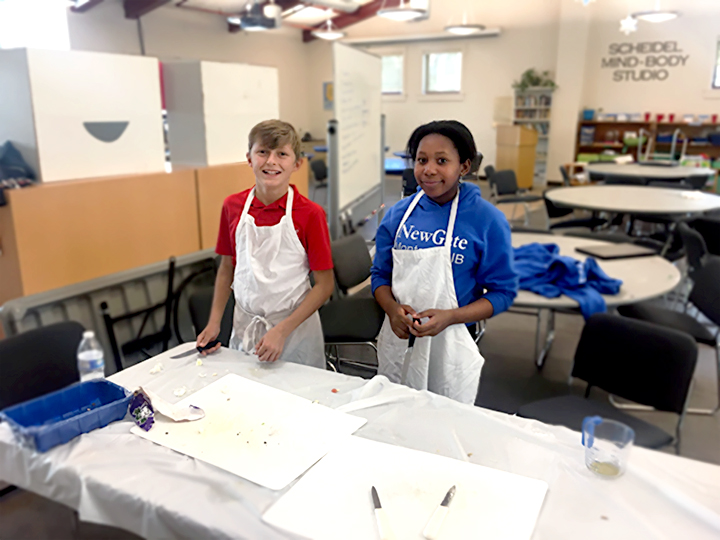
Culinary Nights, a culminating event that happens twice a year at the Montessori Foundation’s Lab School, NewGate Montessori IB School, is one such program that highlights the best of programs for adolescents. It is a night of celebration where the students who participate in culinary classes get to show off their skills to the school community, family members, and friends. The NewGate secondary program encompasses lessons and experiences to develop life skills, including cooking, social skills, community events, and other practical life experiences. This particular evening event allows students to demonstrate their capabilities in cooking, plating, serving, setting tables, and wine pairing a 5-course culinary experience.
In preparation for this event, NewGate secondary students take food preparation classes with Mr. Greg Desvenain, a parent chef at the school, who specializes in French cuisine and French and Italian wines. The course, which is part of the school’s curriculum, teaches basic culinary skills including how to dice an onion, how to use a food blender, even how to make a scrambled egg. Students learn how to prepare meals after investigating and researching balanced diets and a variety of different types of recipes from soups and main courses to desserts.
Mr. Greg teaches all aspects of food preparation and service. He gives lessons on how to hold plates, which side to serve and remove plates, and how to talk politely to guests. Using the commercial grade kitchen on the NewGate secondary campus, students cook various meals and learn how to plate food with a professional flair, arranging each dish in ways that stimulate the palate and excite the diner. Understanding how to tastefully decorate and garnish using herbs, flowers, and sauces are also part of the curriculum. Mr. Greg also gives students who have a personal interest in the culinary arts opportunities to extend their interests by offering an after-school club experience.
In the weeks prior to Culinary Nights, students practice cooking each dish separately. They also practice plating and serving each dish to each other. A theme is picked and the menu is decided upon knowing that the event is the culminating project for the course. The theme tends to have roots in French cuisine but also uses locally grown products. The menu for this year’s event indulged attendees with polenta cakes, gazpacho, fish, stuffed vegetables, and apple crumb cake á la mode.
On the day of the event, in early afternoon, students assemble in the kitchen and begin to cook. Cooking continues throughout the afternoon until guests arrive. Students also arrange and set tables, print menus, organize themselves to receive guests, and have the wine pairing information ready for each table. Conversations in the form of peer-mentoring for each task elevate the excitement of the evening. This culminating event is weeks in the making and gives NewGate students opportunities to market, manage, collaborate, partner, and strengthen communal relationships.
Maria Montessori tells us that it is during this period of adolescence where interest in the construction and function of society forms in the individual consciousness. The culinary arts program at NewGate School is but one program highlighting the best of adolescent experiences that stay true to Montessori principles and give adolescent students opportunities to develop essential skills for the future. ′
Tomorrow’s Child / April 2019 / Pg 27
by Regina Abraham | Child's Work, Empowerment, Imagination, Kindergarten, MFA, Practical Life, Prepared Environment, Primary (3-6), Webinars / MFA
To continue reading, you will need to choose a subscription plan.
by Renee DuChainey Farkes | Empowerment, Maria Montessori, MFA, Mixed Ages, Montessori Charter Schools, Montessori Education, Montessori Parenting, Parent Education, Parent-Teacher Communication, Planes of Development, Practical Life, School Leadership, The International Montessori Council
To continue reading, you will need to choose a subscription plan.
by Punum Bhatia Ph.D | Empowerment, Maria Montessori, MFA, Mindfulness, Montessori Charter Schools, Montessori Education, Peace Education, Practical Life, Prepared Environment, Research
To continue reading, you will need to choose a subscription plan.
by NewGate Secondary Students | Book Reviews, Early Adolescence (12-15), Empowerment, Later Adolescence (15-18), Lower Elementary (6-9), MFA, Mixed Ages, Practical Life, Reading, Tomorrow's Child, Young Adults
To continue reading, you will need to choose a subscription plan.
by Mary Conroy Kitty Bravo | Brain Development, Discipline, Later Adolescence (15-18), MFA, Mixed Ages, Planes of Development, Practical Life, Tomorrow's Child, Upper Elementary (9-12)
To continue reading, you will need to choose a subscription plan.
by Christine Lowry | Kindergarten, Lower Elementary (6-9), MFA, Montessori Family Life, Practical Life, Prepared Environment, Primary (3-6), Upper Elementary (9-12), Video, Webinars / MFA, Writing
To continue reading, you will need to choose a subscription plan.
by Danielle Herzog | Communication, Discipline, Infant-Toddler (0 to 3), Kindergarten, Later Adolescence (15-18), Lower Elementary (6-9), Mindfulness, Mixed Ages, Montessori Family Life, Montessori Parenting, Practical Life, Primary (3-6), Research, Tomorrow's Child, Tomorrow's Child Online Issue, Upper Elementary (9-12), Young Adolescent, Young Adults
To continue reading, you will need to choose a subscription plan.
by Maly Pena | Empowerment, Mindfulness, Mixed Ages, Montessori Charter Schools, Montessori Education, Practical Life, Sensorial, Tomorrow's Child, Tomorrow's Child Online Issue, Young Adolescent, Young Adults
To continue reading, you will need to choose a subscription plan.
by Anne Courts | Adolescence, Brain Development, Children with Exceptionalities, Communication, Discipline, Empowerment, Infant-Toddler (0 to 3), Language, Lower Elementary (6-9), Mindfulness, Mixed Ages, Montessori Education, Montessori Parenting, Parent Education, Practical Life, Primary (3-6), Psychology, Sensitive Periods, Sensorial, Tomorrow's Child, Tomorrow's Child Online Issue
To continue reading, you will need to choose a subscription plan.
by Cathie Perolman | Free Reads, Montessori Family Life, Practical Life, Tomorrow's Child, Tomorrow's Child Online Issue
Dear Cathie—
We are new to the Montessori philosophy and want to make the most of it in our family and our children’s lives. We have come to this a bit late, as we just moved to an area with a Montessori school. We have enrolled both of our children and are trying to learn as quickly as possible. What are the kinds of things we should be doing at home to support the kind of learning the children are doing at school? — new Montessori parents
Dear Parents,
You are asking all the right questions and doing all the right things! Montessori is indeed a philosophy and you can’t adopt it too late in the life of your family or your child. In a Montessori school, the guides believe that your child will reveal himself through the work that he chooses and shows us (the adults in his life) that which he needs to learn at that time. It is our job to aid him in this journey, showing him skills and activities that interest him, challenge him, and grow his academic, social, and motor skills as he moves along this path.
We strive to allow him as much freedom as he can handle in doing things for himself and being independent. We create an environment with maximum accessibility based on the ages and skills of the children and then teach them to use the materials in that environment safely. An Infant/Toddler environment would let the child be able to reach for their own diapers and their own lunch box so they can show us when they are hungry. A 3-6-year-old environment might contain scissors, a stapler, tape dispenser, sewing needles etc. An Elementary environment is much richer with all the tools and resources a child would need to plan a complicated individual or group project or a “going-out” field trip of their own choosing.
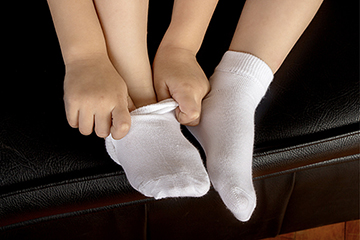
The primary ways that your family can help are to allow your child to be as independent as possible in all areas of his life. Let your child do as much for himself as his age and skill set allow in the areas of dressing, eating, food preparation, and contributing to his family. Let him choose his clothing and dress as much as he is able. If he cannot do all of a dressing task, let him do the part that he can. If he is not strong enough to pull on his whole sock, you can pull the sock over his heel and he can pull it up to his ankle. If he cannot manage his shirt, let him place his hands in the sleeve holes and then help him get his head into the head hole. Together pull the shirt over his torso. Removing clothes is an easier skill and will be mastered more quickly. With that comes the responsibility of placing the dirty clothes into the hamper. Sure, you can do it quicker, but letting him do it aids him in the path to independence! As he gets older invite him to help you sort the laundry, match the clean socks, fold the dish towels, and even carry his own lunch box to the car and into school. Try to constantly think
of things that you are doing that your child might be able to do
for himself.
Strive for independence in eating and food preparation. At mealtime, encourage your child to help prepare the meal. Teach your child to set the table. Perhaps, at first, he will only place the napkins under the fork. Eventually, he will know where all the parts of the table setting go and will be able to do it independently. This is a great way to get some quality family time while teaching valuable table-setting and food-preparation skills. A child as young as two can tear lettuce, and at three or four can cut vegetables using a child-friendly knife (https://www.forsmallhands.com/small-nylon-knife). Preschoolers can also help to cut vegetables or fruit even when they are not brave enough to eat them. Once the meal is on the table, encourage your child to serve himself from the family serving bowls. This is good practice in motor control as well as choosing the amount of food you are planning to eat. If your child is Elementary aged and your family is ordering ‘take out,’ allow your child to help in the planning and even in making the phone call to order the food.
Allow your child to get his own snacks independently (within reason). Create a place in your home that has snacks available for your child. Let him choose his own snack food from among those choices. Since you (the parent) stock the snack spot, you still have ultimate control over how much and what your child is eating. Your child is gaining valuable practice in deciding what to eat and how often to eat from these limited choices. If your refrigerator allows it, place a small pitcher and glass on a low shelf so your child can pour his own water or juice when he is thirsty.
As he moves towards Kindergarten, he is probably ready to take over parts of packing his own school lunch. Try to arrange your refrigerator so the things that your child will need for his lunch are available for him to access independently. He can select his own yogurt, or make his own sandwich, put his own fruit into the reusable container and close it (great motor practice), and fill his own water bottle. Let it be a joint effort until his skills are solid, and then let that be your child’s work because he has mastered another piece of independence. Let your child be a part of choosing what food to buy each week, so he gets to experience being a smart consumer. Once he is old enough, he will be able to contribute to the family grocery list and eventually shop for himself with confidence and skill.
Encourage your child to contribute to the family. A very young child can do simple tasks such as taking their plate to the sink, hanging up their towel or putting their toys away. Children a bit older can bring in the mail, feed the dog, empty the trashcans in the house, or take out the garbage. Families can work together to plan vacations, solve problems within their families, or create a new project, such as a vegetable garden or a fire pit. All of these things help the family to function as a unit and help children realize that they are a member of a group.
Optimal development is the goal of every Montessori classroom and every family. Guides encourage each child to grow in their social, emotional, academic, self-help, and motor skills each on his own timetable. All the adults in a child’s life help him along his path to independence, and by working together, parents and Montessori schools aid the optimal development of a child so he can become his most authentic, happy, and healthy self.
Tomorrow’s Child/ September 2018/Pg 34
by Joyce St. Giermaine | Empowerment, Family Resources, Infant, Infant-Toddler (0 to 3), Mindfulness, Montessori Parenting, Practical Life, Sensitive Periods, Tomorrow's Child, Tomorrow's Child Online Issue
To continue reading, you will need to choose a subscription plan.