
DEAR CATHIE: The Peace CurrIculum
To continue reading, you will need to choose a subscription plan.
Do’s and Don’ts to Handle Picky Eating
To continue reading, you will need to choose a subscription plan.

Adolescents:Secondary Internship Program
Why Have An Internship Program?
Maria Montessori’s wisdom about the adolescent revolved around her observation of their need for meaningful work. She encouraged educators to get students outside the classroom and into appropriate adult experiences as much as possible during adolescence. As one way to put her wisdom into practice, all students in the Secondary Program at NewGate experience an internship for one week every year.
The faculty at NewGate School works to guide each student to choose a meaningful internship that presents him/her with an opportunity to take advantage of local community resources and a chance to work with positive role models and community experts. As a form of independent study, students enjoy the opportunity to engage in a learning experience that enhances classroom learning and extends beyond the traditional four walls of the classroom.
An internship is an excellent tool for testing out a career interest and giving students first-hand knowledge of a particular professional field. Adolescents gain real-world experience while learning how to conduct themselves in a professional workplace environment. They observe firsthand how skills related to decision-making, problem-solving, teamwork, and technology are employed on the job. Students report that an internship helps them to value themselves and their abilities, gain confidence, and reflect more on their future. Moreover, an internship experience can help when the time comes to:
Apply to colleges or technical school —students can detail their experiences in their application essays. select a college major—the opportunity to investigate a possible career choice permits more informed decisions.
Seek an interesting job—an internship can help one secure references for future jobs and may open up opportunities for stimulating summer work. By the time students graduate from NewGate, they have participated in six different internships. The internship experiences grow more sophisticated as a student matures from a young adolescent of 12 to a young adult of 18. Overall, the internship experience is a highlight and a hallmark of our Secondary Program.
What Is Involved In The Secondary Internship Program?
Pre-Internship Week:
Finding and Securing a Placement
NewGate provides students and their families with a list of area organizations that NewGate students have worked with successfully in past years, in addition to other organizations in the area that may take students for internships. Students and parents review the list to generate ideas for organizations that would be a good fit for them.
If a student has a desire to work somewhere that is not already on the list, he/she gets approval from the faculty to pursue placement at the given organization. Middle school students pursue their internships locally, while high school students who want to travel outside the city or state for their internships can develop a proposal in writing to gain faculty approval.
Students develop a list of their top choices for placement and detail why they are interested in the organization and what they hope to get out of the experience. The faculty, student, and parents then begin working to find a host for the student at the chosen organizations.
Preparation Workshops
Students continue to prepare for their placement by spending time in workshops with faculty and visiting professionals for resume writing, business letters, interviewing, thank-you letters, and professional etiquette while on the job.
During Internship Week:
Parents and/or student drivers are responsible for the transportation arrangements to and from the host organization.
Students complete all appropriate tasks as requested at the placement.
Students write a personal reflection about their work each day.
A NewGate faculty member visits each student at his/her host organization at least one time throughout the week.
Post-Internship Week
Students write and send thank-you cards to their host organizations.
Students write a review of their internship experiences for the Internship binder. These reviews are a resource for students the following year during the placement search.
Students prepare a portfolio of their internship experience that includes all the work from before, during, and after the internship experience: placement ideas; resume; interviewing notes; business letters; thank-you notes; daily reflections; pictures of the work experience; the review, etc.
Students share their experiences and new knowledge in oral presentations to the rest of the school community.
Tomorrow’s Child/ November 2017/ Pg 30
Montessori Grandparenting: Papier-Mâché Projects
To continue reading, you will need to choose a subscription plan.

Harvard University’s Top 10 Home Energy Saving Tips
The Sustainable Community Leaders Program provides a unique opportunity for residents living in Harvard University Housing to have a direct and meaningful impact on the University’s greenhouse gas reduction goal and sustainability efforts. You don’t have to go to Harvard to implement these ten simple ways to help our planet (and your budget).
1. Swap CFLs for LEDs
Swaps out all incandescent and CFL bulbs for LEDs in table, desk, and floor lamps. They are 90 percent more efficient, contain no harmful gases, and can last up to 20 years!
2. Change laundry settings
Wait until you have a full load and then do your laundry on cold wash (BRIGHT COLOR SETTING). It not only extends the lifespan and vibrancy of clothing, it also saves 90 percent of the energy that would have been used to heat the water.
3. Clear vents
Have you ever felt that the temperature in your house doesn’t match your thermostat? Take a look around. You may be blocking your air registers! It may help to move some furniture and large items so the air can circulate more freely. This action may improve your heating and air conditioning system efficiency by 25 percent.
4. Unplug devices
Do a routine check to make sure chargers, adapters, and small appliances are all unplugged before you leave your home. Phantom energy is the electricity that electronics pull from the outlet while plugged in, even when the device is off. It can waste as much as 10 percent of your home’s energy.
5. Adjust temperature settings
Adjust your thermostat for when you are away from home versus when you are at home. Keep the fan setting to LOW. This creates a space for optimal comfort, health, and productivity.
6. Turn it off
Turn off EVERYTHING before heading out the door: lights; bathroom vents; computer; coffee maker; TV.
7. Make it easy
Plug in all your electronic equipment into a central power strip and then just hit the switch!
8. Manage power settings
Make sure your computer isn’t wasting any unnecessary energy. Set your power management settings to Energy Saver Mode and get rid of the screen saver. This cuts energy consumption and prolongs the computer’s
battery life!
9. Use your blinds and shades
Use daylight wisely, by keeping drapes open during the day to let in the warm rays or closed to keep out the sun if you are in a hot climate.
10. Take the stairs
Take the stairs instead of the elevator. Good for your health and a good way to save some kilowatts!
Retrieved from:
https://green.harvard.edu/tools-resources/green-tip/top-10-home-energy-saving-tips
Tomorrow’s Child/ November 2017/ Pg 27

Sustainability: 12 Ways to Live More Sustainably
Every day we make choices in our lives that affect the environment, the climate, and other species. Here’s how you can ‘choose wild’ and reduce your environmental footprint to leave more room for wild animals and plants.
1. Think twice when shopping. Before you buy something new, ask yourself if you really need it. If so, consider buying gently used and look for minimal packaging.
2. Boycott products that endanger wildlife. Avoid places that sell products from threatened species, such as sushi restaurants that sell bluefin tuna, and look for products made from sustainable materials that don’t endanger the habitat.
3. Take extinction off your plate. You have three chances a day to reduce your environmental footprint by eating less or no meat. Eating locally sourced fruits and vegetables also lowers the amount of fossil fuel used to transport food over long distances.
4. Pay attention to labels. Choose Fair Trade certified goods and buy organic food whenever possible. If you’re a coffee drinker, look for “shade-grown” coffee.
5. Make sure big purchases have big environmental benefits. Look for the Energy Star label on home appliances and look for more fuel-efficient car models.
6. Be water-wise. Skip the bottled water. Conserve water by taking shorter showers, fixing leaky toilets, and choosing low-flow or low-water appliances.
7. Ditch the plastic. Cut down on plastic waste by shopping with reusable bags, ditching one-time-use water bottles, and avoiding products made from, or packaged in, plastic.
8. Drive less, drive green. Walk, bike, carpool, or use public transportation whenever possible. Combine errands to make fewer trips and keep your car in shape with regular tune-ups and tire inflations.
9. Choose a smaller family. With more than 7 billion people in the world, we’re not leaving much room for wildlife. We need to talk about human rights, overconsumption, and choosing a better future for wildlife, the planet—and us.
10. Green your home. Improve your home’s energy efficiency with adequate insulation, energy-saving windows, and a programmable thermostat. Call your energy provider to see if it offers free energy audits and efficiency incentives or knows of a company that does.
11. Choose renewable energy. If your state allows you to pick your electricity supplier, use a Green-e certified company. Explore the options—and tax credits—for installing solar in your home.
12. Use your voice and your vote. Vote for candidates with strong environmental platforms and urge them to pass policies that protect the environment and wildlife. Sign and share action alerts, and talk to your friends about endangered species protection and the need to address human population growth and overconsumption.
Learn more:
www.biologicaldiversity.org/population_sustainability
Facebook: Facebook.com/PopulationSustainability
Twitter: @choosewild
Instagram: @CrowdedPlanet
Retrieved from http://www.biologicaldiversity.org/programs/population_and_sustainability/sustainability/pdfs/12WaysToLiveMoreSustainably_factsheet.pdf
Tomorrow’s Child/ November 2017/ Pg 26
The Parenting Puzzle : The Basics
Montessori is not only an incredible educational method but it’s also a way of life! What children learn in Montessori becomes part of their being. Sure they learn to read and write and do math, but more than that they learn how to learn; they learn how to be part of a community; they learn how to articulate their ideas confidently; they learn how to listen and seek to understand; they learn how to take care of themselves; and they learn how to solve problems.
As parents, it’s our job to keep that learning going by our words and actions. But children don’t come with a user’s manual, and sometimes we may find ourselves wondering how Montessori teachers work their magic?
Just as it has for 110 years, you will find that the time-tested methods used by Montessori educators will help you build even stronger bonds within your family, stop disruptive behavior as it begins, strengthen parenting partnerships, learn alternatives to punishment and reward, and much more.
If you’ve found yourself engaging in power struggles with your children, reacting instead of responding to everyday situations, such as taking out the trash or trying to be the referee when your children are squabbling, you may appreciate a more Montessori way of parenting. Our new online course, The Parenting Puzzle, was designed with you in mind.
The Parenting Puzzle: The Basics is the first in a new series of Montessori parenting courses developed by the Montessori Foundation. The course can be taken online or in person through a growing community of Montessori schools.
Our first five-week course will teach you the essential strategies to meet your children’s emotional needs and minimize misbehavior. It can help you turn your home into a peaceful haven, rather than a battlefield. Lorna McGrath has been a Montessori parent educator for years and is thrilled to be the Program Director for the Montessori Family Alliance and the primary presenter for The Parenting Puzzle. Based on her work with children of all ages and their families, Lorna provides strategies for cultivating closeness, cooperation, and open communication.
The Parenting Puzzle: The Basics is based on the work of Maria Montessori, Rudolph Dreikurs, and Kathryn Kvols. It will help you to meet children’s emotional needs while refocusing disruptive behaviors in a respectful, positive way. You will experience the atmosphere that you marvel at in Montessori classrooms, as you put the ideas and strategies from the course to work in your family life.
Along with issues raised by parents participating in this course, we will address the following issues:
Taking time to breathe
Raising confident children
Feeling part of a family community
Communicating with honesty and respect
Enjoying your time together as a family
Learning how to work out solutions without excessive family drama
Creating a home environment that is filled with peace, understanding, and harmony
Topics
Week I— Parenting for the Long Haul
Week II— Why Do They Do What They Do?
Week III— What to Do When You Want to Trade Them In!
Week IV— If We Can’t Punish or Reward, What?
Week V— Parenting on the Same Page
Bonuses
Downloadable resources (checklists, worksheets, PDF guides, etc.)
Access to a live group with others
Direct email access
Weekly live webinars
Course completion certificate
Course Texts:
Redirecting Children’s Behavior and accompanying workbook by Kathryn Kvols
How to Raise an Amazing Child: The Montessori Way by Tim Seldin
Other Suggested Readings:
The Child in the Family by Maria Montessori,
Montessori Today by Paula Polk Lillard
Understanding Montessori: A Guide for Parents by Maren Schmidt
The Cost:
$150 a parenting couple/$125 for Members of the Montessori Family Alliance (plus the cost of books)
If you are reading this in Tomorrow’s Child magazine then you are probably a member of the Montessori Family Alliance. The online course is available for only $125 (member price) plus the cost of books. You can sign up today at www.montessori.org
Or if you prefer live classes, talk to your school administrator to find out how your school can offer The Parenting Puzzle: The Basics live.
To Register: tinyurl.com/parentingpuzzle
To join the Montessori Family Alliance:montessori.org/mfa/
Tomorow’s Child/ November 2017/ Pg 25
Elementary Years
To inspire academic excellence; nurture curiosity, creativity, and imagination; and awaken the human spirit
As children near the end of their kindergarten year in Montessori, many parents struggle with the question of whether or not to keep their children in Montessori for the elementary program.
On the one hand, the typical Montessori five-year-old’s self-confidence and love of learning lead many families to ask: Why tamper with something that is clearly working?
Other parents feel that, since their kindergarten graduate will be moving on to another class one way or the other, next year might be the logical time to make the transition from Montessori.
A major consideration for many families will be the opportunity to save the cost of private school tuition by taking advantage of the local public schools. Some will wonder if a more highly structured and competitive independent school will give their child a better preparation for college.
If you are facing this choice, I encourage you to take a good look at your school’s elementary program. Although you will, of course, want to gain an impression of the teachers, focus your attention on the students themselves. Elementary students are often the best spokespeople for the value of a Montessori education!
There are four aspects of the elementary program:
Academic Excellence
Universal Values
Global Understanding
Service
Inspiring Children To Work Hard and AchieveAcademic Excellence
Let’s begin by being very clear. Montessori is one of the most sophisticated pre-collegiate programs available anywhere in North America. It has been described as the ultimate gifted-and-talented program that is offered to a very wide range of students. However, this doesn’t tell the whole story. What makes Montessori special is its ability to nurture talent without needless competition and stress. In a nutshell, Montessori children never lose the joy of learning.
Montessori is, first and foremost, concerned with a child’s character and emotional development, rather than academics for grades and test scores alone. We inspire children toward academic excellence and nurture the curiosity, creativity, and imagination hidden within every human being.
Many Parents Worry That Montessori Will Not Prepare Their Children For The ‘Real World.’
Hearing that we do not give children letter grades (at least until high school), assign hours of nightly homework, give children weekly tests, or expect students to compete for the highest rank in the class, some parents wonder if we’ve lost our minds! After all, who wants to run the risk that Montessori, which was so charmingly right when they were young, doesn’t work in the elementary years or prepare children for the Real World?
Montessori Elementary Education Is Distinctly Different
First, let’s talk about highly selective programs for ‘gifted’ children.
Montessori demonstrated that intelligence is common among human beings. Most schools assume that giftedness is statistically rare and that, given half a chance, children will accomplish little without external structure, extrinsic rewards, and the fear of being embarrassed.
Many of us attended challenging elementary schools. Do you remember what happened in your highly disciplined classrooms when your teacher left the room? In many cases, it was disorder. What use is it to earn high grades, keep your notebook neat, pass every test, and hate your schoolwork? Many children in many good schools are bored, apathetic, or overwhelmed. They do only what must be done to get along. That is not a sound foundation for a real education. In truly wonderful schools, classrooms are filled with students who retain a sense of wonder, curiosity, and eagerness to learn. Those qualities are the almost universal description of elementary Montessori children.
I find the difference between the way many of us think about gifted children in this country and the attitudes we find abroad quite interesting. Americans unconsciously assume that intellectual ability and scholastic success is inborn, i.e. a child is born with special talents and abilities. Many parents in other countries assume that success is more the result of hard work, self-discipline, and high personal motivation.
In writing this, I don’t mean to suggest that truly gifted children (and adults) can’t be found. They are simply uncommon. What we focus on is the human potential hidden within young children.
Montessori demonstrated that intelligence has many forms and that children learn in different ways at different paces. Anyone who has worked with children knows this is true, but traditional schools normally follow a pre-established curriculum.
Montessori felt it was illogical to dismiss a child who finds it difficult to memorize facts without understanding or to remember what the teacher covers in a lecture. She also understood the powerful connection between a child’s inner emotional life, self-confidence, self-esteem, and the ability to learn.
A Montessori elementary program is based on warmth, kindness, and respect. There is a strong sense of community among the children. The classes are more like little villages, with powerful friendships and a clear sense of group identity. Teachers are normally seen as mentors and friends.
Building Character and Teaching Universal Values
There is an old saying that if you abandon a garden, the weeds will run wild. Abandon a child’s moral and spiritual education, and the weeds of confusion, materialism, self-centeredness, and spiritual emptiness will take hold.
Dr. Montessori observed that the elementary years are a sensitive period for moral reasoning. The elementary program integrates character development and family involvement throughout the curriculum.
The teaching of kindness and courtesy, self-discipline and self-respect, and fundamental values is crucial in a child’s moral development, sense of dignity, and academic success. With proper guidance from parents and educators, children can and will excel.
Montessori Schools Strive to Create Global Understanding
They tend to attract teachers from all over the world.
It is normal to find an international student body in a Montessori school anywhere in the world.
Montessori schools generally teach at least one foreign language and often offer programs in several.
World geography, international cultural studies, and world history are central to the elementary Montessori curriculum.
Elementary Montessori students begin to understand the global economy.
As more Montessori schools develop strong upper elementary and middle school programs, many are beginning to sponsor travel-study programs. Some participate in the Montessori Model United Nations and foreign exchange programs.
Service
Children must be inspired to contribute to the betterment of the world. They often begin with projects that care for the environment: planting trees and flowers; composting garbage; controlling erosion around the campus; recycling; and cleaning up litter and debris in the local community. It is quite common for elementary classes to adopt an acre of rainforest in Costa Rica or work to support an environmental organization, such as the Wildlife Federation.
They will normally progress to projects that provide direct help to the needy. Younger children commonly collect canned goods, clothing, and toys for the homeless or needy families. As they are ready, most Montessori schools will take children out into the community.
As they reach the upper elementary class, Montessori children become quite concerned about issues of social justice and human rights. The rights of the poor, homeless, and hungry are of real concern. Some children will begin to explore the possibilities of supporting causes that are meaningful to them.
Elementary Classes Are Multi-Age Group Communities
Elementary Montessori classes continue to bring children of different age levels together. Classes span three age/grade levels, with the common divisions being ages 6 to 9 (grades 1-3) and ages 9 to 12 (grades 4-6). Some schools may follow a somewhat different scheme of grouping their children.
Elementary Montessori Educators Serve As Mentors, Guides, and Friends
The best elementary Montessori teachers tend to be renaissance men and women; individuals who are equally interested in mathematics, the sciences, the arts, architecture, literature, poetry, psychology, economics, technology, and philosophy. Elementary Montessori teachers are generalists rather than a single subject-matter instructor. They provide a blend of structure to ensure that the ‘basics’ are mastered while encouraging and guiding children to explore topics and ideas that capture their imagination.
The elementary Montessori curriculum is very demanding, and requires teachers to have a broad and thorough education of their own. With lessons that range from the history of mathematics to the physics of flight, mineralogy, chemistry, algebra, geometry, linguistics, and literature, to name just a few, the average teacher would be lost.
But beyond this, elementary Montessori educators need patience, understanding, respect, enthusiasm, and a profound ability to inspire a sense of wonder and imagination. Such teachers are very rare but absolutely magical!
Becoming an elementary Montessori teacher requires almost two years of graduate study and student teaching, and many hours of hard work to gather or create the curriculum materials that constitute a fully authentic elementary Montessori environment.
The Montessori Materials And The Passage To Abstraction
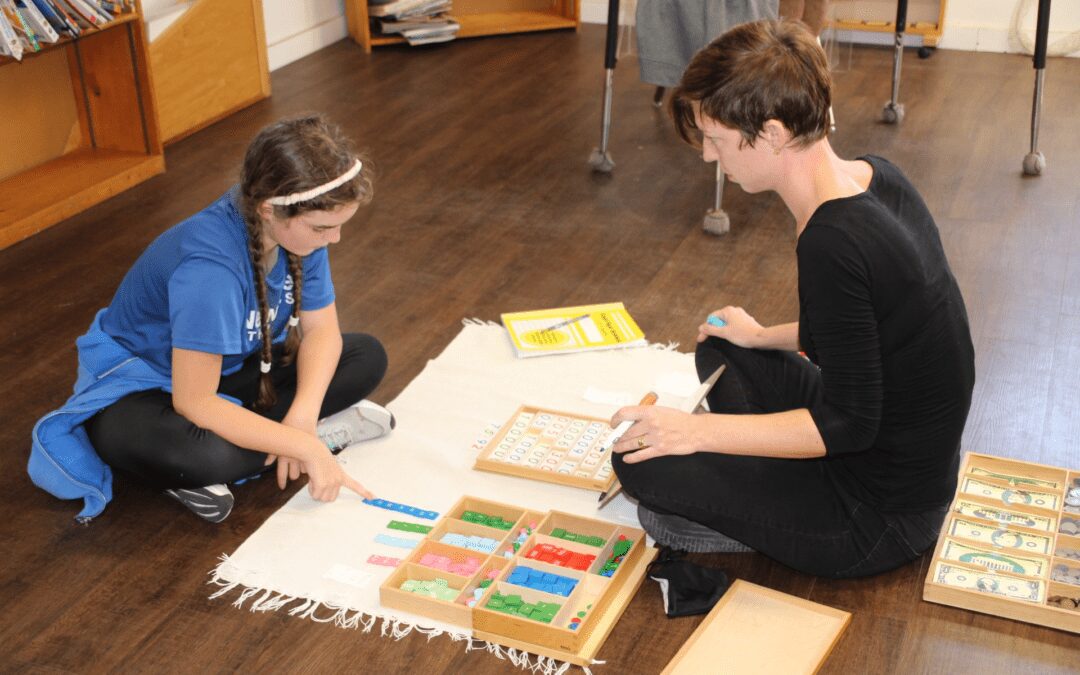
At the elementary level, learning continues to be a hands-on experience, as students learn by trial, error, and discovery.
The advanced elementary Montessori materials move on to more complex and abstract concepts in mathematics, geometry, and pre-algebra. The goal is to lead students away from a dependency on concrete models that visually represent abstract concepts towards the ability to solve problems with pen and paper alone.
Part of this is made possible by the growing child’s brain’s ability to grasp abstractions, but it has been greatly enhanced over the years by countless hours of work with the concrete materials that made the abstract real, and helped him visualize the abstraction.
Similar hands-on Montessori materials help students understand grammar, sentence analysis, geographical facts, and concepts in science.
Three Elements Of The Elementary Montessori Curriculum
1. Mastery of Fundamental Skills and Basic Core Knowledge
Montessori’s international curriculum evolved out of a tradition of academic excellence and offers a rigorous course of study even in the elementary years. Elementary Montessori students explore the realm of mathematics; science and technology; the world of myth; great literature; history; world geography; civics; economics; anthropology; and the basic organization of human societies. Their studies also cover the basics found in the traditional curriculum: the memorization of math facts; spelling lessons; the study of vocabulary, grammar, sentence analysis, creative and expository writing; and research skills.
2. Montessori’s Great Lessons
The Great Lessons are five key areas of interconnected studies traditionally presented to all elementary Montessori students in the form of inspiring stories, related experiences, and research projects.
The Great Lessons include the story of how the world came to be: the development of life on Earth; the story of humankind; the development of language and writing; and the development of mathematics. They are intended to give children a ‘cosmic’ perspective of the Earth and humanity’s (and their own) place within the cosmos.
3. Individually Chosen Research
Elementary students are encouraged to explore topics that capture their imagination. Most former Montessori students look back on this aspect of the elementary program with particular fondness in later years.
Montessori curriculum guides students to become proficient at research and inquiry. Elementary Montessori students rarely use textbooks. The approach is largely based on library research, with children gathering information, assembling reports, teaching what they have learned to their fellows, and assembling portfolios and handmade books of their own. Students are taught how to use reference materials, libraries, and the Internet to gather information and uncover the facts. Their oral presentations and written research reports tend to grow in sophistication and complexity every year.
Is Montessori Opposed To Competition?
No. Dr. Montessori simply observed that competition is an ineffective tool to motivate children to learn and work hard in school.
Traditionally, schools challenge students to compete with each other for grades, class rankings, and special awards. In Montessori schools, students learn to collaborate rather than mindlessly compete. In an atmosphere in which children learn at their own pace and compete only against themselves, they learn to not be afraid of making mistakes. They quickly find that few things in life come easily, and they can try again without fear of embarrassment.
Dr. Montessori, herself an extraordinary student and a very high achiever, was never opposed to competition on principle. Her objection was to using competition to create an artificial motivation to get students to achieve.
Homework, Tests, And Grades
Many parents have heard that Montessori schools do not believe in homework, grades, and tests. This is a misunderstanding. Because Montessori believes in individually paced academic progress and encourages children to explore their interests, rather than simply complete work assigned by their teachers, we don’t assign grades or rank students within each class according to their achievement.
Whenever students voluntarily decide to learn something, they tend to engage in their work with a passion and attention that few students will ever invest in tasks that have been assigned.
Providing Structure: Setting High, But Individually Tailored, Expectations
Montessori children normally work with a written study plan for the day or week. It lists the basic tasks that they need to complete while allowing them to decide how long to spend on each and what order they would like to follow. Beyond these basic individually tailored assignments, children explore topics that capture their interest and imagination, and share them with their classmates.
Montessori children usually don’t think of our assessment techniques as tests so much as challenges. Most elementary teachers will give their students informal, individual oral exams or have the children demonstrate what they have learned by either teaching a lesson to another child or by giving a formal presentation.
Standardized Tests
Montessori educators frequently argue that standardized testing is inaccurate, misleading, and stressful for children. Many feel that standardized tests are unnecessary, since any good teacher who works with the same children for three years and carefully observes their work, knows far more about their progress than a typical paper and pencil test reveals.
However, in our culture, test-taking skills are just another practical life lesson that children need to master. Most Montessori schools regularly give students quizzes on the concepts and skills that they have been studying, and many schools use standardized tests of one sort or another, with students over first grade. Often these may be formative tests that measure each student’s progress over the course of each year, and these will be only part of a comprehensive system of monitoring and documenting learning within the school.
When tests (formal and informal) are used as a feedback loop, at times indicating that a student needs a new lesson and more practice, instead of a mark of shame and failure, then they can be quite useful. Children will face tests throughout their education, and they certainly need to develop good test-taking skills.
Homework
Homework in an elementary Montessori class rarely involves busywork assignments; instead, they are extensions and enrichment of the curriculum. Some classes will allow the children to freely pursue projects that interest them at home, while others prefer to give children a number of optional assignments or challenges. In either case, the Montessori version of homework will rarely be boring and will normally challenge students to think, explore, and pursue tangible projects that give them a sense of satisfaction.
An Integrated Curriculum
Literature, art, music, dance, drama, history, social issues, political science, economics, architecture, science, and the study of technology all complement one another in the elementary curriculum. This integrated approach is one of the elementary Montessori program’s great strengths.
An Exceptional Curriculum In Language Arts And The Humanities
The elementary Montessori language arts program places great stress on the development of strong skills in composition and creative writing. Students are asked to write continuously, emphasizing, at first, the development of an enjoyment of the writing process, rather than the strict use of correct grammar and spelling. However, formal grammar, spelling, and sentence analysis are systematically taught.
Elementary children are normally very interested in words and sentences. They like to parse and analyze; for, in this way, they are clarifying their understanding of the structure of language that they absorbed unconsciously in the primary class. Montessori takes advantage of children’s natural interest and gives them a rich assembly of learning material; for while they study the theory of grammar, spelling, and sentence analysis, they are also perfecting their knowledge of written language.
Creative writing continues to be equally important, and students are encouraged to write and share with others their stories, plays, poetry, and class newspapers.
Finally, and most importantly, the key to the elementary language arts curriculum is the quality of the material Montessori gives children to read. They are introduced, from an early age to first-rate children’s books and fascinating works on science, history, geography, and the arts. Many elementary classes follow the Junior Great Books program, with formal literary studies continuing every year through graduation. By introducing students to the very best literature available for young people, Montessori cultivates a deep love for the world of books.
Unified Mathematics
Montessori math is based on the European “Unified Math” model, which introduces elementary students to the study of the fundamentals of algebra, geometry, logic, and statistics, along with the principles of arithmetic.
Montessori students learn to recognize complex geometric shapes and figures. They learn to define, calculate, and draw all sorts of geometric relationships: angles; polygons; circumference; area; volume; squares and square root, cubes of polynomials, to name just a few. In Montessori, arithmetic, algebra, and geometry are interrelated.
Elementary Montessori students gain hands-on experience by applying math in a wide range of projects, activities, and challenges, such as graphing the daily temperature and computing the average for each month or adjusting the quantities called for in a recipe for a larger number of people. Because children love to work outdoors, we try to prepare tasks that use the school grounds whenever possible.
History And Culture Come Alive In The Elementary Class
One of Montessori’s key objectives is to develop a global perspective, and the study of history and world cultures forms the cornerstone of the curriculum.
Physical geography begins in the elementary program with the study of the formation of the Earth, the emergence of the oceans and atmosphere, and the evolution of life. Students learn about the world’s rivers, lakes, deserts, mountain ranges, and natural resources. Elementary students study the customs, housing, diet, government, industry, arts, history, and dress of countries around the world. They also study the emergence of the first civilizations and the universal needs of humankind. In the upper elementary class, the focus is usually placed on early man, ancient civilizations, and American history.
International studies continue throughout the elementary years, integrating art, music, dance, drama, cooking, geography, literature, and science. The children learn to prepare and enjoy dishes from all over the world. They learn the traditional folk songs and dances in music and explore traditional folk crafts in art. They read traditional folk tales, literature, and reference materials about the cultures under study and prepare reports about them. Units often culminate in marvelous international festivals.
Montessori’s Hands-On Approach to Science
The Montessori science curriculum is focused on the study of life, the laws and structure of the universe, and how humanity has struggled throughout history to put our understanding to practical use.
Much of Montessori science takes place out of doors. Classes grow flowers and vegetables in small gardens. They often raise class pets and sometimes even small farm animals.
Students are encouraged to learn to recognize and name local trees, flowers, birds, and animals.
Older children begin to keep journals of their observations of classroom animals and write poems and stories that attempt to capture the sense of wonder and beauty all around us. Back in the classroom, they pursue their investigations using a wide variety of charts and displays, research materials, and reference books.
More formal elements of biology are taught as well, particularly at the upper elementary levels. Dr. Montessori found that systematic knowledge allows one to discriminate details among species, literally to see on a whole new level; therefore, we introduce the student to the classification of the plant and animal kingdom. The study of the internal and external anatomy of plants and animals likewise gives children a new level of awareness and sensitivity in their observation and study of life. They compare different anatomical systems among species, such as the eyes, teeth, hooves, and claws of various animals.
Elementary students also learn a wide range of important basic concepts of physics and chemistry, such as: the structure of atoms and molecules; the difference between elements and compounds; the chemical composition of familiar compounds; the three states of matter; and chemical and physical change. Students also enjoy doing research about the elements and have a first exposure to the Table of Elements.
Elementary children love to work with scientific apparatus and delight in seeing mixtures change color, testing liquids with litmus paper, experimenting with small electrical circuits, or building models of atomic compounds. Students learn to observe and record what takes place during their experiment. The goal is to teach both the scientific method and techniques for safely working with science equipment.
Foreign Languages
As part of the international studies program, most Montessori schools offer a second language. The primary goal in a foreign language program is to develop conversational skills, vocabulary, the ability to understand basic written information in the second language, and an appreciation for the culture of the countries where the language is spoken.
The Arts Are Integrated Into Every Subject
In Montessori schools, the arts are normally integrated into the rest of the curriculum. They are modes of exploring and expanding lessons that have been introduced in science, history, geography, language arts, and mathematics. For example, students might make a replica of a Grecian vase; study calligraphy and decorative writing; sculpt dinosaurs for science; create dioramas for history; construct geometric designs and solids for math; and express their feelings about a musical composition through painting.
Students participate in singing, dancing, and creative movement with teachers and music specialists. Students’ dramatic productions make other times and cultures come alive.
The ideal elementary Montessori health and physical education program challenges students to develop a personal program of lifelong exercise, recreation, and health management.
The Montessori approach to health and fitness helps children to understand and appreciate how their bodies work and the care and feeding of a healthy human body.
Field trips are often an integral part of elementary Montessori programs. Students take all sorts of trips over the years to planetariums, art galleries, the zoo, museums, and many other destinations. They visit the centers of local government, colleges, hospitals, veterinary clinics, wildlife refuges, libraries, laboratories, factories, and businesses.
Social Skills, Character, And Community Service
The elementary classroom is not only a community of close friends, it is a source of countless life lessons in social skills, everyday courtesy, and ethics. Montessori noted that elementary children not only enjoy each other’s company, they naturally form little social groups of friends, each with its own internal hierarchy and rules of conduct.
The elementary classroom takes advantage of this tendency by operating as a small social community in which children learn to work together, resolve conflicts peacefully, encourage and acknowledge each other, and work as committees to complete complex tasks. Dr. Montessori also noted that the elementary years are a time when children are developing their sense of justice and moral reasoning.
Most classes go beyond simple lessons in grace and courtesy to begin a serious exploration of moral philosophy. It is common to find elementary Montessori students discussing questions, such as: Why are some things considered a sin? What happens to us when we die? Why is it important for the fortunate to lend a hand to the poor? If kindness is so important, what can I do when I am feeling angry?
During the elementary years, Montessori children begin to seriously address the question of aid to the elderly, handicapped, critically ill, and economically disadvantaged. They explore international issues from the perspective of building bridges toward world peace. They study ecology, wildlife preservation, and conservation of natural resources.
Through these and many other efforts, we begin to introduce Montessori children to moral questions in personal relationships to encourage the awakening of their social conscience. n
Tomorrow’s Child/ November 2017/ Pg 18
Setting Limits It’s Not too Late! The Hows & Whys to Setting Limits
What Are Limits?
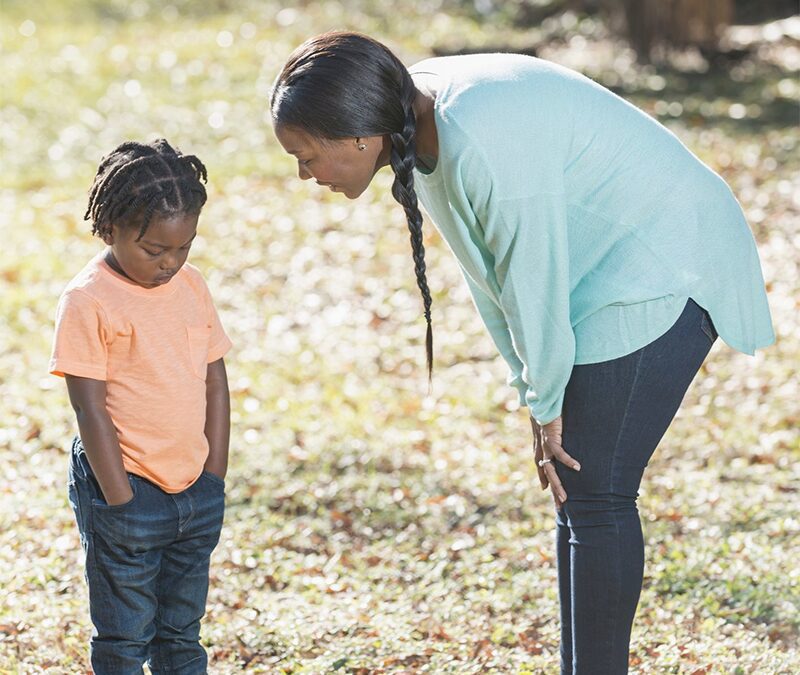
Limits tell your family under what condition you are willing or unwilling to do something. They tell your family where you “draw the line.” They tell what you will or will not tolerate. Their purpose is to take care of you. Limits are not designed to control or manipulate someone else’s behavior. Here are three examples:
Example 1. A mother was playing basketball with her two teenage sons. The boys were getting competitive and soon the game wasn’t fun. Mother announced, “It is not fun for me when you two fight. When you are ready to make it fun again, come and get me. I’d love to play again.”
Example 2. Children need you to set limits so that they can recognize and respect other people’s limits. I was holding hands roller-skating with my daughter. She said in a very demanding tone of voice, “Skate faster!” This wasn’t the first time I had noticed that she was being demanded, so I said, “I am unwilling to have you talk like that to me. It makes me feel like not cooperating with you, and if you continue, I will skate by myself.”
Example 3. A daughter asked her mother to take her to the video store and rent a movie. Her daughter had already spent her allowance that week. Mom said, “I’d be willing to take you to the video store, but I am unwilling to rent a movie for you.” Limits give others important information about you to help them know what they can or cannot expect from you. They are about you, not about criticizing someone else’s behavior or about trying to make them act in a certain way.
Why Do Children Need Limits?
Children need you to set limits so that they can recognize and respect other people’s limits.
Limits provide a sense of security. When children don’t know your limits, they feel lost in an abyss. They feel confused and sometimes literally bounce around trying to find some.
Limits make children feel that we care about them. Children that are raised without limits often feel abandoned.
Children need limits to learn how to deal with conflict. What happens when someone tells me I have overstepped their limits? What happens when someone disrespects mine?
Children need limits to help them define themselves. Limits set by parents help children clarify their own limits because they have seen your model.
Limits help them to learn what is socially acceptable and what is not.
Children need to learn that if they go past a certain point, there will be consequences. Some of
them may be serious.
What Issues Need Limits?
You may want to set limits on the use of your belongings, TV watching, bedtime, your time, the use of profanity, mealtime, chores, care of pets. This is not a conclusive list. Make a list of your important issues.
How Do We Know When Our Limits Are Being Violated?
The best clue to determine whether or not your limits are being violated is by being in touch with your feelings.
If any of the following feelings sound familiar, you know that your limits are being dishonored or that you are not being clear about them:
I feel anger, resentment, imposed upon, smothered, taken advantage of, and/or abused.
I feel as if I am pulling more than my fair share of the weight.
I feel unappreciated.
I feel as if I am being divided between two people I love.
I feel taken for granted.
I feel like a taxi cab driver.
What about me?
Why Do We Have A Difficult Time Setting Limits?
Our ability to set and follow through with limit setting will be largely determined by how we were parented as a child. Setting limits may be difficult for you if you were in any of the following situations:
Not having any limits as a child, being unsupervised.
Being given messages, such as: Don’t make waves; Children are to be seen and not heard; You are being selfish.
If you were told it wasn’t “nice” to assert yourself.
If there was abuse in the home or at work that was mental, physical, emotional, sexual, drug or alcohol related.
If there was someone in your family that you had to give up your needs for because they were sick or disabled.
If self-sacrifice was modeled and expected of you.
If intimidation was used to motivate you.
If you don’t set limits because you don’t feel you deserve them.
If you feel guilty about your own actions such as, working too much or getting a divorce.
What We Do Instead Of Setting Limits?
Because we are afraid of creating conflict, we often choose one of the following behaviors rather than setting limits We are afraid the other person will get angry, leave us, or reject us. We may even feel that what we say or do will not make a difference anyway. Instead of directly setting limits, we sometimes indirectly handle these situations by:
Deny it (act or pretend as though it didn’t happen).
Ignore it and hope it’ll go away.
Talk yourself out of how you are feeling (I shouldn’t feel that way because of … ).
Make excuses for the other person’s behavior (he only said that because he was tired).
Ruminate about the issue (Going over and over the event in your mind, trying to make sense of it).
Blame someone else.
Blame yourself (if I had only done … he wouldn’t act this way).
Get even.
Hide behind righteousness (I’m above having those feelings).
Pretend that you don’t care.
Withhold your love or your communication.
What Can We Expect When We Start Setting Limits?
When you first start setting limits, you can expect that your children’s behavior will get worse. They will test you. They will try everything in their power to get you to go back to the way you used to be. So, make sure your seatbelt is fastened. You may be going for a ride!
Steps For Setting Limits
1. Honor your feelings. Remember, feelings are neither right nor wrong.
They just are.
2. Get clear about what you want. What you are and are not willing to do.
3. Present the information to your family member using an “I” statement. For example, “I am unwilling to wash clothes that are not in the hamper.” There should be no blame, shame, guilt, exaggerations, or complaining. Do this step as soon as possible to prevent an unnecessary build-up of resentment.
4. Be ready to ‘stick to your guns.’ Be consistent and follow through.
Tomorrow’s Child/ November 2017
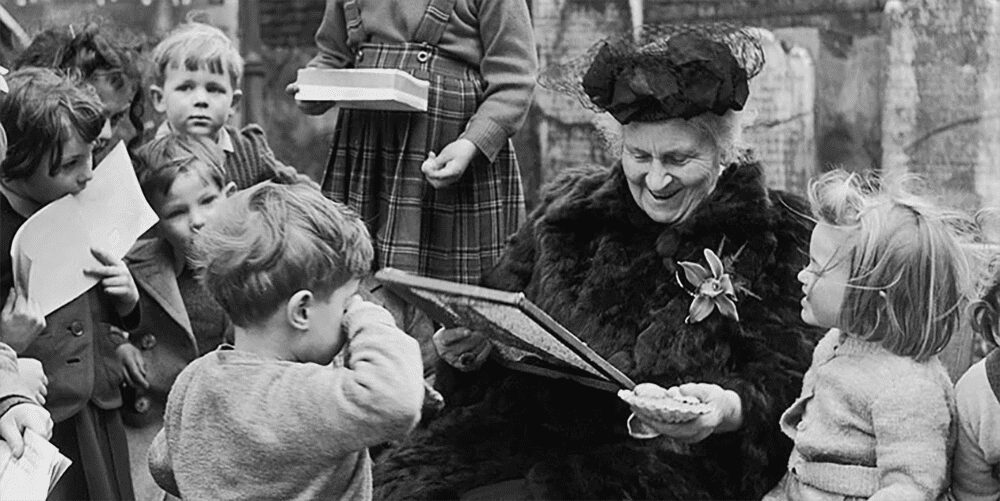
Maria Montessori: How It All Began Introduction to The Montessori Way
In 1907, an Italian physician was invited to open a child-care facility for fifty preschool-aged children in a section of Rome that was avoided and neglected because of its oppressive poverty and crime. The children’s parents worked sixteen or more hours a day. In the absence of adult supervision, these children were vandalizing recently renovated housing. Years later, Dr. Maria Montessori recalled her experience of personal transformation in which she discovered something previously unknown about children:
“What happened will always remain a mystery to me. I have tried since then to understand what took place in those children. Certainly, there was nothing of what is to be found now in any House of Children. There were only rough large tables. I brought them some of the materials that had been used for our work in experimental psychology, the items that we use today as sensorial material and materials for the exercises of practical life.
I merely wanted to study the children’s reactions. I asked the woman in charge not to interfere with them in any way, as otherwise I would not be able to observe them. Someone brought them paper and colored pencils, but, in itself, this was not the explanation of the further events. There was no one who loved them. I, myself, only visited them once a week, and during the day, the children had no communication with their parents.
The children were quiet; they had no interference either from the teacher or from the parents, but their environment contrasted vividly from that which they had been used to; compared to that of their previous life, it seemed fantastically beautiful. The walls were white, there was a green plot of grass outside, though no one had yet thought to plant flowers in it, but most beautiful of all was the fact that they had interesting occupations in which no one, no one at all, interfered.
They were left alone, and little by little, the children began to work with concentration, and the transformation they underwent was noticeable. From timid and wild as they were before, the children became sociable and communicative. They showed a different relationship with each other, of which I have written in my books. Their personalities grew and, strange though it may seem, they showed extraordinary understanding, activity, vivacity, and confidence. They were happy and joyous.
This fact was noticed after a while by the mothers who came to tell us about it. As the children had had no one to teach them or interfere with their actions, they acted spontaneously; their manners were natural.
But the most outstanding thing about these strange children of the St. Lorenz Quarter was their obvious gratitude. I was as much surprised by this as everyone else. When I entered the room, all the children sprang to greet me and cried their welcome. Nobody had taught them any manner of good behavior. And the strangest thing of all was that although nobody had cared for them physically, they flourished in health, as if they had been secretly fed on some nourishing food. And so they had, but in their spirit. These children began to notice things in their homes: a spot of dirt on their mother’s dress, untidiness in the room. They told their mothers not to hang the washing in the windows but to put flowers there instead. Their influence spread into the homes, so that after a while these also became transformed.
Six months after the inauguration of the House of Children, some of the mothers came to me and pleaded that as I had already done so much for their children and they themselves could do nothing about it because they were illiterate, would I not teach their children to read and write? At first I did not want to, being as prejudiced as everyone else that the children were far too young for it. But I gave them the alphabet in the way I have told you. As then it was something new for me also.
I analyzed the words for them and showed that each sound of the words had a symbol by which it could be materialized. It was then that the explosion into writing occurred. The news spread, and the whole world became interested in this phenomenal activity of the writing of these children who were so young and whom nobody had taught. The people realized that they were confronted by a phenomenon that could not be explained. For besides writing, these children worked all the time without being forced by anyone to do so.
This was a great revelation, but it was not the only contribution of the children. It was also they who created the lesson of silence. They seemed to be a new type of children. Their fame spread and, in consequence, all kinds of people visited the House of Children, including state ministers and their wives, with whom the children behaved graciously and beautifully, without anyone urging them. Even the newspapers in Italy and abroad became excited. So the news spread, until finally also the Queen became interested. She came to that Quarter, so ill-famed that it was considered hell’s doors, to see for herself the children about whom she had heard wonders.
What was the wonder due to? No one could state it clearly. But it conquered me forever, because it penetrated my heart as a new light. One day I looked at them with eyes which saw them differently, and I asked myself: ‘Who are you? Are you the same children you were before?’ And I said within myself: ‘Perhaps you are those children of whom it was said that they would come to save humanity. If so, I shall follow you.’ Since then, I am she who tries to grasp their message to follow them. And in order to follow them, I changed my whole life. I was nearly forty. I had in front of me a doctor’s career and a professorship at the University. But I left it all, because I felt compelled to follow them and to find others who could follow them, for I saw that in them lay the secret of the soul.
You must realize that what happened was something so great and so stirring that its importance could never be sufficiently recognized. That it will never be sufficiently studied is certain, for it is the secret of life itself. We cannot fully know its causes. It is not possible that it came because of my method, for at the time my method did not yet exist. This is the clearest proof that it was a revelation that emanated from the children themselves.
My educational method has grown from these, as well as from many other revelations, given by the children. You know, from what I have told you, that all the details included in the method have come from the efforts to follow the child. The new path has been shown us. No one knows exactly how it arose; it just came into being and showed us the new way.
It has nothing to do with any educational method of the past nor with any educational method of the future. It stands alone as the contribution of the child himself. Perhaps it is the first of its kind, which has been built by him, step by step.
It cannot have come from an adult person; the thought, the very principle that the adult should stand aside to make room for the child, could never have come from the adult.
Anyone who wants to follow my method must understand that he should not honor me, but follow the child as his leader.”
—Maria Montessori, January 6, 1942. Excerpted from her talk marking the anniversary of the first House of Children.
Maria Montessori discovered that when young children concentrate and investigate a set of purposefully designed activities, they tend to develop self-control; their movements become ordered, and they appear peaceful. Their demeanor towards others becomes kind and gentle.
These characteristics and other discoveries made with the children of San Lorenzo in 1907 were quickly replicated, as new Montessori schools opened throughout Europe and around the world. Children in Elementary and Secondary Montessori schools displayed tremendous enthusiasm as they explored and studied topics in great detail. Their learning achievements were profound. The overall Montessori experience, however, is deeper than an academic course of study.
Because the Montessori process fully engages children’s natural learning potentials, Montessori students learn about themselves, develop self-confidence, communicate effectively, and work well in groups. Today’s Montessori schools incorporate the discoveries of Maria Montessori as well as recent understandings of how learning and development take place. Montessori schools are now found in private, public, and homeschool settings in the United States and abroad. The educational programs in these schools range from infant care to high school students.
Many of these schools are affiliates of, or are accredited by, one of a dozen national and/or international Montessori organizations. Teachers receive Montessori teacher certification after completing rigorous courses of study. Many teachers describe their own experiences of personal transformation as they, too, witness in children astounding capabilities. From a family’s perspective, becoming part of a Montessori school could be thought of as adopting a natural lifestyle we call The Montessori Way.
Tomorrow’s Child/ November 2017
Montessori’s Gentle Approach To Discipline
Many parents believe that the word discipline means to punish. In reality, it means to teach.
In a Montessori-inspired home, parents are empathetic, caring, and respect children as real and separate human beings. However, children also need to develop a sense of empathy for others and must learn the rules of courteous everyday behavior.
To accomplish this, we need to help them develop a sense of self-respect with both compassion and respect for others. Since we cannot always be with them, we need to teach them to act with honor and integrity whether or not someone is watching. Since we can’t prepare them for every situation that they will face over the years, we need to teach them how to apply general rules of kind behavior to new situations.
Babies and Toddlers
Infants and toddlers don’t respond to discipline, rules, and punishments, but they do respond to unconditional love. They are not yet at a stage where they know right from wrong. They live in the moment, when they want something, they want it right now!
One secret to living happily with very young children is to go out of your way to attempt to understand what they are trying to communicate when they cry. Certainly, don’t take it personally! Even though, in the heat of the moment, it may feel as if your baby is being deliberately defiant, crying is one of the very few ways that young children can use to communicate. It can mean that they are hungry or that they need to be burped, they may be in an uncomfortable position, or they may need a diaper change.
Remember, babies are people too! They can become frightened. They may be bored or lonely. They may have had a bad dream. Watch and listen carefully. If you pay attention to your children, even when they are very young, ultimately, you will be able to determine what they are trying to tell you. Just as most parents learn to recognize the sound of their baby’s cry, we can learn to recognize the way they cry to communicate different emotions.
At this stage, their behavior is impulse-driven, with a limited ability to make the choice to follow ground rules. While you always want to model good behavior and explain why a given behavior is okay or not okay, don’t be surprised when your words go in one ear and out the other.
In a climate of love and respect, toddlers slowly develop the ability to understand our words and will begin consciously to respond to them. Eventually, they begin to imitate our actions when we model polite behavior and will begin to cooperate, in part, to make us happy. Most toddlers have good days when they are cooperative and angelic, and days when they seem to be testing us constantly.
We want to take our children beyond simple obedience, where they do what we ask in hope of a reward or to avoid something unpleasant. We want to help them to develop an internalized sense of right and wrong and courteous behavior. This requires that they eventually develop a social conscience and a sense of self-discipline. This develops slowly as children mature. For better or worse, all parents are moral educators. Our goal is to teach our children the values that we hold dear and teach them in such a way that our children live by them.
Children that achieve this goal develop a high level of self-respect. They also tend to find it much easier to establish strong friendships. They tend to respect the rights of others and are generally pleasant to be around.
Don’t Punish, Teach!
As children get older, do not take it for granted that they will automatically know how to handle a new situation. It’s always better to teach them the right way to act rather than to wait for them to misbehave and then scold, threaten, or punish. If your children do act inappropriately, stop their misbehavior calmly, but firmly, and show them how to handle the situation in a socially acceptable way.
Children have the same emotions as adults, but they don’t instinctively know how to express frustration and anger appropriately, nor do they automatically know how to solve conflicts. As parents, we have to teach our children how to get along with other people.
Montessori teachers call these the ‘Lessons in Grace and Courtesy.’ These lessons set a tone of respect and kindness. We teach our children how to shake hands, greet a friend, and say goodbye. We teach them how to ask politely to join other friends who are playing and how to respond if they are rejected.
We teach them how to interrupt someone who is busy and how to tell someone ‘no thank you’ politely. We teach them how to speak indoors, so their shouts don’t hurt our ears, and how to play without damaging anything or hurting someone. We show them how to offer a sincere apology and how to resolve conflicts peacefully.
To teach a lesson in grace and courtesy we explain a situation in simple terms and demonstrate the right way to handle it. Then we have our children practice with us, role-playing the sequence of events. Most children enjoy these lessons if they are kept short and sweet, and if they have not been embarrassed or threatened because they made a mistake.
For example, if your children tend to yell at the top of their lungs inside the house, you obviously need to give them a lesson in how to keep the indoor noise to a level that does not disturb other people.
First, as it is happening, instead of scolding, instruct them firmly, but politely, to please speak softly in the house.
Wait for a moment when the situation is not emotionally charged and neither you nor the children are upset about the behavior. Then, give them the lesson on the right way to speak indoors.
Rather than giving them a lecture, speak to them in very simple language and show them what you mean. For example, you might say:
“I want to talk to you about indoor voices. When we are outdoors, it’s so big, and sometimes we need to yell so we can hear each other when we’re far away. Outdoors, it does not hurt our ears when someone talks loudly, unless they do it right in our ear. That hurts! So outdoors, we can use our outdoor voices.
But when we are indoors, it hurts our ears and bothers the neighbors, too, if we talk too loudly. Indoors, we use our indoor voices.”
Now show them what you mean. Talk very loudly, and ask, “Was I using my indoor voice or my outdoor voice?” Talk normally. “What do you think? Was I using my indoor or my outdoor voice? Indoors, we use our indoor voices. Outdoors, we use our outdoor voices.”
You can teach all sorts of lessons this way, such as saying “please” and “thank you” or closing doors without slamming.
Practice with each other. Some families have the ‘manner of the week’. They introduce a new rule of everyday courtesy and practice it with one another over meals and around the house.
Other Children and Adults Are Role Models, Too
To teach your children good manners, they need to see that their parents, older siblings, and friends follow them consistently as well. The example that we set through our own behavior is more powerful than anything we say. Especially when they are very young, children are absorbing everything they see us do, and soon they begin to talk and act just like us. We are their role models.
Their brothers and sisters, grandparents, friends and playmates, babysitters, and preschool teachers play a similar and very powerful role as well. Knowing that your children will be influenced profoundly by the people around them, choose wisely the children and adults with whom your children will spend time.
Especially with children under age six, avoid loud, chaotic situations where large groups of children are over-stimulated and generally behave rudely, such as indoor children’s amusement parks with lots of expensive and noisy games and rides.
Choose your child’s play-dates thoughtfully. If your children spend time with a family that allows them to create havoc in their home, tearing up the living room, knocking over lamps, and shoving one another around in rough-and-tumble play, don’t be surprised when your children bring that behavior home with them. Pay attention to the way prospective play-date parents supervise their children. Do they ignore them or talk on the phone amidst chaos? It is not your place to judge other families, but it is your obligation to make good choices for your children.
Positive Discipline: Establishing a Climate of Love
Children are actually so sensitive and impressionable that we should monitor everything we say and do, for everything we say and do will be engraved in their memories forever.
Our children love us with a profound affection. When they go to bed, they want us to stay with them as they go to sleep. When we work in the kitchen, they often want to help. When we sit down to dinner, they want to join us. We may worry that we’ll spoil them if we listen to their pleas, but we shouldn’t. They only want us to pay attention to them. They want to be part of the group.
Children are extremely sensitive to the emotional climate within the family. They love us and basically want us to be pleased with them. This doesn’t mean that they will always behave.
Why Children Test Our Limits
Every child will test the rules to some degree. In fact, most acts of testing parents are a normal part of the child’s process of growing up.
When children test adults, it is often their way of expressing feelings that they don’t understand, and from our responses, they gradually learn how to handle their emotions appropriately. By testing the limits, they learn that we really care about certain ground rules of grace and courtesy in our relationship. In acting out, they are taking their first tentative steps toward independence, attempting to demonstrate that we don’t control them completely.
Agree on your family ground rules and get them written down, where both parents can refer to them. Teach your children how to do the right thing rather than focusing on their infractions.
Family Ground Rules
In the Montessori-inspired home, there are normally just a few basic ground rules:
Be kind and gentle.
Treat everyone with respect.
If you use something, put it back correctly when you are done.
If you break something, clean it up.
Tell the truth and don’t be afraid to admit when you make a mistake.
You should be absolutely clear in your mind about your family ground rules.
Explain your family ground rules positively, rather than as prohibitions. Instead of saying, “Don’t do that!” ground rules should tell children what should be done.
Teach your children how to follow the family ground rules as if you were teaching any lesson in everyday living skills and grace and courtesy.
Model the same behaviors that you are trying to encourage in your children.
Consciously try to catch your children doing something right—reinforce and acknowledge even small steps in the right direction. Don’t wait until they have mastered every new skill. Encourage them along the way.
When your child is breaking a ground rule, there are several things you can do other than scold, threaten, or punish.
You can redirect them by suggesting a more appropriate choice.
You can remind them of the ground rule and politely, but firmly, ask them to stop.
If the event is not emotionally charged, you can calmly re-teach the basic lesson about how to handle such situations.
Be consistent!
If you can’t bring yourself to reinforce a rule again and again, it shouldn’t be a ground rule at your house.
A few good rules are much better than dozens of rules that are often ignored.
Why We Don’t Use Threats or Punishments
Threats and punishments are not good tools to get children to behave. While they tend to produce immediate results, they are rarely long-lasting. They only work as long as the person being threatened cares. Many children who respond to threats and are shaken by punishments are anxious to please us and win back our love. On the other hand, when children are angry or are asserting their independence, they often act out and don’t care if they are punished. Punishment is simply not as effective as people tend to believe.
Teach children to do things correctly and emphasize the positive rather than using insults and anger. It’s not always easy. Above all else, try never to ask your children unanswerable questions, such as, “How many times do I have to tell you … ?” to which the appropriate response would be, “I don’t know, Dad! How many times do you have to tell me?” If you ask a silly question, you’re likely to get a silly answer.
Children can correct their own mistakes
Many parents and teachers believe that they can shape a child’s personality and future through strict discipline, but children carry within themselves the key to their own development. Their early attempts to express their individuality are hesitant and tentative. Our children think that adults are all-wise and all-powerful. They are easily overwhelmed by our best intentions. Our efforts to protect children from mistakes that seem so obvious from our perspective tend to frustrate children about the process of learning for themselves about life.
Our goal should be to help children become mature, independent, and responsible. Unfortunately, as parents, we sometimes tend to overprotect our children, not realizing that they can only learn about life through experience, just as we did.
We want to help our children learn to live in peace and harmony with themselves, with all people, and with the environment. We work to create a home in which our children can learn to function as independent, thinking people. To succeed, we need to treat them with respect as full and complete human beings, who happen to be in our care. Our children need to feel that it is okay to be themselves.
Children must feel our respect; it is not simply enough to say the words. If children believe that they are not living up to their parents’ expectations, that their parents are disappointed in the people that they are becoming, there is a very good chance that their lives will be emotionally scarred.
Cutting down on the word “no”
Sooner or later, every child will stubbornly say No, I don’t want to! This is the classic power struggle that starts in the toddler years and, in many cases, continues through adolescence. Many people call the toddler stage the ‘terrible twos,’ but they don’t have to be—not with two-year-olds nor with older children.
Power struggles start in situations where parents and children are each determined to get their own way and are not willing to back down. Underneath, each feels frustrated and threatened. Parents feel that their children are directly challenging their authority. Children, on the other hand, in situations like this, are feeling generally powerless and are attempting to assert their autonomy and establish more of a balance of power in their relationship.
Here are some strategies that may work for you to reduce the number of power struggles and the word No! in your relationships with your children.
Give your children choices. Children desperately long to feel powerful and resent feeling powerless. Whenever you can, look for ways to let your children make a choice between two equally acceptable alternatives. Would you like water or apple juice with dinner tonight?
Teach your children to say no politely. Mom, I really do not feel like doing
that now.
Remember that the secret is to speak to them firmly and kindly.
Remember Robert Heinlein’s golden rule of family life: “Kindness and courtesy are even more important between husbands and wives, and parents and children, than between total strangers.”
Look for ways that allow you to back down gracefully from a power struggle without simply giving in. Often, through compromise, both you and your children can get most, if not all, of what you want. “Mom, I have so much homework and an essay to write. Do I have to help with the dishes?” Mom responds, “Yes darling, we all have to help clean up, but working together, it will only take a few minutes. Would you like my help in planning the outline of your essay before you begin?”
Many power struggles seen in some homes are cut down to a minimum simply by teaching your children how to be more independent and giving them meaningful levels of independence and responsibility. This tends to make children feel powerful and grown-up.
Preventing some of the stress in children’s lives
Do not over-schedule your children
Many families try to do too much. Sometimes it is unavoidable, but think long and hard before you sign your child up for dance lessons, baby gym, or any other prescheduled classes for young children. Racing from one scheduled activity to another raises everyone’s stress level and sets the stage for temper tantrums. Allow enough time so that you will not have to race to meet a deadline.
Look for patterns in your children’s behavior
Often there are patterns in family life. If your child tends to have a tantrum when you go shopping, why not leave her with her other parent, a grandparent, or a babysitter?
Talk things through in advance
Children do best when they know their limits in advance. For example, if you are going to the store and your children want to buy a toy, tell them in advance what you will agree to and stick with it.
Resolving Conflicts
In Montessori classrooms, the Peace Table is a child-sized table, a plant, a bell, an artificial rose, and possibly a candle. Two children who are having a disagreement decide to retreat to the Peace Table to solve their problem. This can take place at home as well.
Sometimes, children may not remember, and the suggestion might come from the parent or an older brother or sister who, observing the disagreement, might bring them a peace rose (an artificial long-stemmed rose) with the suggestion that they solve their problem at the Peace Table.
Once arrived at the table, a certain procedure ensues. The one who feels wronged places her hand on the table, indicating that she wants to have her say uninterruptedly. The other hand she places on her heart, indicating that she speaks the truth. She then looks her classmate in the eye, speaks her name, and proceeds to explain how she feels, “Sarah, I felt very angry because…” and continues to state why she feels that way, e.g., “because you didn’t let me play with you!”
She then proceeds to state what she wants to see happen to resolve the conflict: “And I don’t want you to do that ever again if you want to be my friend!”
Now that she has stated her case and opened the door for further discussion, she withdraws her hand from the table and from her heart and gives the other child a chance to respond.
The second child proceeds that same way, placing her hands on table and heart, looking the first in the eye, and responds:
“Emily, I feel unhappy that you are angry. I did not mean to hurt your feelings.”
With that, she is finished and withdraws her hands. Now it is the first child’s turn to agree or disagree, in any case, to continue the dialogue until they reach some kind of agreement, even if that means that they disagree. At least they are talking, without yelling, screaming, and blaming. They want to solve the problem. When they have reached an agreement, they ring the bell to let the rest of the class or family know.
In case they cannot come to a positive conclusion, they may ask for a mediator. This may be an older sibling/classmate or a parent/teacher, who has to remain impartial and to listen well.
However, if the problem or conflict is too involved, then one of them may ask for a class or family council, where the entire class or family sit down in a circle, listens to first one, then the other person’s side of the story contributes what they can to it either as facts of what they have seen or heard, or as ethics, right and wrong, or in perspective to rules upon which all have agreed upon previously.
The core experience the children gain from these procedures is that it is necessary to resolve disturbances honestly and with goodwill to maintain an authentically harmonious and cooperative atmosphere. n
Tomorrow’s Child/ November 2017

Helping Children Cope: Tips For Talking About Tragedy
After a tragedy, you might feel helpless—but your child needs your support. Here’s help knowing what to say.
When a tragedy—such as a natural disaster, mass shooting, or terrorist attack—occurs, it can be hard to talk to your child about what happened. How do you explain it? How much will he or she understand? Find out how to start the conversation and what you can do to help your child cope.
Do I need to talk to my child about a tragedy?
Talking to your child about a tragedy can help him or her understand what’s happened, feel safe, and begin to cope. If you don’t speak to your child about a tragedy, there’s a chance that he or she might hear about it elsewhere.
How do I start a conversation with my child about a tragedy?
Take time to think about what you want to say. If possible, choose a time when your child is most likely to want to talk, such as before dinner. Ask your child what he or she already knows about the tragedy—and what questions or concerns he or she might have. Let your child’s answers guide
your discussion.
How do I explain the tragedy to my child?
Tell the truth. Focus on the basics, and avoid sharing unnecessary details. Don’t exaggerate or speculate about what might happen. Avoid dwelling on the scale or scope of the tragedy.
Listen closely to your children for misinformation, misconceptions, and underlying fears. Provide accurate information. Share your own thoughts and remind children that you’re there for them. Reassure children that what happened isn’t their fault.
Children’s age will affect how they process information about a tragedy. Consider these tips:
Preschool children. Get down to children’s eye level. Speak in a calm and gentle voice using words they understand. Explain what happened and how it might affect them. For example, after a severe storm you might say that a tree fell on electrical wires and now the lights don’t work. Share steps that are being taken to keep everyone safe and give hugs.
Elementary and early middle school children. Children in this age range might have more questions about whether they’re truly safe. They might need help separating fantasy from reality.
Upper middle school and high school children. Older children will want more information about the tragedy and recovery efforts. They’re more likely to have strong opinions about the causes, as well as suggestions about how to prevent future tragedies and a desire to help those affected.
How might my child react?
After a tragic event, children might experience a range of emotions, including fear, shock, anger, anxiety, and grief. Age will affect how they handle the stress of a tragedy. For example:
Preschool children. Children in this age range might have trouble adjusting to change or loss. They might become clingy or mimic your emotions. Some children might also revert to wetting the bed or sucking their thumbs. Avoid criticizing this behavior.
Elementary and early middle school children. Children in elementary and early middle school might have nightmares or other sleep problems. They might fear going to school, have trouble paying attention in school, or become aggressive for no clear reason.
Upper middle school and high school children. Older children might deny that they’re upset. Some children might complain of physical aches and pains because they’re unable to identify what’s really bothering them. Others might start arguments or resist authority.
These reactions are normal. However, if children continue to display these behaviors for more than two to four weeks, they might need more help coping. If your child has experienced previous trauma, remember that he or she might be at greater risk of a severe reaction. If you’re concerned about your child’s reaction, talk to a mental health provider.
What can I do to help my child cope?
You can take steps to help your child process what happened. For example:
Remain calm. Children will look to you for cues about how to react. It’s OK for children to see adults sad or crying, but consider excusing yourself if you’re experiencing intense emotions.
Reassure children of their safety. Point out factors that ensure children’s immediate safety and the safety of the community. Consider reviewing your family’s plans for responding to a crisis.
Limit media exposure. Don’t allow young children to repeatedly see or hear coverage of a tragedy. Even if your young children are engrossed in play, they are likely aware of what you’re watching and might become confused or upset. Older children might want to learn more about a tragedy by reading or watching TV. However, avoid repetitive loops of news information once you have the facts. Constant exposure to coverage of a tragedy can heighten anxiety.
Avoid placing blame. If the tragedy was caused by human violence or error, be careful not to blame a cultural, racial or ethnic group, or people who have mental illnesses.
Maintain the routine. To give your child a sense of normalcy, keep up your family’s usual dinner, homework, and bedtime routine.
Spend extra time together. Special attention can foster children’s sense of security. Spend a little more time reading to them or tucking them in at night. If your children are having trouble sleeping, allow them to sleep with a light on or to sleep in your room for a short time. Extra cuddles might help, too.
Encourage the expression of feelings. Explain that it’s OK to be upset or cry. Let children write about or draw what they are feeling. Physical activity might serve as an outlet for feelings or frustration. If they are acting out, explain that there are other ways of coping.
Seek out school resources. If their school offers counseling after a tragedy, take advantage of the opportunity to meet with a counselor.
Do something for those affected by the tragedy. Consider ways that you and your child can help victims and their families. You might take your child to your place of worship or write thank-you notes to first responders.
What else can I do?
It might be the last thing on your mind, but caring for yourself after a tragedy is important. Pay attention to your own feelings of grief, anger, or anxiety. Lean on loved ones for support or talk to a mental health provider. Get enough sleep, eat a healthy diet, and stay active. Taking care of yourself will enable you to care for your child and serve as a role model for how to cope.
Retrieved from http://www.mayoclinic.org/healthy-lifestyle/childrens-health/in-depth/helping-children-cope/art-20047029?pg=1
Tomorrow’s Child/ November 2017

Letter from the Editor
It has been a long, challenging few months for many of us in the Americas and around the world. Along with an unusually active and violent hurricane season, earthquakes, wildfires, and flooding, we have watched in horror as gun violence, terrorism, and the threat of nuclear war have taken a very disturbing uptick.
In this issue, we have included some information on helping children cope with the aftermath of disasters, natural and human-made. We have also included some information on environmental sustainability because we all need to pay attention, even if it no longer seems to be a priority project for all leaders of the world.
The voices and efforts of Montessori parents, teachers, and students are more important now than ever. Without action, the words to victims and survivors, that they “are in our thoughts and prayers” are empty. This strung-together expression of condolence no longer provides comfort; instead, in my opinion, it has become an over-used excuse for the inability or unwillingness to take personal and governing responsibility.
What we do and say matters to the children in our lives.
Be their voice.
Peace,
Joyce St. Giermaine, Editor
PS: For those of us living in the US, should you want to know where to start, here’s a link to the people who represent you at the state and national level: https://www.usa.gov/elected-officials.
PPS: For many years, we’ve provided a free print subscription to every school in our database within the US and Canada. To help with saving some trees, we are discontinuing this practice and encourage those schools that wish to continue reading our magazine to consider ordering a membership.
Tomorrow’s Child/ November 2017
Notes from the Hive: Honey Bees Help Us Prepare Our Home Environment
To continue reading, you will need to choose a subscription plan.

Montessori Teacher Training: The Calypso Paradigm
By Nancy McCormick Rambusch
Introduction
Dr. Nancy McCormick Rambush
Dr. Nancy McCormick was the founder of the American Montessori Society in 1960 and is widely considered to the tireless inspiration of the second wave of interest in Montessori education in the United States during the 1960s and 1970s. In 1992, she was a member of the founding board of the Montessori Foundation.
All of us who knew and worked with Nancy remember her as she often described the parents who formed the energetic Montessori movement of the 1960s: she was “sassy, critical and articulate”.
Nancy published the following article in The Constructive Triangle, the former journal of the American Montessori Society (AMS Teachers’ Section), in the summer of 1978 (Vol. V, No. 3). We want to thank the American Montessori Society for giving us permission to republish it in the September 2007 issue of Montessori Leadership. It is included here in the archive of articles from past issues for reference by members of the International Montessori Council. Copyright remains with the American Montessori Society, and this article may not be reproduced or republished without the American Montessori Society’s permission.
We feel that Nancy McCormick Rambusch’s perspective and concerns are just as relevant today as they were thirty-eight years ago when first published. As evidence documenting the widely varying interpretations of Montessori practice continues to mount, we note a concurrent growing level of concern expressed by parents about the inconsistency that they find in educational philosophy and practice from one ‘Montessori’ school to another.
The International Montessori Council welcomes all members of the Montessori community. However, while embracing diversity, we believe that our common heritage is what Dr. Maria Montessori actual wrote, said, and did. To maintain both intellectual and spiritual integrity, we hold that the legacy of Dr. Montessori’s theory and practice, as it evolved during her lifetime, should remain the foundation of our own practice today and the standard against which our own evolving work must be measured.
The Montessori approach is not a closed book. However, it is not a blank journal into which anything can be written either. What leads us to identify our own professional identity with that of a woman who died fifty-five years ago is that her ideas formed a systems-based approach that shares the characteristics common to all important reforms: it is effective, it is replicable, it can be adapted to many different situations, and it is sustainable over time.
As Nancy McCormick Rambusch points out, a truly major concern has yet to be adequately addressed by the Montessori community. That concern is our mistaken emphasis on a limited subset of her larger ideas, such as the role of the prepared didactic materials, without preparing Montessori educators to truly understand the essential concepts of a systematic, anthropologically-based approach to observation and study of children individually and within the context of the children’s community that they form together. Equally important, Rambusch points out the vital importance of allowing children liberty (freedom from unnecessary adult intervention) to choose their work freely and to interact with one another and the prepared environment, within reasonable guidelines of courteous and responsible behavior. Rambusch argues that by ‘placing the accent on the wrong “syl-LAB-bell”, we have missed the meaning and message within Montessori’s keys ideas. She proposes some specific steps toward a new approach to Montessori teacher education.
We believe that the ideas that Nancy set forth in this seminal article deserve a close second reading by those of us who first read it many years ago, and careful consideration by those reading it now for the first time.
* The author did not add notations to demark subsections nor did she use bold font to make certain points stand out. She did occasionally print certain words and phrases in italics, which we have continued. We have added some subsection headings and bolded some words for additional clarity or emphasis.
Tim Seldin
Preface
The following preface appeared on the preceding page of the original publication:
The following article may be construed by some readers to contain criticism of existing AMS teacher training courses, of current Montessori teacher practices, and of the implementation of Montessori methodology in classrooms. We have been pleased to print Ms. Rambusch’s essay in The Constructive Triangle because we appreciate the innovative, conceptual thrust of her research. Always a prophet, she points in forceful style to what may be the road ahead for all of us. We welcome her opinions in that spirit.
Bonnie O’Connor
Chairperson, AMS Teachers Section
MONTESSORI TEACHER TRAINING: THE CALYPSO PARADIGM
By Nancy McCormick Rambusch
The history of Montessori teacher training, both in Montessori’s lifetime and after her death, is one based on an act of the heart, conversion, rather than an act of the mind, persuasion. This is a perception that has been twenty-five years in the making.
In her lifetime, Montessori’s mode of induction into her “method” was one of conversion. She spoke of the need to convert or transform both teacher and school at the same time.
The transformation of the school must be contemporaneous with the preparation of the teacher.1
Since Montessori had more immediate access to would-be teachers than to schools, she diffused her message through teacher training, which, in its beginnings, was based upon observation of and anecdotal information concerning her work.2
The ‘conversion’ mode of training was admirably suited to a person of Montessori’s charismatic personality and stature. Anna Maccheroni, one of her first followers, described her first encounter with Montessori.
It was as if I had been thirsty and had found pure water.3
The conversion mode was also congruent with the manner in which Montessori became not only the center of a ‘method’ of education but of a social movement. The roots of her dual definition were seen in comments such as those contained in a 1914 Times Educational Supplement review of Mr. Cecil Grant’s English Education and Dr. Montessori.
…to say he canonizes her is to put it mildly. He is so carried away by his zeal that he regards her as a special creation of the Providence, which ordereth all things in heaven and earth. She has been raised up by God, ‘in these last days’, after much and careful preparing of the way … to show us how simple and inevitable, yet how new and radically change-bringing, are the required reforms.4
The same journal published a comment of an “ex-official of the Montessori Society” who saw the danger of her dual definition in 1921.
A movement might be set up to introduce a method, but a method should be able to justify itself intellectually and to demonstrate its satisfactoriness with well-authenticated facts. A movement, on the other hand, makes a moral appeal and relies very largely on suasion in which the emotions are stirred.5
Suasion is perilously close to uncritical acceptance. It was the hallmark of those of Montessori’s followers who sought discipleship. Published versions of life with Montessori used expressions like “cenacle” or “faithful band.”
The little band of women, living, and working with Montessori, Dorothy Canfield Fisher compared to nuns about an adored Mother Superior.6
The conversion model is powerful in the hands of a true prophet. As long as Montessori lived, it was the model for the diffusion of her ideas and practices, and as such, it permeated teacher training. In retrospect, it is clear that Montessori might as well have awarded a chasuble as a diploma to many of those who completed a training course under her direction.
After Montessori’s death in 1952, there were two groups who could make no further claim on the conversion model. One group, her son and other close followers, was the Association Montessori International (AMI); the other, those who came to Montessori’s ideas as “method” rather than “movement” because they had not known Dr. Montessori in life. Neither of these groups was able to establish convincingly the conversion model of teacher training, although some in each group tried.
Persuasion or appeal to reason seemed a surer strategy to the young American parents of the late 50’s and 60’s believed in Montessori’s ideas. As strong as the appeal to reason in Montessori education was its appeal to the lived experience of these parents who sought a match between their aspirations for their children and an education which would represent those aspirations. Such was the exclusive nature of these parental aspirations in the beginnings of the American Montessori movement, that John McDermott, professor and student of American philosophy, accused it of foreclosing the larger community. Thus did the vision of Montessori come to depend upon those willing to implement it in America, in a particular way. Had this group of “sassy, critical and articulate” parents had a larger vision, there would have developed a greater variety of American versions of Montessori’s method, and a greater acceptance of it.
When young Dr. Montessori visited the Hospice de Bicetre in Paris, at the turn of the century, she went in search of the practice that her French inspirer, Eduoard Seguin, had initiated there fifty years earlier. She was dismayed to find the pedagogy widely discrepant with her understanding of Seguin’s original text.
Like Seguin, who developed much of the apparatus, which Montessori modified, Montessori recognized that the apparatus was merely the occasion for the child’s awakening to learning, not the cause.
We must know how to call to the man, which lies dormant within the soul of the child. I feel this intuitively and believed that not the didactic material but my voice which called to the children awakened them, and encouraged them to use the didactic material, and through it, to educate themselves.7
Seguin had perceived the preparation of teachers as the most critical aspect of his work. What Montessori saw in Paris was both a shift in emphasis within Seguin’s method and a difference in interpretation from what she perceived as Seguin’s intention.
At the Bicetre, where I spent some time, I saw that it was the didactic apparatus of Seguin, far more than his method, which was being used although the French text was in the hands of educators.8
Although Seguin was constantly quoted in all of the publications dealing with institutions for deficients, the educational applications described were quite different from the applications of Seguin’s system.9
Seguin’s method, in Montessori’s view, had been lost by his disciples. This insight could have proved instructive to Montessori.
Had Montessori been more aware of the fate of educational theorists, she would have been less surprised in the changes wrought in Seguin’s method over time. McDermott, as one of the founders of the American Montessori movement, stated the case for a reexamination of Montessori in the same terms as one might have done for Seguin.
It is so strange that Montessori is in need of updating when no philosopher of education has ever developed more than a handful of practical suggestions which were instituted beyond his own historical period?10
When, in 1963, McDermott took a look at the direction that the American Montessori movement was taking, he raised questions, which proved to be of methodological import. In penetrating Montessori’s original insights, McDermott questioned the parochial interest of affluent Americans in only one version of Montessori education, and in one which excluded those children for whom Montessori’s vision seemed most relevant.
A presentation of the Montessori position in its generalized fundamental contentions will prove revealing … Montessori is important for precisely those youngsters who are in need of personal development at an age prior to their complete submission to hostile surroundings.11
He further questioned the notion of the “supranational” child, which absolved its believers from a willingness to address the specific concerns of American culture.
The contentions of the traditional Montessorians about the universal similarity of children for purposes of education display a basic naiveté about the extraordinarily powerful and irreducible interrelationships between a culture and the child’s development of a modality of consciousness.12
McDermott suggested that if all the American Montessori movement aspired to was a “private history”, then it could continue to ignore the ways in which growth and change occur in America … Of particular significance for the American scene is the tradition of public education and the needs of an egalitarian-oriented society.13
McDermott demonstrated that while the mechanics of organizing a national movement were engaging the time and attention of a small band of committed zealots, the larger questions concerning the “method” remained as unaddressed and unanswered as they were in Europe.
Montessori had attempted a synthesis of physical anthropology and pedagogy, a science of education, which she called “pedagogical anthropology.” The first and most important statement of her work appeared as The Method of Scientific Pedagogy applied to the Education of Young Children in the Case dei Bambini. This book, written in 1909, appeared in English as The Montessori Method. It contained Montessori’s educational philosophy.
… if we make of the teacher an observer, familiar with the experimental methods, then we must make it possible for her to observe and to experiment in the school. The fundamental principle of scientific pedagogy must be, indeed, the liberty of the child—such liberty shall permit a development of individual spontaneous manifestations of the child’s nature.14
Montessori used the pedagogical methods she devised,-an amalgam of intuition, information and observational acuity,-to watch children act on their environments. She focused particularly on the interaction of children with the standard assembly of her didactic materials. Critics of Montessori tended to see her method as “nothing but the didactic apparatus.” Sheila Radice, writing of Montessori to an English audience, suggested that Montessori was far more than this.
To critics who complained that Montessori reduced the world of the child to nothing but the didactic apparatus, Radice replied that ‘no one can continue to nurse this absurdity who meets this clever, sensible woman-doctor and woman of the world face-to-face, who has listened to her terse summings -up and trenchant criticisms, and noted her kindly, sympathetic, assured manner and the occasional deprecatingly humorous glance of her dark, far-seeing eyes.15
The critical features of the Montessori “method”, as Montessori presented it, were observational acuity and an attendant sensitivity to the spontaneous manifestations of individual children, exemplified by their interactions with the prototypical materials, which she had devised as information models. In translating or transposing Montessori pedagogy across space and time, the critical variables in her “method” would be the capacity to observe and the ability to use observation as the basis for advisement in helping a child move from where he is to where the culture intends him to go. That there were many ways to achieve this goal was apparent from Montessori’s willingness to respond to every spontaneous manifestation of every child in every culture.
The Montessori training I received in London under the auspices of the AMI in 1954 consisted of lectures containing short anecdotes of Montessori’s life and long dictations of the sequences of Montessori’s didactic apparatus. Such “training” was an inadequate reflection of Montessori’s thought and a dysfunctional translation of that thought into pedagogy.
The focus of the training was the manipulation of the didactic material. The material was divided into categories of Practical Life or self-mastery, Sensorial Education and the Indirect Preparation for Academic Learning. Lecturers in the course, like Claude and Francesca Claremont, illustrious stars in the tiny Montessori firmament, presented the didactic material in the context of anecdotal information about Montessori’s life and thought. The materials were not discussed in terms of the concepts they, encapsulated. They were offered as quasi-magical mechanisms, through which children would prehend sensorially what others struggled to comprehend cognitively.
Each of the students in the course was expected to make a series of Albums of all the didactic materials and to write out, from dictation, the sequences of highly ritualized steps of each of the “presentations”. In the many evenings spent in the course, fully three-quarters of the time was spent in taking dictation.
The reason for copying from dictation the procedures to be used in the presentation of didactic material had its origin in Montessori’s remembered experience. Montessori described the catalytic effect that meditation on the works of Itard and Seguin had had on her “method”, when she copied their works by hand, translating them into Italian.
Having through actual experience justified my faith in Seguin’s method, I withdrew from active work among deficients, and began a more thorough study of the works of Itard and Seguin. I felt the need of meditation. I did a thing which I had not done before, and which perhaps few students have been willing to do. I translated into Italian and copied with my own hand, the writing of these men, from beginning to end, making for myself books as the old Benedictines used to do before the diffusion of printing.
I chose to do this by hand, in order that I might have time to weigh the sense of each word, and to read, in truth, the spirit of the author.16
Montessori’s own education had been one of ceaseless memorization. The Italian schools from primary through university level demanded uncritical regurgitation of received subject matter. Kramer suggests that the two methods of learning most employed in the schools of Montessori’s time were “drill and more drill.”17
The teachers’ work consisted in overseeing the performance of required exercises by pupils. The school system was not one that did much to develop or encourage imagination. Montessori’s secondary education was very like her primary.
There was a syllabus to be taught in every subject, and most teaching was by means of the printed text only, which pupils were required to memorize and repeat. It was heresy to dissent in any way from the ideas as presented in the syllabus.18
Her medical school experience was yet another example of the same pedagogical strategy.
The university existed primarily to administer examinations, a highly ritualized set of hurdles marking the progress of the student toward his diploma, and he could prepare himself or them as he saw fit as long as he reproduced the required answers,-all of which could be found in his lecture notes.19
The point to be made concerning Montessori’s school experiences is not that she transcended them in her own creative, imaginative thought, but that she incorporated them into the diffusion strategy of what came to be called her “method.” By insisting that students master the intricacies of each of a series of prototypical materials, which she had developed, and then commit to memory the ritual for demonstrating each of them, Montessori had devised a way of exporting a discernibly different educational strategy around the world. It was one which could be overseen by those far less gifted than she.
As Montessori moved from the center to the periphery of her world, she revealed her emergent concerns and speculations to her disciples. As Montessori materials moved from the center to the periphery of her world, there was little thought that her disciples would have concerns and speculations relating to the “method.” There seems to have been little change in the training after Montessori’s death.
The (London) training offered by the AMI was similar in content to that offered during Montessori’s lifetime. Bereft of her genial presence, much of it made little sense. The principal focus of the training was the provision of structured experiences with an array of `didactic apparatus” which Montessori. .. had developed and which was to her `method’ what Froebel’s Gifts and Occupations were to his. A secondary focus was on the transmission of Montessori folklore and myth in the form of anecdotes of Montessori’s life and work, which were delivered with the reverence and solemnity usually, accorded scripture. Since none of the didactic apparatus was demonstrated with children present, students had to imagine what child responses to it would be. They also needed to ponder what all of it might mean in the context of their own culture-specific educational settings.20
When Betty Stephenson embarked to conduct the first American training course, her reticule contained the standard store of anecdotes about Montessori’s life, repetitious statements from Montessori’s written works and a standard set of the Montessori didactic apparatus. This was the core of the Montessori teacher training. It was completely a-contextual, based on the assumption that children the world over were more alike than different. This training was, after all, the best that any of Montessori’s disciples could offer in lieu of her living presence. The manipulation of the ritual objects of Montessori pedagogy was the core of the teacher training. It was what Montessori had, in fact, disseminated as training in her lifetime, but then such manipulation was situated in the rich context of her living and evolving thought.21
I never knew Montessori. I met her cenacle of disciples shortly after her death. I worked for almost ten years with the group surrounding her son, Mario. In this group, discussions on the relevance of her thought or apparatus were never entertained. It was assumed that the entire corpus of her work was beyond challenge. In light of this, McDermott’s 1963 question concerning the need for Montessori to be updated beyond her lifetime, like every other educational philosopher, was considered impertinent in the extreme.
Methodological questions raised were not resolved. Dewey’s difficulty with Montessori’s apparent insistence that a child’s enactment with the didactic apparatus automatically elicited understanding was one such question.
(The Montessori) demand is for materials which have already been subjected to the perfecting work of mind … That such material will control the pupil’s operations so as to prevent errors is true. The notion that a pupil operating with such material will somehow absorb the intelligence that went originally into its shaping is fallacious.22
Montessori had standardized part of her message so that it could be transmitted around the world with minimal distortion. Her materials, she argued, could be used effectively anywhere in the world, if they were used according to prescribed rubrics. Montessori’s contention that all children were more alike than different translated into the universal applicability of her methods. However, her diffusion strategies and those of her disciples gave rise to a teacher training phenomenon which can be called “the Calypso paradigm”, or putting the accent on the wrong syllable.
Outside the American Montessori movement, concern was expressed at the direction taken by Montessori’s American followers. In 1964, J. Mc.Vicker Hunt, an American psychologist who had come to know Montessori through a Swedish colleague, argued that in any “revisitation” of Montessori, one needed to beware of cultishness and its consequences.
There may be another aspect to the danger of cultishness. (This is the) danger of standardizing the ways in which each child is supposed to utilize the various didactic materials … Various people have complained about Montessori teachers who insist that each child must pass through each of a set of prescribed steps of work with each kind of material … Such insistence loses the basic advantage of breaking the lock step of having all children doing the same thing at the same time, by demanding that all children do a series of things with each kind of didactic material … The basic pedagogical implication of individual differences is missed, and children lose the growth-fostering measure of following their own predilection in their informational interaction with the environment.23
David Elkind, an American explicator of Piaget, reiterated Hunt’s concern twelve years later.
(Montessori) believed that teachers have to watch how children use materials as clues to how materials should best be presented. It is important to emphasize this point, because some of Montessori’s followers have rigidified her teaching practices to the point where children are allowed to use materials only in prescribed ways.
This is contrary to the spirit of Montessori teaching, which is to allow children to experiment on their own, and to take clues for teaching practice from children’s experiences.24
One might ask how it was that both Hunt and Elkind were able to see as Montessori’s original insights something that those calling themselves Montessorians had missed. The answer is simple. Hunt and Elkind approached Montessori as Montessori had approached Seguin. They read the “text” and they saw the practice. They found that text and practice were discrepant.
What had happened in the diffusion of the Montessori “method” as didactic apparatus was that the apparatus had become the centerpiece of the method in an inflexible way. What Montessori professed concerning the respect for the child’s spontaneous manifestations with materials had been lost. The way in which the teacher presented a piece of material was seen as the model for the way in which the child operated on the material. This was not Montessori’s intention. It had become Montessori practice because those trained in the “method” had not been trained in observation and the attendant sensitivity to divergent child response.
The first American Training Course in 1958 was a replay of the European training. The training was a reflection of the vision and capabilities of the Montessori emissary. There was no systematic training in observation offered in the course. In lieu of this, there was a strong exhortation to the students that they learn to observe. How they were to do this was and remained unclear. Frustration mounted as one read in The Montessori Method that:
In the giving of lessons, the fundamental guide must be the method of observation in which is included and understood the liberty of the child.25
What emerged as the core of the American training was the didactic apparatus, presented by adults and used by children in an identical way.
The inadequate grasp of Montessori’s thought by those disciples sent to establish training programs was masked in the early years of the American movement by the focus placed upon the didactic apparatus as the center of the training. Small wonder that terror was struck into the hearts of Montessori practitioners whenever a McDermott or a Hunt would insist that the materials should not be considered “sacrosanct.” The notion that one might organize a Montessori school, true in spirit to Montessori, without any Montessori apparatus was thought laughable by Montessorians heavily dependent on the apparatus for their definition of the “method.”
The disparity which Montessori had observed between Seguin’s method, as he expressed it, and its codification by those disciples who carried on after his death, was becoming evident in her own method.
The American Montessori Society began to accredit courses in Montessori teacher training in 1963. In that year, the joint AMS-AMI Course was held for the last time. What is clear, in retrospect, is that the message of Montessori’s closest disciples, brought to America to provide the foundation for the American training, was flawed. The people who had spent their lives with Montessori missed the point of what she had been talking about for years, at least as far as training was concerned. Perhaps they were so attentive to her person, that they missed her message. Whatever the explanation, it is interesting to speculate on the possibility that Montessori herself understood, years before she died, how difficult it would to be to transmit her real message to her followers, and so settled for less. Clearly, these “happy few” failed to communicate what Montessori knew her message to be. Her failed message became the basis for American training. The failed message was the emphasis on didactic material at the expense of observation.
What the first years of American Montessori training demonstrated to me, who had been trained in the inadequate European model, was the importance of its achieving parity with American Early Childhood teacher preparation. This would prove a necessary condition for the diffusion of Montessori education in the culture.
An enormous amount of time and energy was spent in the early years of the American movement in fruitless palaver with Mario Montessori and the AMI. Attempts to persuade them of the importance of teacher professionalization fell on deaf ears. Over time, it became apparent, that the AMI saw the diffusion of Montessori’s ideas as solely a phenomenon of conversion. In 1963, the American Montessori Society severed the transatlantic umbilical cord that connected to Amsterdam, the headquarters of the AMI and the putative world center of Montessori education. In McDermott’s opinion, it was not a moment too soon.
… the American professional community finds it difficult to see why such long distance control has to be exercised over a movement devoted to specifically American educational needs.26
As the American Montessori Society expanded and became institutionalized, it developed a Teacher Training Committee, charged with the evaluation and management of Montessori training. The group was comprised of persons heading already “approved” training courses. It was doubtful that a re-examination of Montessori’s original insights would come from them.
In the training programs sponsored by the American Montessori Society, attention is paid to Observation or Child Study, two names for the generic enterprise of looking at children in the demonstration class during the introductory summer phase of training and hoping to God to see “something.” Techniques of observation are introduced, but it can be stated confidently that, in the subsequent internship year, the practice of observation is not characterized by Montessori’s quality of concern nor by Hunt’s or Elkind’s sophistication of instrumentation.
Because the didactic apparatus is at the center of the training, it provides the most usual and comfortable point of departure for observation in a Montessori pre-school environment. A typical observation activity is the checking of individual children’s activity against a list of didactic apparatus. Such a list offers little help in discerning an individual child’s “spontaneous manifestations,” since such activity is often forbidden or ignored. Granted, observation is a difficult task. Hunt suggests:
… It is not easy to teach (observation) to teachers. Those who have attempted to do so have commonly fallen back upon metaphors and similes for their communication.27
The Calypso paradigm may be seen at work again in the way in which observation is dealt with in the Montessori class. The recording of a child’s use of the ritual objects of the “method” is different than a look at the child, according to the “method.”
The method of observation is established upon the fundamental base, the liberty of the pupils in their spontaneous manifestations.28
The codification of teacher training through the AMS has been in the direction of further specification of materials, their extensions and variations rather than in the direction observation. Hunt suggests that:
If a teacher can discern what a child is trying to do in interaction with the environment, and if that teacher can have on hand materials relevant to that intention, if he can impose a relevant challenge with which the child can cope, supply a relevant model for imitation, or pose a relevant question that the child can answer, the teacher can call forth the kind of accommodative change that constitutes psychological development or growth. This sort of thing was apparently the genius of Maria Montessori.29
Part of the present state of Montessori teacher training derives from the fact that although Montessori spoke of the necessity for teachers to acquire observational skills, she did little to train them, after an initial, abortive attempt to use the tools of physical anthropology.
Montessori acknowledged her great pedagogical debt to Jean Marc Gaspard Itard, her medical inspirer.
Itard was perhaps the first educator to practice the observation of the pupil in the way in which the sick are observed in hospitals.30
She exhorted her hearers at the University of Rome in 1913 to consider that as teachers:
our only book should be the living individual; all the rest taken together, (i.e., theoretical knowledge) forms only the necessary means for reading it.31
Montessori posited the necessity of teachers being “trained” in observation.
To observe it is necessary to be ‘trained’ and this is the true way of approach of science …32
She then moved quickly to how the “trained” observer would behave.
He who has been `trained’ to see begins to feel interest, and such interest is the motive power which creates the spirit of the scientist. As in the little child, internal coordination is the point of crystallization round which the entire physical form will coalesce, so, in the teacher, interest in the phenomenon observed will be the center round which her complete new personality will form spontaneously.33
Montessori insisted that the teacher prepare herself, not by means of content, but by means of the “method”, which is observation.
The fundamental quality is the `capacity’ for observation, a quality so important that the positive sciences were also called `sciences of observation’, a term which was changed into `experimental science’ for those in which observation is combined with experiment. Now it is obvious that the possession of senses and knowledge is not sufficient to enable a person to observe; it is a habit which must be developed by practice. 34
A new type of mistress has been evolved; instead of facility in speech, she has to acquire the power of silence; instead of teaching, she has to observe . . ,35
I retained as the only essential (of my work), the affirmation or rather the definition of Wundt, that ‘all methods of experimental psychology may be reduced to one, namely, the careful recorded observation of the subject.’36
In the giving of lessons, the fundamental guide must be the method of observation, in which is included and understood the liberty of the child. So, the teacher shall observe whether the child interests himself in the object, how he is interested in it, for how long, etc., even noticing the expression on his face… .37
How are teachers to become observers? Certainly one may not merely exhort them to look at children, Montessori would argue, although in fact that appears to have been what she did.
We cannot create observers by simple saying ‘Observe,’ but by giving them the power and the means for this observation, and these means are procured through education of the senses .38
Montessori saw in the anthropometry of her time, a possible instrument for the training of teachers in observation. She proposed a method:
… starting from an individual (which) would be decidedly original, very different from other methods which preceeded it. It would indeed signify a new era …based upon anthropology. 39
Montessori used a general definition of Anthropology as the science or study of man. A specific definition of it included observation. To Montessori, the determining factor in anthropology was “the same that determines all experimental science, the method.” 40
The content bursts upon us as a surprise, as a result of applying the method, by means of which we make advances in the investigation of truth. 41
It is our duty to read the truth, in the book of nature. (I) by collecting separate facts, according to the objective method; (II) by proceeding methodically from analysis to synthesis. The subject of our research is the single human being. 42
We need method and a mental preparation, that is a training which will accustom us … to become simple instruments of investigation. 43
We shall become anthropologists only at the moment we become investigators of living human individuals. 43
The originality of Montessori’s “method” of Scientific Pedagogy was due to the use of anthropology as its base. Its concerns and hers, in her time, were congruent. Frederick Gearing, a pioneer in the use of ethnography in educational settings, suggests that
historically anthropology and education studies have usually sought to have some impact on human practice,- principally an impact on the schools … the most instructive early career is that of an adoptive colleague, Maria Montessori.
She was half scientist and inquirer, half mystic and prophet … At all crucial points, she acted like an anthropologist, in her insistence that the human animal learns not with tongue and ear and brain alone but with all its parts, not through transactions between adult and child alone but through interaction with the total physical and human environment …She insisted that however ‘true’ (processes of cultural transmission as prevailing patterns might prove to be) there must be ethnography, that one must see the general in the rich, particularized detail of good ethnography. She required this disciplined constraint of herself and even insisted that the workers in her schools …incessantly do ethnography.
She has been described as ‘the woman who looks at children as a naturalist looks at bees. 45
Gearing looks at Montessori’s environmental design in relation to her ethnographic emphasis.
She structured classroom environments mainly in the form of a cafeteria-like array of ‘didactic apparatus’ among which the child moved, selected, manipulated. But her main task and her teachers’, was ethnographic; to watch what the children did. When it became evident that an item was not working for the child, the task was then to devise some modification or some alternative device, on the spot, or later if necessary, and the new device, in turn, became part of the cafeteria. 46
Like Hunt, Gearing saw the task of Montessori’s teacher as one of observation leading to the revisioning of the child’s needs.
What is ethnography, according to Gearing? It is
the art and discipline of watching and listening and of trying to inductively derive meaning from the behaviors initiated by others. 47
Montessori as anthropologist proposed a new way of educating children, observation coupled with the willingness to be advised by it. Montessori modeled this behavior in her lifetime. Although her desire was to have those trained by her become effective observers, she was not able to provide them with the tools necessary to accomplish this. The anthropometric charts which appeared in Pedagogical Anthropology and The Montessori Method represent her intentions with respect to a fully formulated strategy for observational training, not the strategy itself. The strategy never materialized.
The ethnography of which Gearing speaks is an enterprise involving data collection and analysis. Its purpose is this.
The task of ethnography is one of setting down the meanings particular social actions have for the actors whose actions they are and stating, as explicitly as we can manage, what the knowledge thus attained demonstrates about the society in which it is found …48
One of Montessori’s contemporaries, Emile Durkheim, would argue that her desire to focus on the particular in order to illuminate the general was a very sensible strategy.
… when one comes in contact with social phenomena, one is surprised by the astonishing regularity with which they occur under the same circumstances. 49
What Montessori was proposing as her “method” of Scientific Pedagogy derived from her recognition that the observational strategies of the adult would dictate all subsequent pedagogy. If her words concerning observation went largely unheeded by those who surrounded her, so did those concerning the liberty of the child.
Montessori was no breeder of social anarchy. She never suggested that children be permitted to behave in any way they liked. It was clear that her norm in any situation or any culture was one of what she called “good breeding.” She emphasized the need for respecting children according to whatever cultural norms constituted the “best.” Like Dewey, she envisaged schools reflective of what “the best and wisest parents” wanted for their children.
Montessori described the well-ordered environment in this way:
The pedagogical method of observation has for its base the liberty of the child, and liberty is activity. . . . The liberty of the child shall have as its limit the collective interest; as its form, what we universally consider good breeding, We must, therefore, check in the child whatever offends or annoys others, or whatever tends toward rough or ill-bred acts. But all the rest-every manifestation having a useful scope-whatever it be, and under whatever form it expresses itself, must not only be permitted, but must be observed by the teacher. Here lies the essential point. From her scientific preparation, the teacher must not bring only the capacity, but the desire, to observe the phenomena. In our system, she must become a passive much more than an active influence, and her passivity shall be composed of anxious scientific curiosity and of absolute respect for the phenomenon which she wishes to observe. The teacher must understand and feel her position of observer; the activity must lie in the phenomenon. 50
Once the environment had been delineated socially by the teacher and the child knew what the social boundaries were, Montessori presumed that the child, in interaction with the environment, would be left free to explore. This is the reading of all of Montessori’s recent American critics. This is the heart of Montessori’s message.
What a retrospective glance at the past two decades makes clear is that a teacher training enterprise centering on the manipulation of materials was a great deal easier to manage than one built on as complex a conception as Montessori’s notion of observation. In the attempt to simplify an explanation of Montessori’s “prepared environment”, her disciples prevented its occurrence. In place of Montessori’s view, there developed one of the teacher as respectful and silent, establishing an environment in which children were exposed to the standards and constraints of good breeding, but one in which the manipulation of the didactic materials was no experiment. The child was enjoined to repeat literally the presentation offered him by the adult. The issue of adult adjustment or modification of the material in light of the child’s reaction to it was simply not joined.
The didactic apparatus was able to travel well and far in Montessori’s persuasive hands. Through it, Montessori was able to standardize certain aspects of her pedagogy. But, the materials were not the method. The method was observation. The materials were catalytic agents for the emergence of particular kinds of child responses, to be acted upon by the teacher. Such responses could not be predicted.
After Montessori’s death, those succeeding her failed to distinguish between the ways in which adults were trained to manipulate the apparatus in order to understand its encapsulated concepts and the way in which they were to permit children to manipulate it, given the latter’s need to experiment with it. The English Montessori disciples, those missionaries who came to America and many of the Americans trained in the “method” shared the erroneous assumption that the way in which an adult demonstrated the material was the way in which the child should operate on the material. It became common to find Montessori classes in which children were permitted only to the behavior with the material that had been shown them by their teacher.
A way to look at a child’s interaction with his environment is as a model involving three successive, yet overlapping steps: 1) Exploration, wherein a child involves himself in an experience, 2) Consultation, wherein a child seeks additional information after the limits of the experience are reached by him, and 3) Improvisation, wherein he combines the new-found information he has derived from Consultation with that he started with, creating new information. John Ciardi calls creativity “the recombination of known elements into new patterns.” This is what a young child does constantly in his efforts to invest his experiences with ever greater meaning. This model of experience is entirely child-managed. Were one to compare this model with that of the typical adult-managed Montessori materials presentation, one would find an adult-managed model allowing little room for the child’s investment in his own definition of the experience. The Montessori model has three steps:
1) Presentation or Demonstration, wherein the adult shows the child how to manage the material and interact with it. 2) Imitation, wherein the child copies the adult’s manner of interaction with the material and 3) Repetition, wherein the child repeats the imitation of the adult presentation. Although a child will tend to improvise in his successive attempts to enact with the material, the strict rhetoric of Montessori ritual behavior with the material precludes this. A corollary of the “strict” constructionist manner of working with any piece of the Montessori apparatus is the notion that that piece of apparatus may be placed only in an invariant sequence of materials. Thus are many children prevented from working with the materials, unless they follow the “approved” sequence.
Hunt and Elkind maintain persuasively that the point of the Montessori apparatus is lost at the moment that the child is no longer free to invest it with his own definition, but must accept the “ready made” definition of the teacher. So strong is the presumption that the child who does not follow the “approved” sequence of materials will not learn correctly, that many a child in a Montessori setting is short-circuited in his attempts to remove materials, out of sequence, from the display shelves. It is very common to find teachers redirecting such a child to work deemed more appropriate to the child’s perceived level of competence. This short-circuit phenomenon gives the child a mixed message. Although materials are on the shelves to be used, one may not learn what one has not been “shown”. Ought one wonder that American Montessorians are criticized by those astute enough to discern Montessori’s original intent?
The consequence of such behavior is inevitable.
When stagnation is the inevitable consequence, reform is the inevitable response.51
A New Format For Montessori Teacher Education
Once teacher training is seen as dictated by a revisitation of Montessori’s original thought, the challenge of devising a new format for it is clear. What might an imaginatively conceived Montessori teacher training program look like?
The content of the typical Montessori training program has changed relatively little in the past two decades (Editor’s note: remember this was written in 1978). What has changed is the emphases accorded the various foci of the program, with Methods and Materials and Montessori Philosophy holding pride of place more often than any other areas of the curriculum.
A new look at training will require that observation and child development occupy larger shares of participants’ attention, since both provide the equivalent of the rich and living context that Montessori provided in her life and that have been absent since her death.
Video As A Tool In Teacher Education
One of the dilemmas in the training of the Montessori practitioner in a “new” way derives from the use of an “old” conceptual framework. This framework has become rigid and inert, over time. A way to break through it is to express Montessori’s ideas in a new medium. Videotape provides a common perceptual vocabulary for doing this.
Videotape may be used in several effective ways in training. As documentation, it provides both context and content for insights achieved inductively in observation and deductively through the presentation of didactic apparatus.
As documentation, videotape can serve as a tracking device for the recording of the temporary system’s (ed.: children’s community) evolution (emphasis added). Like the Disney “flower blooming in the desert,” the videotape, through skillful editing of time-sampled elements, can draw to the participants’ notice the intentional social design of the training.
Used as an observational tool, videotape provides the living context which serves in learning the skills of microanalysis. As the student sees the flow of behavior pass by and seeks vainly to entrap it, the same behavior taped can be seen again and again and will net, over time, initially unseen information. A skilled ethnographer who has coded typical “routines” on videotape can use these to show students what the definition of a “routine” is.
Videotape used as a record of the physical environment demonstrates the way in which the use of space changes in light of child behavior and perceived needs.
Whatever the prominence accorded didactic apparatus in Montessori training, a very effective way to present it in an optional classical mode of enactment is through videotape. Such tape once presented to students as a standard permits practice against it. This tape is the perceptually accessible equivalent of the written Album, which may be used to rehearse each of the steps in enactment with the material. The videotape seizes and holds the students’ attention in a special way since it frees them from the necessity of reading.
In the area of child development, the same videotape that is useful to the ethnographer may be used to demonstrate the presence or absence of culturally normative behaviors in the children under observation. A demonstration class in a training program provides the focus for this kind of valuable data collection.
Finally, videotape is useful in the area of “self-confrontation.” Each of the students may be videotaped in interaction with children, and have the opportunity of seeing him or herself as “another.” There is evidence to support this strategy as one conducive to the development of changed behavior.
The Value of A Live, Face-To-Face Teacher Education Experience
If the training followed the common intensive summer plus internship format, the first phase might be designed consciously as a “temporary” system. Whether the small number of participants lived in a residential setting or commuted to the program, it would seem important that they share a context of common work reflecting their shared concerns. (Editor’s Note: Keep in mind that the Internet, as a means of delivering prepared media, and of facilitating inexpensive worldwide communication, had not been developed when this was written. Today, the Internet adds yet another and potentially invaluable component to the tools of the temporary community of residential learning during summer academic coursework, the student-teaching experience, the use of video, and a deeper emphasis on child development, Montessori philosophy, classroom management, methods in Montessori education, and [most important of all] observation.)
The “temporary system”, unlike the school or college, is not destined for an extended life. In fact, it often exists in an interstitial relationship to permanent systems.
(Its) members hold from the start the basic assumption that, at some more or less clearly defined point in time, they will cease to be.52
In this sense, the summer phase of such a training program may be compared to a love affair, an office party, or a company picnic.
What characterizes such a system is its anticipated duration. It tends to be strongest when all of its members enter and leave the system at the same pre-specified time.53
The temporary system as a metaphor for temporal organization focuses both on short-term accomplishment on long-term change. It is easier to accomplish tasks in a supportive and novel environment specifically organized for the purpose than in an on-going institutional setting where energy allocation for maintenance in the system often precludes this.
The research project, the industrial `task force,’ the ad hoc committee, the scientific expedition, the jury, the political campaign committee—all are assembled to focus on particular tasks and they dissolve when their mission is completed.54
The permanent systems from which the participants come carry historical freight, which the temporary system does not. All of the energies of the group may be directed toward the task at hand.
The central function of the temporary system has often been seen as that of inducing change in persons, in groups and in organizations. The support of a group is often helpful to an individual attempting to change himself. Permanent systems require energy allocations, which often leave little left for innovation or deliberate change.
In a training program focusing on a persuasion rather than conversion model, the emphasis will be on the group’s acquisition of experience and strategies which permit it to operate in the near future in a way markedly different from that of the recent past. Many students who come into programs set up on the temporary system model feel for the first time, “part of something big.” Whether the intent of the program is to change an organization or an individual, the spirit is typically clearly visible. Miles suggests that a very clear “esprit de corps” evolves early.52
The ad hoc nature of the temporary system is one characteristic that makes of it a training group for contemporary life. Kimball and McClellan argue that
every group is ad hoc in the sense that one’s association with it is tempered by the deep, implicit awareness that one must be prepared to leave whenever the proper moment arrives.
The ability to relate oneself effectively to other people…. and yet to be prepared to move on at any time is, without doubt, the most difficult demand placed upon personality by the conditions of life in contemporary society.57
Temporary systems are training grounds for this kind of social competence. The time-limited dimension of the temporary system provides for other competencies. Goals are defined clearly and a focused range of content is typically selected, reducing the diffuse anxiety attendant upon one’s participation in open-ended groups over indeterminate time periods.
The temporary system frees members’ energies to concentrate on a particular aspect of a keenly felt problem.58
The people who enter temporary systems are usually closely specified. People are brought on board for the “whole” trip. The implicit assumption is that no one will jump ship. By specifying the group within the system, goal focus can be assured and status problems hopefully avoided. By the provision of a context of physical isolation, analogous to that of a summer camp or Caribbean cruise, there is created an alternative reality for a specified period of time. Research indicates that physical and social isolation of the group intent on accomplishing a task removes barriers to change, reduces role conflicts and develops, within the group, a protective feeling. A further benefit is the way in which the group exists outside the constraints of the larger world, at least for the duration of the temporary system.
Changes in persons or systems always involve risks; one can never be sure at the outset that the costs will not outweigh the rewards of a contemplated action. 59
One can risk change by rehearsing in private before one performs in public. Temporary systems need to be small to be effective and need to have a definite “turf” for their duration. Thus do they escape the “restraints of historical time and place. 60
The process characteristics of the temporary system occur predictably. They are the way in which time is perceived and used, the redefinitions of goals, the importance accorded procedural matters, social role-definition, and clarity concerning communication and power structure.
The existence of stress tends to narrow time perspective so that the person lives more “fully” in a present, copes with immediate demands, and forgets both past and future. This narrowed time perspective also induces a sense of clarity and coherence for the life of the system.
Toward the end of the system’s existence, there is a heightened awareness, leading often to intensely creative work. The phenomenon of “living life to the hilt” is a typical exit strategy. No matter what the group set out to do, there has occurred a reconfiguration of initial goals, in which the whole group has been involved. Thus may
Those who have participated in temporary systems speak of the phenomenon of heightened significance as part of the experience. 61
This heightened feeling is congruent with the conversion model used by Montessori and many other social reformers. Disciples avow that they never felt more alive than when in the presence of the master. The heightened significance dimension of the temporary system suits it admirably to educational reform efforts. In coming to feel more fully alive, many participants feel that they have come to know themselves in a new way. Whether this self-awareness outlasts the group effort is not entirely clear. There is evidence that the European Wanderjahr experience, or its American equivalent, the Junior Year Abroad, can be considered a mechanism for defining identity.
Why do temporary systems work? Miles suggests that focused goals make appropriate behavior highly visible and promote a special kind of interdependence among group members.
The consequences of temporary systems are these: They maintain and support the person, they solve problems and they do bring about change .62
Some Problems Inherent In Relatively Short Intensive Face-To-Face Teacher Education Experiences
What are the problems that flow from temporary systems? The first and biggest problem for a group of hard-working enthusiasts electing to stay together for common work is information overload. Training programs typically transmit far too much information. Although in the area of “brainwashing” this might be considered effective, in the area of teacher training it may prove disastrous. Participants become numb with stimuli. They complain of fatigue and often discover that they are “burned out” by the end of the training phase. Planners of training programs must address the problem of overload if they are not to waste a great deal of the time and energy of the participants.
XXXXX
Pull Quote
“Training programs typically transmit far too much information. Although in the area of “brainwashing” this might be considered effective, in the area of teacher training it may prove disastrous. Participants become numb with stimuli. They complain of fatigue and often discover that they are “burned out” by the end of the training phase. Planners of training programs must address the problem of overload, if they are not to waste a great deal of the time and energy of the participants.”
XXXXX
Unrealistic goal setting is the second consequence of the euphoria that pervades the temporary system. Participants believe that they can do “anything.” Utopian planning inevitably leads to failure, due to unrealistic expectations. Lack of interpersonal skills on the part of participants in temporary systems is another common pitfall. With such a short time to be together, it behooves those who are together to know how to work together.
When the group finally disbands, its members return to the larger “real” world. The smoothly working relationships which may have characterized the smaller group often evaporate in the larger.
One may be seduced into the assumption that ideas or innovations developed in the temporary system can be carried over bodily to the permanent system, forgetting the fact that the temporary system may have been created precisely because of the permanent systems’ inability to tolerate such ideas.
Being aware of the dysfunctional aspects of temporary systems seem especially important when the next step after an intensive summer is that of internship. In the school to which the intern goes, there may be many elements which the training was framed to avoid. Interns need to be prepared carefully for the inevitable assault of reality on their carefully crafted fantasies. Choosing as a training model the temporary system offers some interesting and novel challenges to Montessori training groups.
The training programs of the future will focus on a reformulation of Montessori’s original insights. The area in which there appears to be the greatest hope for doing this is in that of elementary education. To the degree that McDermott’s criticism of Montessorians holds, and the importance of the culture in which the individual child lives is deemed unimportant in the evolution of the child’s consciousness, the need to rethink training will seem unnecessary. To the degree that training programs are committed to the ritual behaviors with materials as the Montessori method”, there will be little change in their formats or emphases.
A new perspective, phoenix-like, is developing on Montessori training. It will no more be denied than was the American impulse of twenty-five years past.
Montessori, Maria The Montessori Method. New York: Schocken, 1964
Kramer, Rita. Maria Montessori: A Biography. New York: G.P. Putnam’s Sons, 1976 p. 67.
Ibid., pp. 133.
Ibid p. 242
Ibid, pp. 272-3
Ibid, 1. 179
Montessori Method, p. 37
Ibid., p. 36
Ibid,. p. 35
McDermott, John, Montessori and the New America. In Building the Foundations of Learning, New York; American Montessori Society, 1963.
Ibid., p. 14
Ibid., p. 18
Ibid,, p. 19
Montessori, Method, p. 28
Kramer, op. cit. p. 27.
Montessori, Method, p. 41
Kramer, op. cit. P. 27
Ibid., p. 32
Ibid., p. 37
20. Rambusch, Nancy M. The American Montessori Experience. American Montessori Society Bulletin, XV, 2, 1977. p. 9.
21. Ibid., p. 17.
22 . Dewey, John. Democracy and Education: An Introduction to the Philosophy of Education. New York. MacMillan, 1916, p. 232.
23. Hunt, J. McV. “Introduction” in Montessori, Method.
24. Elkind, David. Child Development and Education: A Piagetian Perspective. New York: Oxford University Press, 1976, p. 50.
25. Montessori, Method, p. 108.
26. McDermott, op. cit. p. 17.
27. Hunt, op. cit., p. xxxiv.
28. Montessori, Method, p. 60
29. Hunt, op. cit., p. xxxiv
30. Montessori, Method. P. 34.
31. Montessori, Maria. Pedagogical Anthropology. New York: Stokes, 1913. p. 26.
32. Montessori, Maria. Spontaneous Activity in Education. New York: Schocken, 1965, p. 130.
33. Ibid, p. 130
34. Ibid.
35. Ibid. pp. 127-8
36. Montessori, Method, p. 72-3
37. Ibid. pp. 108-9.
38. Ibid. p. 229.
39. Montessori, Method, p. 160.
40. Montessori,PedagogicalAnthropology, p. 23.
41. Ibid.
42. Ibid, p. 24
43. Montessori, Pedagogical Anthropology, p. 23
44. Ibid.
45. Gearing, Frederick 0. Anthropology and Education in Honigmann, John J. (ed). Handbook of Social and Cultural Anthropology. Chicago: Rand McNally, 1974, p. 1226
46. Ibid., p. 1227
47. Ibid.
48. Geertz, Clifford, Thick Description: Toward an Integrated Theory of Cultural
Anthropology, The Interpretation of Cultures. NY: Basic Books p. 4.
49. Durkheim, Emile, Rules for Explanation of Social Facts, Bohannan, P. and Glazer, M.
(eds) High Points in Anthropology. NY: Alfred A. Knopf pp. 233.
50. Montessori, Method, pp. 86-87.
51. Kramer, op. cit. p. 67.
52. Miles, Matthew (ed) On Temporary Systems in Innovations in Education NY: Teachers College, Columbia U. 1964. p. 438.
53. Ibid. p. 441.
54. lbid. p. 442.
55. Ibid. p. 446
56. Ibid. p. 451.
57. Ibid. p. 452
58. Ibid. p. 455
59. Ibid. p. 457
60. Ibid. p. 458
61. Ibid. p. 460
62. Ibid. p. 461
This article was first published in The Constructive Triangle, the former journal of the American Montessori Society (AMS Teachers’ Section), in the summer of 1978 (Vol. V, No. 3). We want to thank the American Montessori Society for giving us permission to republish it in Montessori Leadership.
Webinar: Understanding Your Child: Sensitivities Birth to Six Years Old
To continue reading, you will need to choose a subscription plan.
The Montessori Leaders Collaborative
The International Montessori Council was pleased to receive the following communiqué from the Montessori Leadership Collaborative. The IMC supports the aim of the collaborative to speak with one voice for Montessori, and will continue to publish any information available about the activities of the Collaborative. Communique The Montessori Leadership Collaborative group members convened in Washington […]
Featured
-
 Montessori Family Alliance School Group Membership (Print & Digital 2026 1/2 year pricing)
Original price was: $30.00.$15.00Current price is: $15.00.
Montessori Family Alliance School Group Membership (Print & Digital 2026 1/2 year pricing)
Original price was: $30.00.$15.00Current price is: $15.00.
-
The Montessori Way, Revised and Expanded: An Education for Life; A Comprehensive Guide for Parents and Teachers
$25.00
-
The Montessori Child: A Parent's Guide to Raising Capable Children with Creative Minds and Compassionate Hearts (The Parents' Guide to Montessori)
$20.00
-
The Montessori Toddler: A Parent's Guide to Raising a Curious and Responsible Human Being (The Parents' Guide to Montessori)
$20.00
-
Montessori in Action: Building Resilient Montessori Schools 1st Edition
$29.95